Jakarta (ANTARA) – Have you ever witnessed a sport that blends the nimble agility of volleyball with the acrobatic kicking techniques of football, all played without the use of hands? This exhilarating spectacle is Sepak Takraw, a traditional Southeast Asian sport that continues to captivate audiences and participants across numerous nations, including Indonesia, Thailand, Malaysia, and the Philippines. Its unique blend of athleticism and skill has solidified its place as a cherished cultural heritage and a dynamic competitive arena.
The name "Sepak Takraw" itself is a linguistic fusion, drawing from two distinct languages. "Sepak," derived from the Malay language, translates to "to kick," while "Takraw," originating from Thai, refers to a "woven rattan ball." Literally, Sepak Takraw signifies "kicking a rattan ball." This nomenclature was officially adopted following a significant match between Malaysia and Thailand in Kuala Lumpur in 1960, marking a pivotal moment in the sport’s formalization.
Prior to this standardization, the sport was known by various regional names. In Malaysia, for instance, it was recognized as "Sepak Raga Jaring." The addition of the term "jaring" (net) is attributed to Hamid Mydin, widely regarded as a founder of modern Sepak Takraw. He introduced this distinction in Penang in 1945 to differentiate it from the traditional "Sepak Raga" game, which was played without a net. This evolution highlights the sport’s adaptability and the efforts to refine its rules and presentation over time.
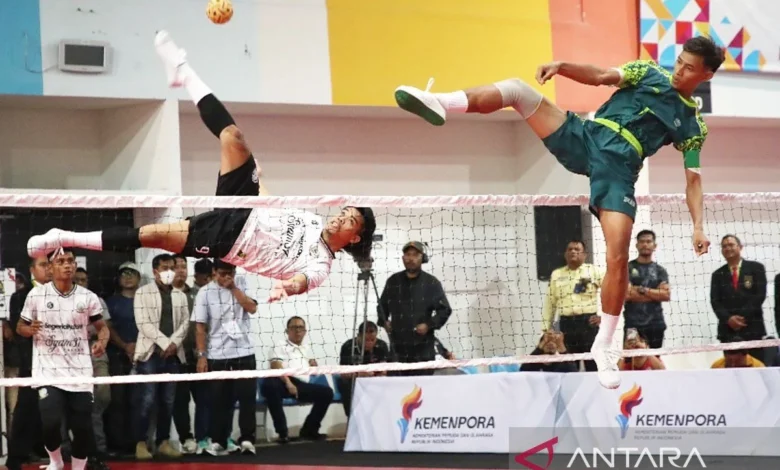
Often referred to as "kick volleyball," Sepak Takraw is a team sport typically contested by two to four players per side. The playing court bears a striking resemblance to that of a badminton court, underscoring the sport’s aerial dynamics. Sepak Takraw masterfully integrates elements from volleyball and footvolley, with a crucial restriction: players are forbidden from using their hands. Instead, they are permitted to employ specific body parts – namely their feet, knees, shoulders, chest, and head – to propel the ball over the net, mirroring the objective of volleyball. This constraint necessitates an extraordinary level of coordination, flexibility, and precision.
Internationally, the governance of Sepak Takraw falls under the purview of the International Sepaktakraw Federation (ISTAF), established in 1988. ISTAF plays a crucial role in standardizing rules, organizing global championships, and promoting the sport worldwide. The sport’s rich cultural tapestry is further evident in its diverse local appellations across different countries. It is known as "Sepak Raga" in Indonesia, Brunei, Malaysia, and Singapore; "Sipa" in the Philippines; "Chinlone" in Myanmar; and "Takraw" in Thailand, among other regional variations in Asian nations. This multiplicity of names speaks to its deep roots and widespread adoption across the Southeast Asian archipelago.
The Genesis of Sepak Takraw: A Journey Through Centuries
The historical lineage of Sepak Takraw traces back approximately 500 years to Malaysia, where it gained considerable popularity, particularly within royal circles during the 15th century. Its journey did not cease there; the sport gradually traversed geographical boundaries, reaching Indonesia around the 16th century, where it was embraced under the name "Sepak Raga." By the 1940s, Sepak Takraw had achieved widespread recognition and popularity throughout Southeast Asia, coinciding with the nascent stages of formal rule development.
A significant milestone in its organized history was the first official competition held in Penang in 1945. This event, then known as "Sepak Raga Jaring," laid the groundwork for standardized play. The subsequent establishment of the Malaysian Sepak Raga Federation in Penang in 1960 marked another crucial step towards its institutionalization. Its inclusion in the Southeast Asian Peninsula Games in 1965 proved to be a transformative moment, as it was at this prestigious event that the sport was officially christened "Sepak Takraw," solidifying its modern identity.
Interestingly, some historical accounts suggest that Sepak Takraw may have been introduced to Southeast Asia by Chinese travelers, sharing common ancestral roots with football. This theory posits that the sport evolved from "Cuju," an ancient Chinese game recognized by FIFA as an early precursor to modern football. Cuju, in its original form, served as a military exercise, where soldiers would engage in kicking a leather ball, striving to keep it airborne for as long as possible. This historical connection, if accurate, would lend Sepak Takraw an even more profound and ancient lineage, linking it to millennia-old traditions of ball games and physical prowess.
Navigating the Court: The Fundamental Rules of Sepak Takraw
The dynamic and fast-paced nature of Sepak Takraw is governed by a set of clearly defined rules that ensure fair play and strategic depth. While the provided text mentions player positioning regulations, a comprehensive understanding of the game’s mechanics is crucial.
Player Roles and Court Formation
In a standard Sepak Takraw match, three players typically form a team on each side of the court. The court itself is divided into specific zones, and players occupy distinct roles:
- Tekong (Server): This player is responsible for initiating each rally. The Tekong stands within a designated service circle and serves the ball to the opposing team. Their role is critical, as a strong and accurate serve can set the tone for the point.
- Feeder (Setter): The Feeder’s primary responsibility is to set up attacking opportunities for the Killer. They strategically "feed" the ball to their teammate, often with precise aerial passes, enabling the Killer to execute powerful shots.
- Killer (Attacker): The Killer is the primary offensive player. They are tasked with launching powerful and skillful shots over the net to score points. This role demands exceptional agility, aerial awareness, and the ability to execute a wide range of acrobatic kicks and spikes.
The strategic interplay between these three roles is paramount. The Feeder and Killer must work in seamless synchronization to break down the opponent’s defense, while the Tekong’s consistent and effective serving provides the crucial foundation for the team’s offensive strategy.
The Flow of Play: From Serve to Point
The game commences with a coin toss to determine which team serves first. The winning team has the option to serve or choose their side of the court. The Tekong then initiates the rally by tossing the ball into the air and kicking it over the net into the opponent’s court.
Once the serve is in play, the game transforms into a rapid exchange of kicks, headers, and body-controlled maneuvers. Teams have a maximum of three touches to return the ball to the opponent’s side. However, these touches must be executed using legal body parts – feet, knees, chest, shoulders, and head. The objective is to strategically direct the ball into the opponent’s court in a way that they cannot legally return it, thereby scoring a point.
The interplay is often characterized by breathtaking aerial rallies, where players leap, twist, and contort their bodies to keep the ball in play and launch offensive attacks. The defensive players must anticipate the opponent’s moves, position themselves strategically, and be ready to receive powerful shots, often with quick reflexes and acrobatic saves.
Scoring and Match Progression
Points are awarded to a team when the opposing team fails to return the ball legally within the designated three touches, or when the ball lands out of bounds on the opponent’s side. The scoring system in Sepak Takraw is typically played in sets, with a team needing to reach a predetermined number of points to win a set. The first team to win two sets is declared the winner of the match. While the provided text indicates a target of 21 points per set, specific tournament regulations may vary, with some employing a 15-point system for certain stages or formats. This adaptable scoring system ensures that matches remain competitive and engaging throughout.
Beyond the Court: Broader Context and Implications
The enduring popularity of Sepak Takraw in Southeast Asia is a testament to its cultural significance and its ability to foster national pride. The sport has become a symbol of regional identity, celebrated in international competitions and at major sporting events like the Southeast Asian Games.
Recent developments, such as the resolution of dualism in Indonesian Sepak Takraw governance, as reported by ANTARA, highlight the ongoing efforts to strengthen and professionalize the sport within the region. The International Sepaktakraw Federation (ISTAF) has consistently voiced its support for such resolutions, recognizing that unified leadership is crucial for the sport’s growth and development on both national and international stages. The successful resolution of these internal issues is a positive indicator for the future of Sepak Takraw in Indonesia, potentially leading to enhanced training programs, increased funding, and greater participation at all levels.
The global reach of Sepak Takraw continues to expand, with federations and clubs emerging in countries beyond its traditional heartland. This growing international presence, supported by organizations like ISTAF, promises to elevate the sport’s profile and attract a wider audience. The unique blend of martial arts-like acrobatics and strategic teamwork offers a compelling spectacle that appeals to sports enthusiasts worldwide.
As Sepak Takraw continues to evolve, its ability to adapt and innovate while staying true to its cultural roots will be key to its sustained success. The commitment to developing young talent, improving coaching standards, and ensuring fair competition will undoubtedly contribute to its long-term viability as a globally recognized and cherished sport. The ongoing narrative of Sepak Takraw is one of rich history, dynamic athleticism, and a promising future on the international sporting landscape.