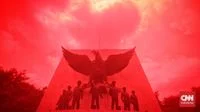
Comprehensive Guide and Reference Tapes for the National Sanctity of Pancasila Day Ceremony

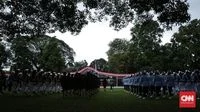
Every year on the first of October, the Republic of Indonesia observes the Hari Kesaktian Pancasila, or the Pancasila Sanctity Day, a solemn national commemoration dedicated to preserving the ideological foundation of the nation. The central government typically hosts the primary state ceremony at the Monumen Pancasila Sakti located in Lubang Buaya, East Jakarta, drawing high-ranking state officials, military leaders, and representatives from various civic organizations. Similar state-mandated ceremonies are simultaneously executed across the archipelago, spanning provincial government offices, educational institutions ranging from elementary schools to prominent universities, and Indonesian diplomatic missions abroad.
The ceremonial protocol for Pancasila Sanctity Day mirrors other high-profile national observances in Indonesia, following a standardized sequence of events designed to instill national discipline and historical reverence. The procedural framework traditionally begins with the raising of the Red and White national flag, accompanied by the solemn performance of national anthems by a dedicated choir or marching band. This is followed by a moment of silent reflection, designated to honor the fallen heroes and victims of the historical political upheavals that threatened the nation’s integrity. The proceedings subsequently move into the reading of historical texts, including the Pledge of Commitment, and culminate in a formal prayer session. Because this commemorative rite is widely replicated at institutional and grassroots levels nationwide, access to standardized, formal prayer texts has become an essential logistical requirement for ceremony organizers.
Historical Context and Background of the Observance
The historical genesis of Pancasila Sanctity Day is deeply rooted in the turbulent sociopolitical climate of the mid-1960s, specifically following the tragic events of the September 30 Movement in 1965, commonly known as G30S. The movement involved an abortive coup d’état that resulted in the assassination of six prominent Indonesian Army generals and one officer at the hands of dissenting military factions. The subsequent swift stabilization of the political landscape under the leadership of the military and civilian coalitions underscored the perceived resilience of Pancasila—the state ideology comprising five foundational principles—as the definitive shield against ideological subversion, communism, and internal dissolution.
By Presidential Decree Number 153 of 1967, issued by acting President Suharto, October 1 was officially designated as Hari Kesaktian Pancasila. The overarching objective of establishing this commemorative day was to reaffirm the absolute supremacy of Pancasila as the sole philosophical foundation of the Indonesian state, countering alternative ideological frameworks such as communism or religious fundamentalism. Over subsequent decades, the observance evolved from a rigid military-dominated spectacle into a broader civic reflection on national unity, pluralism, and democratic resilience. Historians note that while the political narratives surrounding the day have shifted following the fall of the New Order regime in 1998, the core essence of the commemoration remains anchored in national cohesion and the prevention of historical amnesia regarding threats to state sovereignty.
Standardized Prayer References for Institutional Ceremonies
To assist organizers in conducting seamless and uniformly solemn commemorations, official guidelines from state organizing committees and the Ministry of Religious Affairs provide authorized liturgical texts. These prayers are carefully curated to reflect themes of national gratitude, ethical governance, social harmony, and the perpetual safeguarding of the national motto, Bhinneka Tunggal Ika (Unity in Diversity). Below are two standardized prayer texts officially utilized for the Pancasila Sanctity Day ceremonies.
Example 1: Official Prayer Text from the 2025 Commemoration Committee
The first reference is adapted directly from the organizational guidelines issued for the 2025 national ceremony, emphasizing humility, moral integrity, and collective dedication to the state ideology.
Bismillahirrahmanirrahim
Allahumma sholli ‘ala sayyidina Muhammad, wa ‘ala ali sayyidina Muhammad
O Allah, Lord, the Bestower of All Things,
Bestow upon us honesty and humility,
Grant us the grace to always appreciate one another,
Endow us with the continuous capacity to serve faithfully,
Keep us consistently mindful in expressing gratitude.
O Allah, Lord of All Existence,
Who knows the clear and hidden intentions,
Who holds dominion over death and life,
Who confers dignity upon the martyrs and heroes.
O Allah, Lord who knit the hearts of our predecessors together,
Who inspired the founders of our motherland,
Who firmly established Pancasila as our life philosophy and national identity.
O Allah, Lord who paints destiny across the sheets of mystery,
Do not let us become ungrateful beings,
Who undermine the very pillars of our shared home.
O Allah, Lord magnified in every breath of life,
With You resides true strength and absolute sanctity,
By Your decree, Pancasila was preserved,
By Your assistance, we are continuously enabled to face the future.
O Allah, Creator of all things beautiful and beauty itself,
Creator of harmony within our diversity,
Architect of Indonesia, the land of our dreams,
Architect of Indonesia, the land of our hopes,
Praise and gratitude we shall endlessly offer.
O You, Lord who softens the hearts,
Keep us far from envy and malice,
Keep us far from destructive wrath,
Keep us far from mutual insults,
Keep us far from any intent to tear apart and ruin our nation.
O Allah, Lord, the Most Forgiving,
Forgive all our sins and transgressions, the faults of our parents, and our leaders,
Indeed, Your forgiveness surpasses everything beneath Your sky in the final era.
O Light of All Lights,
Illuminate our path toward the way of light,
Leading us toward a progressive and peaceful Indonesia.
Robbana atina fiddunya hasanah wa fil akhiroti hasanah waqina adzabannar,
Walhamdulillahi robbil ‘alamin.
Example 2: Official Prayer Text Issued by the Ministry of Religious Affairs
The second reference is sourced directly from documentation provided by the Ministry of Religious Affairs of the Republic of Indonesia, offering a comprehensive supplication focused on geographical blessing, constitutional democracy, and social prosperity.
Bismillahirrahmanirrahim
Alhamdulillahi rabbil ‘alamin. Hamdan syakirin hamdan yuwafi ni’amahu wa yukafi’u mazidahu. Ya rabbana lakal hamdu kama yanbaghi lijalali wajhikal karimi wa ‘azhimi sulthanika. Allahumma shalli wa sallim ‘ala sayyidina Muhammadin wa ‘ala alihi wa shahbihi ajma’in.
O Allah, Lord and Master of the Universe,
Who placed our nation and people across the expanse of the equator,
Who endowed us with a vastly wealthy nature,
Adorned with seas across the archipelago, named Indonesia Raya.
On this bright and solemn morning, we offer our supplications,
Lifting our prayers and extending our requests,
May safety, mercy, and blessings be poured out,
Upon the entire nation and all the blood-stained soil of Indonesia.
O Allah, Lord of Absolute Unity,
Make this commemoration of Pancasila Day,
A momentum to mend our unity with our entire souls,
Keep this nation far from friction, hostility, and division.
Grant our nation the capability,
To practice Pancasila as the foundation of statehood and nationality,
The foundation upon which our state was established,
The foundation where our Red and White flag is hoisted,
The foundation where our nation stands and aims its aspirations.
O Allah, Lord of the heavens and the earth,
You equipped us with reason and conscience,
You guided our predecessors in managing the affairs of the state,
In resolving differences while preserving the integrity of the Unitary State of the Republic of Indonesia (NKRI),
In practicing deliberation as our intrinsic identity.
Therefore, ignite the spirit of deliberation with the fire of the constitution,
A fire from which radiates the awareness of Pancasila as our baseline for managing the Motherland.
Inspire our minds and hearts with the wisdom of knowledge,
So that our democracy may become more dignified,
So that our deliberations yield true benefit and well-being.
O Allah, Light above all lights,
Enlighten us so that we may skillfully appreciate Your unmatched blessings,
Foster within our selves absolute sincerity and willingness,
To sacrifice for the nation and state,
To struggle for the upholding of Pancasila values.
O Allah, Supreme Creator,
You who created the night, empower us to build lanterns,
You who fashioned marble, teach us to craft trophies,
You who decreed our birth and presence in the Nusantara,
Strengthen us to guard and nurture it through Pancasila,
To realize an independent Indonesian State,
United, sovereign, just, and prosperous.
Rabbana atina fid-dunya hasanatan wa fil-akhirati hasanatan wa qina ‘adzaban-nar. Wa adkhilnal-jannata ma’al-abrar. Ya ‘azizu ya ghaffaru ya rabbal-‘alamin. Subhana rabbika rabbil-‘izzati ‘amma yashifun. Wa salamun ‘alal-mursalin. Walhamdulillahi rabbil-‘alamin.
Socio-Political Implications and Significance
The annual observance of Hari Kesaktian Pancasila and the inclusion of structured, reflective prayer rituals carry profound socio-political implications for modern Indonesia. Sociologists and political analysts emphasize that these ceremonies serve not merely as bureaucratic routines, but as vital pedagogical tools for transmitting national values to younger generations. In an era marked by rapid globalization, digital polarization, and ideological contestation, institutionalizing references to Pancasila helps reinforce national resilience against transnational extremism and radicalism.
Furthermore, the integration of inclusive prayer texts—which consistently invoke themes of social harmony, economic prosperity, and constitutional democracy—acts as a unifying spiritual anchor in a religiously diverse society. By aligning religious devotion with civic nationalism, the state reinforces the symbiotic relationship between faith and national identity, a hallmark of Indonesia’s Pancasila state philosophy. Consequently, the meticulous preparation of commemorative protocols and prayer recitations remains a cornerstone of institutional stability and cultural continuity across the Indonesian archipelago.
Related posts: