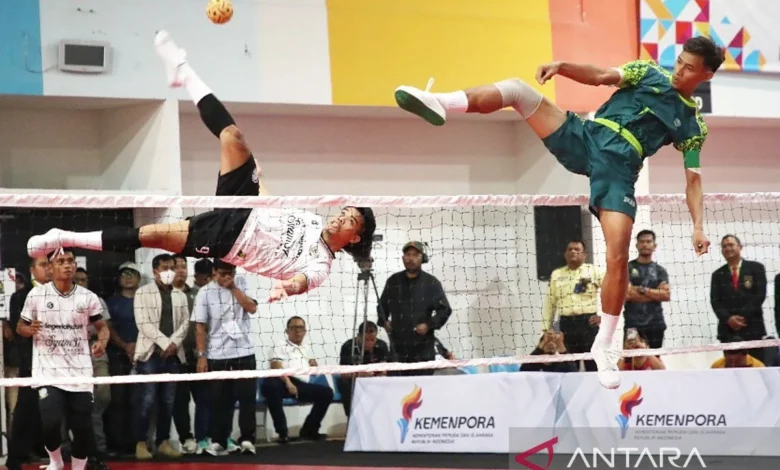
The evolution of Sepak Takraw from a traditional pastime into a sophisticated, internationally recognized athletic discipline represents one of the most compelling narratives in the history of Southeast Asian sports. Often described as a mesmerizing fusion of volleyball’s strategic depth, soccer’s agility, and the gravity-defying maneuvers of martial arts, Sepak Takraw challenges the physical limits of the human body. Played on a court similar to badminton, athletes execute high-speed, acrobatic kicks to propel a woven rattan ball over a net, all while strictly adhering to a rule that prohibits the use of hands.
The Linguistic and Cultural Genesis
The nomenclature of the sport is a testament to its regional integration. The term "Sepak Takraw" is a linguistic hybrid, combining the Malay word "Sepak," meaning "to kick," and the Thai word "Takraw," which refers to the intricately woven rattan ball that serves as the sport’s centerpiece. While the modern competitive version was formalized in the mid-20th century, the sport’s roots are deeply embedded in the cultural fabric of Southeast Asia.
Historical accounts suggest that the game originated in Malaysia approximately 500 years ago, serving as a popular entertainment within the royal courts of the 15th century. By the 16th century, the game had migrated across the archipelago, finding a home in Indonesia under the name "Sepak Raga." Over the centuries, variations of the game emerged across the continent—known as "Sipa" in the Philippines, "Chinlone" in Myanmar, and "Takraw" in Thailand.
Some sports historians posit a broader, transcontinental origin for the game. There is compelling evidence suggesting that Sepak Takraw may share an ancestral lineage with "Cuju," an ancient Chinese military exercise documented as early as the Han Dynasty. FIFA, the global governing body for football, has historically recognized Cuju as the earliest known form of competitive, ball-based sport. In this ancient context, soldiers practiced foot-eye coordination by keeping a leather ball in the air, a foundational skill that mirrors the modern requirement for ball control in Sepak Takraw.
The Formalization: From Village Games to Global Arenas
The transition from a recreational activity to a standardized sport occurred in the mid-1940s. A pivotal moment in this evolution took place in Penang, Malaysia, in 1945, when Hamid Mydin introduced the use of a net, distinguishing the competitive "Sepak Raga Jaring" (literally "net-kicking ball") from the traditional, non-competitive "Sepak Raga," which was played in a circle.
The year 1960 serves as the definitive milestone for the sport’s international recognition. Following a series of landmark matches between Malaysia and Thailand in Kuala Lumpur, the rules were codified, and the sport was officially rebranded as "Sepak Takraw." This standardization paved the way for its inclusion in the Southeast Asian Peninsular Games in 1965, marking its debut on the regional multi-sport stage.
The globalization of the sport continued throughout the late 20th century, leading to the establishment of the International Sepaktakraw Federation (ISTAF) in 1988. Based in Bangkok, Thailand, ISTAF has been instrumental in refining the laws of the game, fostering international competitions, and lobbying for the inclusion of Sepak Takraw in major events such as the Asian Games.
The Technical Anatomy of a Match
Sepak Takraw is as much a tactical battle as it is a display of athleticism. A standard match features teams of three players, referred to as a "regu." Each position has a distinct, specialized role:
- The Tekong: Positioned at the back of the court, the Tekong is the specialist in serving. The serve is arguably the most critical maneuver in the game, requiring high-velocity kicks that force errors from the opposition.
- The Feeder (Apong): Positioned at the front, the Feeder is responsible for controlling the ball after it crosses the net, setting it up in a precise trajectory for the striker.
- The Killer (Striker): Also positioned at the front, the Killer is the primary attacker. This player is responsible for the acrobatic "spike" or "roll spike," where they leap into the air and strike the ball downward into the opponent’s court with immense force.
The mechanics of the game are unforgiving. Players must use their feet, knees, chest, or head to manipulate the ball. The use of hands or arms is strictly prohibited, a rule that necessitates extraordinary balance and spatial awareness. Matches are typically played as a best-of-three-set series, with each set won by the first team to reach 21 points.
Recent Administrative Challenges and Resolution
In recent years, the sport has faced significant administrative turbulence in Indonesia, a key hub for the game. For an extended period, the national governing body for Sepak Takraw in Indonesia was plagued by dualism—a situation where two competing organizations claimed legitimacy, creating friction that hindered athlete development and international participation.
The Indonesian Ministry of Youth and Sports, in collaboration with the National Sports Committee of Indonesia (KONI) and the Indonesian Olympic Committee (KOI), recently intervened to resolve these disputes. The successful consolidation of the governing body has been met with enthusiasm by the international community. ISTAF officials have formally welcomed the resolution, noting that a unified national organization is essential for maintaining the integrity of the sport and ensuring that Indonesian athletes remain competitive on the world stage.
This resolution is expected to have a cascading positive effect on the sport’s domestic development. With a unified leadership, the focus can shift from internal governance to infrastructure, grassroots talent identification, and the professionalization of the national league.
Broader Impact and Global Implications
The resilience of Sepak Takraw as an indigenous sport in an era dominated by Western-originated games like football and basketball is a testament to its cultural significance. Beyond its role as a spectator sport, Sepak Takraw plays a vital role in physical education and cultural preservation in Southeast Asia.
From a physiological perspective, the sport is a rigorous workout. It demands extreme core strength, explosive power, and flexibility—attributes developed through years of repetitive, high-impact training. For researchers in sports science, the biomechanics of the "roll spike" provide a fascinating study in human movement, as athletes must rotate their bodies in mid-air while maintaining visual tracking of a small, fast-moving target.
Looking toward the future, the sport’s inclusion in the Asian Games has been a massive success, drawing high viewership and fostering a sense of regional pride. However, the next frontier for ISTAF remains the expansion of the sport into non-traditional markets. While the sport has gained traction in Europe and North America through expatriate communities and niche sports clubs, achieving status as an Olympic discipline remains the ultimate goal.
To reach this level, the federation continues to work on standardizing refereeing procedures, enhancing broadcast quality, and promoting the sport through digital platforms. The transition from a local, traditional game to a standardized, televised spectacle reflects the broader trend of modernizing traditional sports for a global audience.
The Future of the Rattan Ball
As Sepak Takraw continues to evolve, it must balance its traditional roots with the demands of modern athletic competition. The ongoing efforts to standardize the ball composition, court surfaces, and officiating protocols reflect an awareness that, to maintain its growth, the sport must be accessible and fair.
The resolution of governance issues in countries like Indonesia marks a significant step forward, promising a period of stability and growth. As a new generation of "Killers" and "Tekongs" emerges, the sport is poised to maintain its position as a crown jewel of Southeast Asian culture—a vibrant, fast-paced, and technically demanding discipline that continues to captivate audiences worldwide. Through the fusion of history, athleticism, and modern governance, Sepak Takraw remains a definitive symbol of regional sporting excellence, proving that a sport born in the royal courts of the 15th century can still resonate in the 21st-century global arena.
Related posts: