
Category Food Science Molecular Gastronomy
Molecular Gastronomy: Deconstructing Food Science for Culinary Innovation
Molecular gastronomy, a field bridging culinary arts and scientific inquiry, delves into the physical and chemical transformations that occur during cooking. Far from being a mere stylistic trend, it represents a fundamental understanding of the ingredients and processes that underpin all food preparation. At its core, molecular gastronomy seeks to demystify the "why" behind culinary phenomena, from the browning of bread to the emulsification of sauces, and to leverage this knowledge for novel and exciting culinary creations. This scientific approach has revolutionized restaurant kitchens and home cooking alike, empowering chefs and home cooks to experiment with techniques and textures previously unimagined. It encourages a systematic, experimental mindset, treating the kitchen as a laboratory where ingredients are variables and cooking methods are experiments. The ultimate goal is not just to create palatable dishes, but to enhance sensory experiences, explore new flavor combinations, and push the boundaries of what we perceive as "food."
At the heart of molecular gastronomy lies the application of scientific principles to food. This encompasses understanding the molecular structure of food components like proteins, carbohydrates, fats, water, and flavor compounds, and how these molecules interact under various conditions such as heat, pressure, and pH changes. For instance, comprehending protein denaturation, the process by which proteins unfold and change their structure when heated, is crucial for achieving the perfect sear on a steak or the ideal texture in a custard. Similarly, understanding the behavior of emulsions, mixtures of liquids that don’t normally mix, like oil and vinegar in salad dressing, allows for the creation of stable and aesthetically pleasing sauces and vinaigrettes. The science of gelation, where liquid substances transform into gels, is fundamental to techniques like spherification, a signature of molecular gastronomy that creates liquid-filled spheres with a delicate membrane. Carbohydrates, particularly starches and sugars, play a vital role in texture and sweetness. Their breakdown through enzymatic or thermal processes influences mouthfeel and flavor development. Fat, with its unique ability to carry flavor and contribute to richness, is also a key area of study, influencing how flavors are perceived and how dishes are perceived as satisfying. Water, the universal solvent, is central to almost every cooking process, from boiling to steaming to creating flavorful broths. Its phase transitions, evaporation, and ability to form hydrogen bonds are all critical to understanding cooking.
One of the most recognizable techniques within molecular gastronomy is spherification. This process involves creating small, often spherical, droplets of liquid encased in a thin gel membrane. There are two main types: direct and reverse spherification. Direct spherification involves mixing a liquid containing calcium ions (such as calcium chloride) with a bath of sodium alginate. The sodium alginate reacts with the calcium ions, forming a gel on the surface of the droplets, creating a liquid core. Reverse spherification, conversely, involves adding a calcium-rich ingredient (like calcium lactate gluconate) to the flavored liquid and then immersing it in a sodium alginate bath. This method is particularly useful for liquids with a high calcium content or a high pH, preventing premature gelling. Spherification allows for the creation of surprising textural contrasts and concentrated bursts of flavor, transforming everyday ingredients into something extraordinary. Imagine a "caviar" of balsamic vinegar or a "ravioli" filled with fruit juice, all created through this remarkable technique. The precise control over the gelling process, dictated by the concentration of alginate and calcium ions, as well as the pH of the liquid, highlights the scientific precision involved.
Another hallmark of molecular gastronomy is the use of hydrocolloids, a broad category of ingredients derived from natural sources that form gels, thicken liquids, or stabilize emulsions. Common examples include agar-agar, carrageenan, gellan gum, and xanthan gum. Agar-agar, derived from seaweed, is a powerful gelling agent that can create firm gels even at room temperature and is often used as a vegetarian alternative to gelatin. Carrageenan, also from seaweed, comes in various forms (kappa, iota, lambda) each producing gels with different textures, from brittle to elastic. Gellan gum, produced by bacterial fermentation, is known for its ability to create clear, heat-stable gels. Xanthan gum, a polysaccharide produced by bacteria, is an excellent thickener and stabilizer, commonly used in gluten-free baking and to prevent oil and water from separating in sauces. The precise control over the rheological properties of food – its flow and deformation – is a primary objective when working with hydrocolloids. Understanding the optimal concentrations, temperatures, and mixing techniques for each hydrocolloid is crucial for achieving desired textures, from delicate foams to firm jellies.
Emulsification and foam creation are also central to molecular gastronomy, offering new ways to manipulate texture and presentation. Emulsification, the process of dispersing one liquid into another immiscible liquid, is essential for creating stable sauces, dressings, and creams. Lecithin, a natural emulsifier found in egg yolks and soybeans, is frequently employed. Techniques like using an immersion blender at high speed or employing a centrifuge can create incredibly stable and finely textured emulsions. Foams, or aerated preparations, are achieved by incorporating air into a liquid. This can be done using a whisk, a siphon, or by incorporating stabilizing agents like lecithin or protein. Foams offer a light, ethereal texture, delivering flavor in a delicate cloud. The creation of stable foams requires understanding surface tension and the ability of emulsifiers to lower it, allowing for the formation and preservation of air bubbles. The science behind these processes allows chefs to achieve textures that are not only novel but also enhance the overall eating experience by providing contrasting mouthfeels and visually appealing presentations.
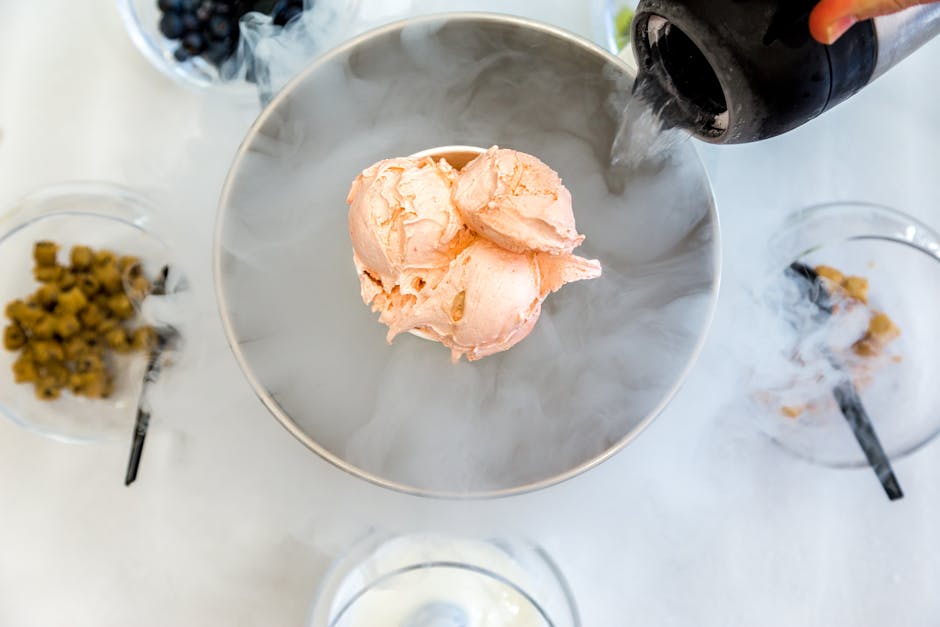
Cryogenic cooking, utilizing liquid nitrogen, is perhaps one of the most dramatic and visually striking techniques in molecular gastronomy. Liquid nitrogen boils at -196°C (-320.8°F), allowing for rapid freezing of food items. This can be used to create instant ice creams and sorbets with an incredibly smooth texture, as the rapid freezing prevents the formation of large ice crystals. It can also be used to flash-freeze herbs or other delicate ingredients, preserving their flavor and color for later use in powders or infusions. The extreme cold can also be used to create interesting textural contrasts, such as a frozen exterior with a liquid interior. However, working with liquid nitrogen requires strict safety protocols due to its extreme temperature and the potential for asphyxiation if used in poorly ventilated areas. The rapid phase transition of water within the foodstuff, from liquid to solid, is key to the texture achieved.
Sous vide, a French term meaning "under vacuum," is a technique that involves vacuum-sealing food in a plastic pouch and then cooking it in a precisely temperature-controlled water bath. This method allows for unparalleled control over the cooking process, ensuring that food is cooked to an exact internal temperature throughout. This results in exceptionally uniform doneness, eliminating the risk of overcooking or undercooking. For example, a steak cooked sous vide will be perfectly medium-rare from edge to edge. The controlled temperature also allows for tenderization of tougher cuts of meat, as enzymes have more time to break down connective tissues without the risk of drying out the meat. Furthermore, the vacuum-sealed pouch prevents the loss of moisture and flavor, resulting in more succulent and flavorful dishes. The science behind sous vide lies in understanding heat transfer and the precise temperature at which proteins denature and enzymes become active.
The exploration of flavor is paramount in molecular gastronomy, extending beyond simple taste to encompass aroma, texture, and even sound. Techniques like aroma capture and vaporization allow chefs to isolate and present the aromatic essence of ingredients, enhancing the olfactory experience of a dish. Flavor pairing, often guided by scientific understanding of volatile compounds and their interactions, can lead to unexpected yet harmonious flavor combinations. For instance, understanding the chemical compounds responsible for the flavor of specific herbs or spices can inform novel pairings. The study of retronasal olfaction, the perception of aromas through the back of the throat, highlights how scent plays a crucial role in our perception of flavor. Molecular gastronomy seeks to manipulate and enhance these sensory inputs to create a more profound and multi-layered dining experience. This might involve creating flavored "airs" that are inhaled before tasting, or dishes that release specific aromas upon being cut or broken.
The intersection of food science and gastronomy also extends to the development of novel ingredients and food technologies. This includes the creation of plant-based meat alternatives, the use of 3D printing to create intricate food structures, and the development of encapsulated flavors and nutrients. Food scientists are constantly innovating, seeking to improve the nutritional profile, sustainability, and sensory appeal of food. For example, advancements in food processing, often informed by molecular gastronomy principles, are leading to the creation of "clean label" products with fewer artificial ingredients. The development of new emulsifiers, stabilizers, and texture modifiers, all rooted in a deep understanding of food chemistry, allows for the creation of foods that meet the demands of modern consumers for both health and enjoyment. The future of food will undoubtedly be shaped by the continued integration of scientific research and culinary artistry.
In conclusion, molecular gastronomy is not a fleeting trend but a profound evolution in how we understand and interact with food. By applying scientific principles to culinary practices, it empowers chefs and home cooks to innovate, experiment, and create dishes that are not only delicious but also intellectually stimulating and sensorially engaging. The knowledge gained from deconstructing food at a molecular level opens up a universe of possibilities, pushing the boundaries of taste, texture, and presentation, and fundamentally reshaping our relationship with what we eat. It encourages a continuous cycle of inquiry, experimentation, and innovation, ensuring that the culinary landscape remains dynamic and ever-evolving. The underlying science, from protein chemistry to hydrocolloid functionality, provides the foundational understanding that allows for the artistic expression that defines the best of molecular gastronomy.
