SpaceX Successfully Launches Starship Rocket into Earth Orbit for the First Time in Historic Milestone Test

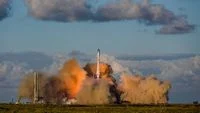
In a monumental leap forward for commercial aerospace engineering, SpaceX successfully launched its massive Starship rocket into Earth orbit for the first time from its Starbase facility in Boca Chica, Texas. Blasting off at 7:15 a.m. local time, the mission marks a transformative chapter in modern space exploration. Designed explicitly to serve as the foundational transport system for future crewed and cargo-heavy expeditions to the Moon and Mars, this latest flight test represents the culmination of years of rigorous iterative design, regulatory hurdles, and high-stakes static fire testing.
The comprehensive flight test, projected to span approximately ten hours from ignition to final splashdown, involves sending the vehicle’s upper stage into a targeted circular orbit approximately 275 kilometers above the Earth’s surface. Once established in this orbital corridor, the spacecraft is scheduled to deploy a payload of 26 next-generation Starlink satellites, further expanding the company’s already sprawling global satellite internet constellation.
Main Facts of the Orbital Flight Test
The unprecedented mission pushed the boundaries of what privately funded aerospace companies have achieved to date. The Starship vehicle, featuring a striking black-and-silver thermal protection system and structural configuration, stands as the largest and most powerful operational rocket ever flown in human history.
To achieve a stable orbit, the spacecraft must attain staggering velocities of approximately 28,000 kilometers per hour. The mission profile dictates that the vehicle will execute a series of six orbits around the Earth before initiating its final descent sequence and targeted splashdown in the remote waters of the Pacific Ocean. Beyond the deployment of the Starlink payloads, engineers are utilizing this flight to test critical long-duration orbital coasting capabilities and lay the technical groundwork for future orbital propellant transfer demonstrations—a mandatory capability for deep-space missions where spacecraft must refuel in orbit before journeying to lunar or Martian trajectories.
Chronology and Evolutionary Path of the Starship Program
The journey to this historic orbital flight has been characterized by aggressive prototyping, rapid iteration, and high-profile setbacks. SpaceX began flying the Starship in its full stacked configuration in 2023, initially relying on cautious suborbital trajectories designed to gather telemetry on aerodynamic performance, stage separation mechanics, and atmospheric re-entry dynamics.
Over the course of more than a dozen integrated flight tests, engineers implemented numerous structural and software modifications. Each successive test provided invaluable data regarding the performance of the Raptor engines, the structural integrity of the stainless-steel hull, and the thermal resilience of the heat shield tiles. While previous iterations experienced catastrophic anomalies during ascent or descent, these failures aligned with SpaceX’s philosophy of fast-paced, hardware-rich development, where empirical flight data supersedes computer simulations.
Despite facing regulatory scrutiny, environmental assessments, and periodic launch license delays that pushed back projected timelines, the company maintained its momentum. This mission marks the fourteenth major integrated flight test for the program, showcasing the rapid cadence at which SpaceX continues to iterate on its heavy-lift architecture. Notably, this launch is part of a remarkably busy operational week for the company, which includes three additional scheduled launches across its broader fleet, including a mission to transport a fresh crew of astronauts to the International Space Station (ISS).
Technical Challenges and Engineering Complexities
Reaching orbit with a vehicle of this unprecedented scale introduced immense technical hurdles. According to aerospace analysts, the execution of a secondary engine burn in the vacuum of space to circularize the orbit represents one of the most precarious phases of the entire mission profile.
Kathleen Curlee, a senior analyst at Georgetown University’s Center for Security and Emerging Technology, emphasized the sheer complexity of the maneuver. "To achieve the altitude and velocity required, the rocket must perform entirely different operational actions while facing drastically changing gravitational gradients and atmospheric transitions," Curlee noted.
The physics of orbital insertion demand precise timing, flawless guidance systems, and immense thrust. Unlike suborbital hops where the vehicle simply arcs through the upper atmosphere, entering orbit requires the spacecraft to match the Earth’s curvature dynamically, balancing forward momentum against gravitational pull at extreme altitudes. Furthermore, managing cryogenic propellants—liquid methane and liquid oxygen—during prolonged orbital coasts presents an ongoing thermodynamic challenge that engineers must master to ensure long-term mission viability.
Industry Implications and the Commercial Space Race
The successful integration and orbital validation of Starship carry profound implications for the global aerospace sector and geopolitical space race. For years, SpaceX has dominated the commercial launch market primarily through the reliability and partial reusability of its workhorse Falcon 9 and Falcon Heavy rockets. However, the introduction of a fully and rapidly reusable heavy-lift vehicle with a payload capacity exceeding 100 metric tons to low Earth orbit fundamentally alters the economics of space access.
By drastically lowering the cost per kilogram to orbit, Starship opens the floodgates for heavy infrastructure deployment, including next-generation space telescopes, modular commercial space stations, and industrial manufacturing facilities in microgravity. Moreover, the vehicle serves as the designated Human Landing System (HLS) for NASA’s Artemis program, which aims to return American astronauts to the lunar surface later this decade.
The success of this orbital test validates the foundational architecture required for NASA’s Artemis III mission and reinforces confidence in commercial partnerships for deep-space exploration. As international space agencies and private competitors watch closely, SpaceX’s milestone achievement underscores a paradigm shift: humanity is moving rapidly from an era of exploratory visits to the threshold of sustained industrialization and habitation beyond Earth.
Related posts: