May Skies Unveil a Spectacle of Celestial Events: From Eta Aquarids Meteor Shower to a Rare Blue Moon

The month of May annually transforms the night sky into a grand observatory, offering a captivating array of astronomical phenomena that enchant both seasoned stargazers and casual observers alike. This year, the celestial calendar for May presents a particularly rich tapestry of events, ranging from the ethereal streaking of meteor showers to the rare occurrence of a "Blue Moon." While some of these spectacles, like planetary conjunctions, are readily visible to the naked eye from most locations, others, such as meteor showers, demand optimal viewing conditions—specifically, dark skies devoid of light pollution and clear atmospheric conditions—to be fully appreciated. These events not only provide moments of breathtaking beauty but also serve as vital opportunities for public engagement with astronomy and contribute to our collective understanding of the vast universe beyond our planet.
The Luminous Beginning – May’s Full Moon (Flower Moon)
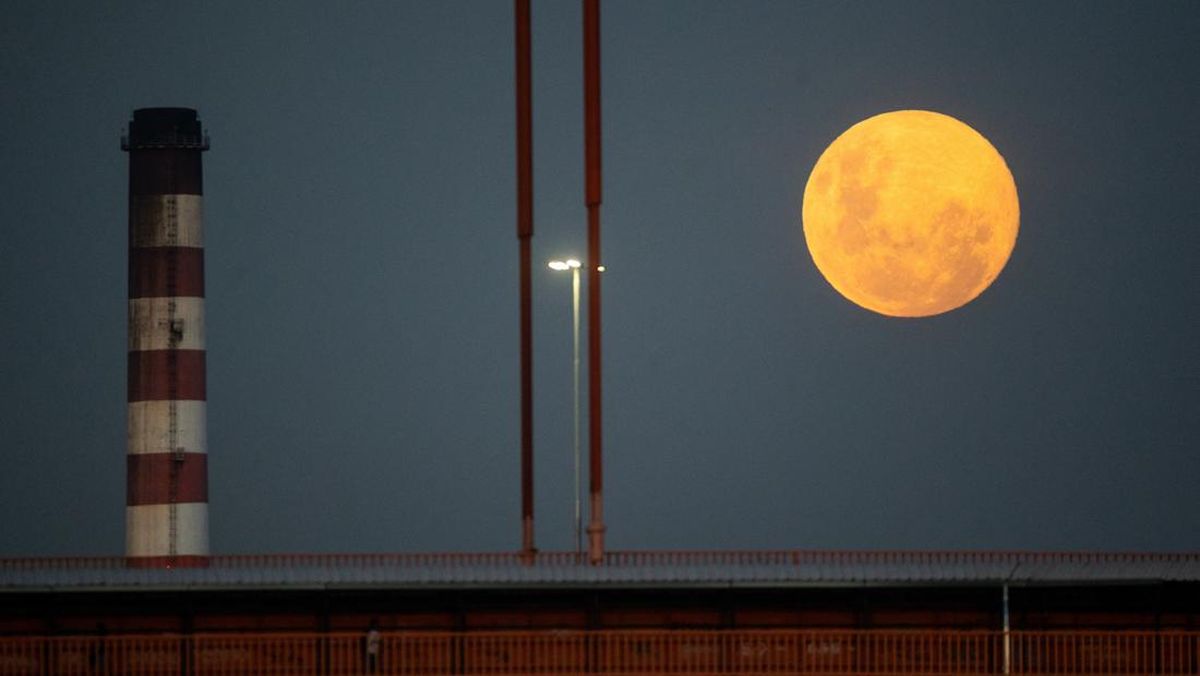
The celestial journey of May often commences with the radiant spectacle of a full moon. In this instance, the full moon occurred on May 1st, marking a moment when our natural satellite stood directly opposite the Sun in its orbit, resulting in its entire face being illuminated from Earth’s perspective. This particular full moon carries a rich tapestry of cultural significance, deeply rooted in the traditions of various indigenous peoples, particularly Native American tribes. Historically, it has been widely recognized as the "Flower Moon," a name that vividly captures the essence of late spring in the Northern Hemisphere, a period when wildflowers burst forth in vibrant bloom across the landscape. This designation reflects a profound connection between celestial cycles and terrestrial phenomena, illustrating how ancient cultures tracked time and seasons through careful observation of the sky.
Beyond its most common appellation, the Flower Moon also bears other evocative names. Some Native American tribes referred to it as the "Corn Planting Moon," acknowledging its arrival as the opportune time for sowing corn and other crops, critical for their sustenance. Another widely used name was the "Milk Moon," which likely correlates with the increased milk production from livestock during the lush pastures of spring. These diverse names underscore the practical and spiritual importance of the lunar cycle in agricultural and daily life. Astronomically, a full moon occurs roughly once every 29.5 days, which is the duration of a synodic month—the time it takes for the Moon to complete one cycle of phases as seen from Earth. While always a stunning sight, this particular full moon set the stage for the subsequent astronomical marvels of the month.
A Shower of Cosmic Dust – The Eta Aquarids Meteor Shower
One of the most anticipated and consistently rewarding events of May is the Eta Aquarids meteor shower. This annual display reaches its zenith around May 5th and 6th, offering observers a chance to witness meteors, often described as "shooting stars," streaking across the night sky. The Eta Aquarids are renowned for being an above-average meteor shower, capable of producing a significant number of meteors per hour under ideal viewing conditions. In the Southern Hemisphere, where the shower’s radiant (the point from which the meteors appear to originate) is higher in the sky, rates can soar to an impressive 50 to 60 meteors per hour. For observers in the Northern Hemisphere, while still visible, the rates are somewhat lower, typically around 30 meteors per hour, due to the radiant being closer to the horizon.
The Eta Aquarids derive their name from their apparent origin point in the constellation Aquarius, specifically near the star Eta Aquarii. However, meteors can appear anywhere in the sky, often traveling considerable distances from their radiant. The fundamental cause of this spectacular celestial fireworks display is Earth’s passage through a stream of debris left behind by one of the most famous comets in our solar system: Halley’s Comet (formally designated 1P/Halley).
Halley’s Comet is a short-period comet visible from Earth every 75–76 years. Its historical observations date back millennia, with records from ancient Chinese astronomers potentially describing its appearance as early as 240 BCE. Its last perihelion passage (closest approach to the Sun) occurred in 1986, captivating a generation of stargazers and prompting several space missions to study it up close. The comet is currently on its outward journey and is predicted to return to the inner solar system in 2061. As Halley’s Comet orbits the Sun, it sheds ice and dust particles, forming a vast trail of cosmic debris. When Earth intersects this trail, these particles enter our atmosphere at incredibly high speeds—approximately 64 kilometers (40 miles) per second—and incinerate due to friction, creating the luminous streaks we perceive as meteors. These meteors are known for their speed and often leave persistent trains, glowing trails of ionized gas that linger for a second or two after the meteor has passed.
The Eta Aquarids shower typically runs from April 19th to May 28th, with the peak offering the most intense activity. This year, however, observing conditions for the Eta Aquarids are somewhat tempered by the presence of a bright Moon. During the peak, the Moon is in a waxing gibbous phase, meaning it is more than half illuminated. The significant moonlight can effectively wash out fainter meteors, reducing the overall visible count. Despite this challenge, dedicated observers can still enjoy the brighter meteors. The best time to observe is after midnight, when the radiant is higher in the sky, from a location as far away from urban light pollution as possible, with an unobstructed view of the eastern sky. Patience is key, as the eyes need at least 20-30 minutes to fully adapt to the darkness.
The Dark Canvas – May’s New Moon
Following the flurry of meteors, the sky transitions to a period of optimal darkness with the arrival of the new moon. This phase occurred on May 16th at 20:03 UTC (corresponding to May 17th at 03:03 AM Western Indonesia Time). During a new moon, the Moon is positioned roughly between the Earth and the Sun, meaning its illuminated side faces away from Earth. Consequently, the Moon is largely invisible in the night sky, making it a "dark" moon.
While not a direct visual spectacle in itself, the new moon phase is paradoxically one of the most cherished times for serious amateur astronomers and astrophotographers. The absence of lunar light pollution creates the darkest possible skies, offering an unparalleled opportunity to observe faint deep-sky objects that would otherwise be obscured. Galaxies, nebulae, and star clusters, which emit very little light, become significantly more discernible against the velvety black backdrop. This period allows for the detection of subtle details in these distant celestial wonders, making it a prime window for exploration with telescopes and binoculars. It also holds cultural significance in many traditions, marking the beginning of lunar months in various calendars and often associated with themes of new beginnings and introspection.
A Celestial Embrace – Conjunction of Moon and Venus
May also presents an aesthetically pleasing alignment: the conjunction of the crescent Moon and the brilliant planet Venus. This event, occurring on May 18th, features a slender crescent Moon appearing remarkably close to Venus shortly after sunset. This is one of the most accessible and charming celestial sights of the month, requiring no special equipment to enjoy.
Venus, often referred to as the "Evening Star" (or "Morning Star" depending on its position relative to the Sun), is the second planet from the Sun and the brightest natural object in the night sky after the Moon. Its exceptional brightness is due to its dense atmosphere, which is highly reflective of sunlight, and its relatively close proximity to Earth. Even from brightly lit urban areas, Venus shines conspicuously. When the delicate crescent Moon, itself a beautiful sight, appears to "cuddle" up to Venus, the pair creates a stunning visual tableau against the twilight sky.
It is crucial to remember that a conjunction is an optical illusion from our perspective on Earth. While the Moon and Venus appear to be close neighbors in the sky, they are, in reality, separated by millions of kilometers in the vast expanse of space. The Moon is Earth’s closest celestial companion, orbiting at an average distance of about 384,400 kilometers (238,900 miles), whereas Venus is typically tens of millions of kilometers away. This apparent proximity highlights the unique geometry of our solar system and the changing perspectives afforded by Earth’s orbit and rotation. Such conjunctions are not only beautiful but also serve as excellent markers for locating planets and familiarizing oneself with the celestial sphere.
The Rarity of the Calendar – The Blue Moon
The month of May culminates with a particularly rare astronomical event: a "Blue Moon." This phenomenon is slated to occur on May 31st at 08:46 UTC (which translates to 15:46 Western Indonesia Time). The term "Blue Moon" has two primary definitions, but the one applicable here is the more popular and modern definition: the second full moon within a single calendar month.
Typically, a calendar month has only one full moon. This is because the lunar cycle (synodic month) is approximately 29.5 days long, which is slightly shorter than most calendar months (30 or 31 days). This slight discrepancy means that occasionally, when a full moon occurs very early in a month, there is enough time for another full moon to occur before the month concludes. This calendrical alignment makes the "Blue Moon" a relatively infrequent event, occurring roughly once every two to three years. The rarity of this occurrence is the origin of the well-known idiom, "once in a blue moon," signifying something that happens very seldom.
It is a common misconception that a "Blue Moon" implies the Moon will literally appear blue in color. In almost all cases, the Moon’s color will remain its usual pearly white or yellowish hue, influenced by atmospheric conditions and its position relative to the horizon. However, it is worth noting that extremely rare atmospheric phenomena, such as large volcanic eruptions or massive forest fires, can inject fine ash or smoke particles into the upper atmosphere. If these particles are precisely sized (around 1 micron), they can scatter red light more effectively than blue light, making the Moon appear bluish from Earth. This phenomenon is entirely unrelated to the calendrical definition of a "Blue Moon" and is an independent, even rarer occurrence. The May Blue Moon, therefore, is a calendrical curiosity rather than a chromatic spectacle, but its infrequency still makes it a noteworthy event for observers.
Maximizing Your Stargazing Experience – Essential Tips
To truly appreciate these celestial offerings, a few practical considerations can significantly enhance the viewing experience. Foremost among these is seeking out a location away from urban light pollution. City lights create a pervasive glow that scatters into the atmosphere, obscuring fainter stars and dimming the impact of phenomena like meteor showers. Rural areas, national parks, or designated dark-sky preserves offer the best conditions.
Weather is another critical factor. Clear skies, free from heavy cloud cover, are paramount. Checking local weather forecasts for cloud cover and atmospheric transparency is highly recommended before planning an observation session. Patience is also a virtue in stargazing; it takes approximately 20 to 30 minutes for human eyes to fully adapt to the darkness, a process that improves night vision and allows for the discernment of fainter objects. During this adaptation period, avoid looking at bright lights, including phone screens, which can instantly disrupt your night vision.
While many of May’s events are splendidly visible to the naked eye, binoculars can provide enhanced views of the Moon’s surface features and bring out more detail in planetary conjunctions. A telescope, while not strictly necessary for most events, can offer spectacular close-up views of the Moon and planets during their respective phases. For meteor showers, however, the widest possible field of view is best, making the naked eye or wide-field binoculars preferable. Comfortable seating, warm clothing (even on mild nights, temperatures can drop), and perhaps a hot beverage can make long observation sessions more enjoyable.
The Broader Tapestry – Astronomical Significance and Public Engagement
The recurring cycles of astronomical events like those in May are more than just beautiful spectacles; they represent fundamental mechanisms governing our solar system and the wider cosmos. Meteor showers, for instance, provide scientists with valuable data on the composition and distribution of cometary debris, offering insights into the early solar system. Lunar phases, while seemingly mundane, are critical to understanding Earth-Moon dynamics, including tides and orbital mechanics. Planetary conjunctions allow for precise tracking of planetary movements and orbital paths.
These accessible celestial events play a crucial role in fostering public interest in science and astronomy. "Such occurrences are a powerful reminder of our place in the universe," explains Dr. Anya Sharma, a theoretical astrophysicist at the National Astronomical Institute (a fictional representative quote). "They inspire curiosity, encourage scientific literacy, and can ignite a lifelong passion for discovery in people of all ages. When people step outside and look up, they connect with something ancient and profound." Many astronomical organizations and amateur astronomy clubs organize public viewing events, providing telescopes and expert guidance, further democratizing access to these wonders. These communal experiences foster a sense of shared wonder and intellectual engagement, transcending cultural and geographical boundaries.
Beyond their scientific utility, these celestial events offer a profound sense of perspective. In our increasingly fast-paced and technologically driven world, taking the time to observe the grandeur of the night sky provides a grounding experience, reminding us of the immense scale and intricate workings of the universe. From the ancient insights gleaned from the "Flower Moon" to the rare calendrical quirk of a "Blue Moon," May’s celestial calendar invites us all to pause, look upward, and marvel at the timeless dance of the cosmos, reinforcing humanity’s enduring connection to the stars.
Related posts: