The Rise and Fall of the Indonesian Communist Party: A Historical Overview of Political Transformation and Conflict

The Partai Komunis Indonesia (PKI) stands as one of the most significant and contentious entities in the history of modern Indonesia, evolving from an underground anti-colonial movement to a major political powerhouse before its final proscription in 1966. Its trajectory reflects the turbulent journey of the Indonesian nation, marked by ideological polarization, revolutionary fervor, democratic experimentation, and ultimately, a violent transition that reshaped the state’s political architecture for over three decades. Understanding the PKI requires a multidimensional approach that balances documented facts, state-sanctioned narratives, and evolving historiographical analysis derived from international and domestic archives.
Origins and Early Political Aspirations
The ideological roots of the communist movement in the Dutch East Indies can be traced back to 1914 with the establishment of the Indische Sociaal-Democratische Vereeniging (ISDV) by Henk Sneevliet and other Dutch socialists. By 1920, the organization transitioned into the Perserikatan Komunis di Hindia, which officially adopted the name Partai Komunis Indonesia (PKI) in 1924.
During the 1920s, the party sought to mobilize the burgeoning labor movement and peasantry against the Dutch colonial administration. This culminated in the failed 1926 uprising, a desperate attempt to overthrow colonial rule. The Dutch response was swift and brutal, resulting in mass arrests, the execution of key leaders, and the forced exile of hundreds of cadres to the Boven-Digoel concentration camp in West Papua. This suppression forced the PKI into a period of dormancy, operating either underground or in exile for nearly two decades.
The 1948 Madiun Conflict: A Defining Schism
Following Indonesia’s proclamation of independence in 1945, the PKI re-emerged as a legal political actor. However, the post-revolutionary period was defined by intense debates over the direction of the young republic. By 1948, internal friction within the leftist bloc—specifically the Front Demokrasi Rakyat (FDR)—led to the Madiun Affair.
On September 18, 1948, a segment of the PKI led by Musso proclaimed the "Republic Soviet Indonesia" in Madiun, East Java. This move was viewed by the Republican government under President Sukarno and Vice President Mohammad Hatta as a direct insurrection against the state during a critical phase of the National Revolution. The government launched a swift military campaign to quell the rebellion. Within months, the movement was crushed, and key leaders were executed. The Madiun Affair left an indelible scar on the Indonesian political consciousness, casting the PKI as a disruptive force in the eyes of the military and nationalist factions.
The Resurgence in the 1950s
Despite the catastrophic losses in 1948, the PKI proved to be remarkably resilient. Under the pragmatic leadership of D.N. Aidit, Lukman, and Njoto, the party restructured itself, shifting its focus toward "mass-based" politics. By the mid-1950s, the PKI had transformed into one of the most efficient political machines in Southeast Asia.
The 1955 general elections served as the zenith of this resurgence. Data from the Komisi Pemilihan Umum (KPU) indicates that the PKI secured over 6.17 million votes, accounting for 16.36 percent of the national tally. This granted the party 39 seats in the legislature, positioning it as the fourth-largest political entity in the country, trailing only the PNI, Masyumi, and the NU. This success allowed the PKI to wield significant influence in the Konstituante and participate in the parliamentary system, effectively normalizing its presence in the corridors of power.
Nasakom and the Demise of Democracy
The transition to "Guided Democracy" in 1959, following President Sukarno’s decree, fundamentally altered the Indonesian political landscape. Sukarno’s concept of Nasakom (Nasionalisme, Agama, Komunisme) aimed to synthesize the three major pillars of Indonesian society into a unified governing framework. This provided the PKI with unprecedented access to the presidential circle and public discourse.
However, this alignment exacerbated tensions with the Indonesian military, particularly the Army, and conservative religious groups. The early 1960s were marked by fierce competition over agrarian reform policies, the administration of mass organizations, and the proposed creation of a "Fifth Force" (arming workers and peasants). These frictions created a powder keg environment as the country approached the mid-1960s.
The 1965 Crisis: A Turning Point
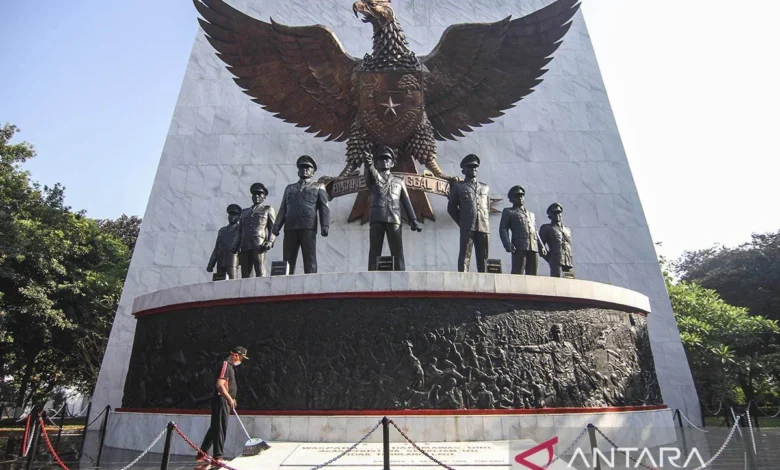
On the night of September 30, 1965, the abduction and murder of six high-ranking Army generals and one officer in Jakarta triggered the event known as the Gerakan 30 September (G30S). The immediate aftermath saw the military, led by Major General Soeharto, move to neutralize the alleged perpetrators.
The historiography of 1965 remains a subject of intense debate. While the "New Order" government maintained that the PKI was the sole mastermind behind the coup attempt, contemporary scholars and archives—including those released by the National Archives of the Republic of Indonesia (ANRI) and international sources—suggest a more complex web of internal military factions, intelligence maneuverings, and local political actors. Regardless of the precise orchestration, the political fallout was immediate and devastating for the party.
The Purge and Institutional Dissolution
The months following October 1965 witnessed one of the most violent episodes in modern history. The military-led campaign against the PKI and its suspected affiliates resulted in mass killings, arbitrary detentions, and systematic human rights violations. According to findings by the National Commission on Human Rights (Komnas HAM), the period saw widespread atrocities including extrajudicial executions, forced disappearances, and torture across Java, Bali, and parts of Sumatra.
The institutional collapse of the PKI was formalized on March 12, 1966, when Soeharto, then acting on behalf of President Sukarno, issued a decree banning the party. This was later codified through the MPRS Decree Number XXV/1966, which prohibited the dissemination of Marxism, Leninism, and Communism in any form. This decree remains part of the legal framework of Indonesia, serving as the basis for the continued prohibition of the party and its ideology.
Legacy and Historical Reflection
The destruction of the PKI in 1966 did more than remove a political party; it fundamentally changed the structure of the Indonesian state. The consolidation of power under the New Order regime led to a centralized, military-backed government that would persist until the Reformasi era in 1998.
In recent years, the discourse surrounding the PKI has evolved. ANRI continues to catalog and preserve historical records, emphasizing that a comprehensive understanding of the 1965 period requires an objective synthesis of diverse archival materials. Scholars from around the globe utilize records from the United States, Japan, and the Soviet Union to piece together the complexities of the Cold War era in Indonesia.
The events of 1965-1966 continue to pose difficult questions regarding human rights and historical memory. For many families affected by the purges, the quest for truth and recognition remains an ongoing struggle. As Indonesia moves further into the 21st century, the history of the PKI is increasingly analyzed not as a closed chapter, but as a crucial, if painful, element of the nation’s political evolution—a reminder of the fragility of democratic institutions and the enduring impact of systemic political conflict on society.