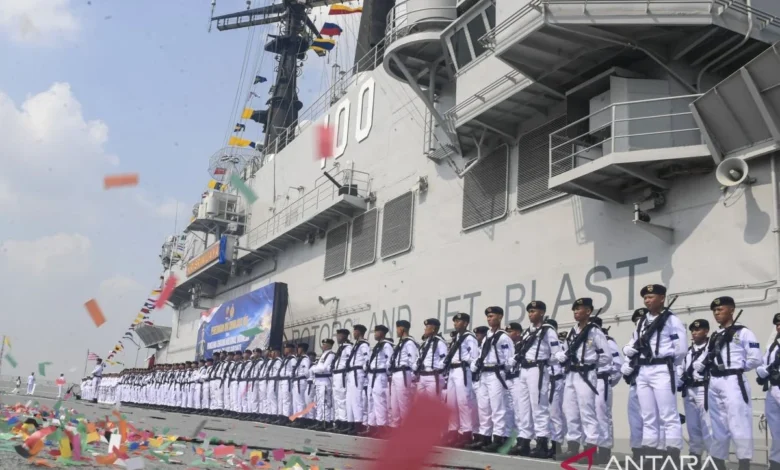
The arrival of the former Italian Navy flagship, ITS Giuseppe Garibaldi, at Pier 107 of Tanjung Priok Port in North Jakarta on Friday, September 18, 2026, represents a transformative moment in Indonesia’s maritime defense history. As the vessel docked, it signaled the formal introduction of the nation’s first-ever aircraft carrier into the Indonesian Navy (TNI AL) fleet. This strategic asset, which will undergo a transition to become KRI Sriwijaya, is set to significantly enhance Indonesia’s power projection capabilities, disaster response effectiveness, and regional maritime presence.
A New Era for the Indonesian Navy
The acquisition of the vessel—formerly known as ITS Giuseppe Garibaldi (hull number C551)—is the result of a long-standing diplomatic and defense cooperation agreement between Indonesia and Italy. The transition process, which includes a formal hand-over ceremony and the symbolic raising of the Indonesian flag, is scheduled for September 24, 2026. This acquisition is not merely a transfer of hardware but a strategic pivot for the TNI AL, shifting the scope of operations from localized coastal defense to blue-water maritime surveillance and expanded humanitarian reach.
The selection of the name "KRI Sriwijaya" is deeply symbolic. Named after the Srivijaya Empire—a powerful thalassocracy based in Sumatra that dominated the maritime trade routes of Southeast Asia from the 7th to the 13th century—the naming reflects the government’s ambition to revitalize Indonesia’s historical status as a global maritime power.
Defining the Aircraft Carrier: A Mobile Sovereign Platform
To understand the significance of KRI Sriwijaya, it is essential to define the tactical role of an aircraft carrier. Unlike traditional surface combatants—such as frigates or destroyers—which rely primarily on surface-to-surface missiles and deck-mounted guns, an aircraft carrier is designed as a mobile, sovereign airfield. Its primary utility is to extend the reach of air power into regions where terrestrial airbases are non-existent or inaccessible.
An aircraft carrier functions as a floating command center. It provides the necessary infrastructure for the deployment of helicopters, fixed-wing aircraft, and unmanned aerial vehicles (UAVs). This includes a flight deck for launch and recovery, hangars for maintenance, extensive fuel storage, and advanced command-and-control (C2) suites. By deploying a carrier to a specific region, a nation can maintain a continuous presence, monitor vast stretches of open ocean, and respond to threats or crises without being constrained by the geographic limitations of fixed ground installations.
Strategic Rationale and Operational Focus
The decision to incorporate an aircraft carrier into the TNI AL fleet is grounded in the unique geography of the Indonesian archipelago. Comprising over 17,000 islands, Indonesia faces significant challenges in rapid disaster response and maritime domain awareness.
Admiral Muhammad Ali, Chief of Staff of the Indonesian Navy, has emphasized that KRI Sriwijaya will not be employed solely as a combat platform. Instead, the vessel is envisioned as a versatile asset for "Operations Other Than War" (OOTW). Given Indonesia’s high vulnerability to natural disasters, the ship’s ability to serve as a floating base for heavy-lift helicopters and medical personnel is paramount. During a disaster, when local runways may be destroyed or flooded, KRI Sriwijaya can act as an off-shore logistics hub, facilitating the delivery of aid, medical triage, and search-and-rescue operations.
Furthermore, the integration of drones (UAVs) onto the vessel allows for persistent, low-cost surveillance of Indonesia’s Exclusive Economic Zone (EEZ). This capability is vital for monitoring illegal, unreported, and unregulated (IUU) fishing, smuggling, and piracy, tasks that are currently stretched thin across the existing fleet.
The Evolution of the Giuseppe Garibaldi
The vessel itself, the ITS Giuseppe Garibaldi, has a storied history. Commissioned in 1985, it served as the flagship of the Italian Navy for decades. It was the first Italian ship designed to operate V/STOL (Vertical/Short Take-Off and Landing) aircraft, most notably the AV-8B Harrier II. Its design, which incorporates a "ski-jump" ramp, allows aircraft to take off with higher payloads than would be possible from a flat deck.
While the TNI AL is currently reviewing the integration of fixed-wing aircraft, the primary focus for the near term will be the enhancement of the ship’s rotary-wing and drone capabilities. Naval engineers and defense planners are currently conducting an extensive refit of the ship’s propulsion systems and electronic architecture to ensure it meets the operational requirements of the 2020s and beyond. This modernization phase is critical, as it aligns the vessel’s legacy systems with the modern digital combat management systems used by other vessels in the Indonesian fleet.
Comparative Analysis: Carrier vs. Conventional Warships
In the maritime lexicon, it is important to distinguish between a "carrier" and a "helicopter-capable combatant." Many modern frigates and corvettes carry a single helicopter; however, they lack the endurance, maintenance facilities, and command capabilities of a dedicated aircraft carrier.
A carrier serves as a force multiplier. It allows for the synchronization of an entire task force. In a typical deployment, KRI Sriwijaya would likely be supported by a screening group—consisting of frigates for anti-submarine warfare and destroyers for air defense. This group formation protects the carrier while the carrier provides the group with superior situational awareness and aerial support. By operating in this manner, the Indonesian Navy can project influence far beyond its littoral waters, establishing a credible deterrent posture in the Indo-Pacific region.
The Humanitarian Dimension: A Force for Good
Beyond military doctrine, the humanitarian utility of KRI Sriwijaya cannot be overstated. During the 2004 Indian Ocean Tsunami, the international response was heavily dependent on foreign aircraft carriers that could operate independently of damaged port infrastructure. By possessing its own carrier, Indonesia significantly reduces its reliance on international aid for immediate disaster relief.
The ship’s large internal volume allows for the stowage of heavy equipment, desalination plants, and field hospitals. When paired with its ability to launch helicopters, the vessel becomes the most efficient tool in the government’s arsenal for responding to island-bound catastrophes. This capability reinforces Indonesia’s commitment to regional stability and disaster resilience within the ASEAN framework.
Looking Ahead: Challenges and Considerations
The transition of KRI Sriwijaya into active service is not without challenges. Operating an aircraft carrier requires a high degree of specialized training for both flight-deck crews and ship-handling personnel. The logistics chain for maintaining specialized aircraft parts and aviation fuel at sea is complex and requires significant investment in infrastructure and human capital.
Defense analysts have noted that the success of the program will depend on the long-term sustainment budget allocated by the Ministry of Defense. Continuous maintenance, crew training, and the procurement of modern aircraft will be essential to ensure the ship remains a viable asset. Furthermore, the integration of KRI Sriwijaya into the broader defense network will require the development of new tactical doctrines that move away from traditional small-ship engagements.
Despite these hurdles, the consensus among military observers is that the acquisition represents a bold and necessary step for Indonesia. As global powers increasingly focus on the Indo-Pacific, having a credible, versatile maritime platform that can support both security and humanitarian missions is a strategic imperative.
Conclusion: A Landmark for Indonesia
The arrival of the vessel in Tanjung Priok is a historic landmark that signals Indonesia’s growing confidence on the international stage. As the flag is formally transferred on September 24, 2026, the KRI Sriwijaya will officially join the fleet, carrying with it the aspirations of a nation committed to safeguarding its vast oceanic territories. Whether as a guardian of maritime sovereignty or a beacon of hope during natural disasters, the ship is poised to become the cornerstone of the Indonesian Navy’s modernization effort, ensuring that the legacy of the Srivijaya era is felt in the modern maritime domain for decades to come.
As the Indonesian public and the international community watch the transformation of this former Italian flagship, the message is clear: Indonesia is ready to take on a larger, more active role in the security and stability of the maritime corridors of Southeast Asia. The journey of KRI Sriwijaya has only just begun, and its operational lifecycle will be a closely watched indicator of Indonesia’s progress as a premier maritime nation.