Skies Across Indonesia Illuminate with Rare Lunar Occultation of Venus and Crescent Moon Conjunction

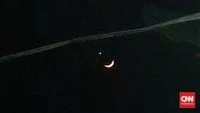
The night sky across several regions of Indonesia transformed into a magnificent celestial canvas as a rare astronomical alignment brought the planet Venus into temporary disappearance behind the lunar disc, while other parts of the archipelago witnessed a stunning crescent moon and planet conjunction resembling a classic cosmic emblem. This remarkable celestial event, which captured the attention of astronomers, astrophotographers, and casual stargazers alike, offered a vivid reminder of the dynamic mechanics governing our solar system. As twilight faded into night, millions turned their eyes toward the western horizon to witness the planetary dance unfold in real time.
According to astronomical calculations and official statements released by the prestigious Bosscha Observatory, the phenomenon known as the lunar occultation of Venus occurs when the Moon passes directly between the Earth and the planet Venus from our observational vantage point. Because of this precise alignment, the brilliant light of Venus—often referred to by observers as the morning or evening star—was temporarily obscured by the opaque piringan, or disc, of the Moon.
The Observatory noted that this alignment is part of a predictable yet mesmerizing series of orbital intersections. Prior to the actual moment of occultation, Venus appeared to graze the luminous outer edge of the lunar crescent, creating a visual effect strikingly reminiscent of the preliminary phases of a solar eclipse, albeit operating on a planetary scale. While solar eclipses involve the Moon blocking the Sun relative to Earth, an occultation of a planet involves the Moon moving precisely in front of a distant world in our cosmic neighborhood, blotting it out of view for observers situated along a very narrow geographical path on the Earth’s surface.
Geographical Visibility and Regional Disparities
The ability to witness the occultation in its entirety was dictated strictly by geography. Because the Moon is relatively close to Earth compared to Venus, its precise position in the sky varies slightly depending on the observer’s exact location on the globe—a visual shift known as parallax. Consequently, the complete occultation—where Venus completely vanished behind the lunar limb and later reappeared—was visible exclusively from specific territories within Indonesia.
The prime viewing corridor encompassed parts of Sumatra, western regions of Java, and a small segment of West Kalimantan. In these designated areas, onlookers with clear weather conditions experienced the surreal sight of Venus winking out of existence as it slid behind the dark side of the lunar crescent, only to emerge moments later on the opposite side.
For populations residing outside this narrow observational corridor, the event manifested as a breathtaking conjunction. Instead of the planet disappearing behind the Moon, observers in these regions witnessed Venus passing extremely close to the lunar crescent. The resulting view featured a luminous crescent moon accompanied by a brilliant, unblinking celestial point of light positioned in close proximity. This striking visual configuration has historically held deep cultural and symbolic significance across the region, frequently evoking the classic crescent-and-star motif deeply ingrained in the cultural and religious heritage of the Islamic world. Astronomers and science educators frequently use such conjunctions as public outreach opportunities to clarify that the brilliant "star" accompanying the crescent moon is, in fact, our neighboring terrestrial planet, Venus.
Chronology and Optimal Viewing Parameters
The astronomical spectacle followed a strict temporal schedule dictated by the orbital speeds of the Earth, Moon, and Venus. For Indonesian observers, the prime window for viewing both the occultation and the accompanying conjunction occurred during the early evening hours, specifically between 19.30 and 20.43 Western Indonesia Time (WIB).
Astrophysicists emphasize that exact viewing times varied slightly depending on the specific longitude and latitude of the observer. The sequence of events typically began shortly after sunset, as the fading orange and purple hues of twilight gave way to the deep indigo of the night sky. As the Sun sank further below the horizon, the dazzling brilliance of Venus became clearly visible to the naked eye long before darker stars could pierce through the atmospheric haze.
Experts recommended that interested observers direct their line of sight toward the western horizon, where both the Moon and Venus were positioned low in the sky. One of the most remarkable aspects of this particular astronomical event was its accessibility. Unlike deep-sky phenomena such as faint nebulae, distant galaxies, or faint comets, the lunar occultation of Venus required no specialized equipment. While binoculars or amateur telescopes offered a magnified view of Venus grazing the lunar craters and mountains, the core phenomenon was easily discernible with the naked eye, allowing millions of citizens across urban and rural landscapes to participate in the observation without financial barriers.
Scientific Context and Background of Planetary Occultations
To understand the significance of the September 14 celestial alignment, one must examine the orbital mechanics governing the inner solar system. Venus orbits the Sun at an average distance of approximately 108 million kilometers, while Earth orbits at roughly 150 million kilometers. Because Venus is closer to the Sun, it continually laps our planet or falls behind it from our perspective on Earth, creating recurring cycles of elongations, conjunctions, and occasionally, occultations.
Occultations of bright planets by the Moon are not exceptionally rare on a global scale, but witnessing one from a specific populated landmass like Indonesia requires a precise alignment of the lunar nodes, orbital inclination, and local timing. The Moon’s orbit is tilted by approximately 5 degrees relative to the Earth’s orbital plane around the Sun (the ecliptic). Because of this tilt, the Moon usually passes slightly above or below planets during most monthly orbits. It is only during specific orbital intersections that the Moon intersects a planet’s precise path in the sky, resulting in an occultation.
Astronomers place high value on occultation events for several scientific reasons. Historically, timing the exact moment a planet or star disappears behind the lunar limb has provided crucial data for refining lunar cartography and understanding the irregularities of the Moon’s polar topography. Because the edge of the Moon is not a smooth geometric circle—being heavily pocked by impact craters, mountain ranges, and valleys—the light of an occulted object flickers or dims in a predictable pattern as it encounters lunar terrain features.
Furthermore, when an occultation involves a planet with an atmosphere, such as Venus, astronomers can study how the starlight or planetary light is refracted and filtered through the upper layers of that planet’s atmosphere just before disappearance. Although Venus possesses an extremely thick, carbon dioxide-dominated atmosphere that obscures its surface from optical view, atmospheric dispersion studies during occultations help scientists model global meteorological and chemical properties of the planet’s upper envelope.
Public Engagement and Educational Implications
Events of this magnitude serve a vital role in science communication and public engagement. In an era dominated by digital screens and urban light pollution, celestial phenomena provide a powerful catalyst for drawing public attention back to the natural world. Institutions such as the Bosscha Observatory—historic astronomical research facilities operated by the Bandung Institute of Technology (ITB)—frequently leverage these occurrences to foster public interest in STEM fields, particularly astronomy and astrophysics.
Social media platforms and digital news outlets played a pivotal role in disseminating accurate viewing times and safety guidelines ahead of the event. Science educators noted a sharp increase in public inquiries regarding the nature of the night sky, demonstrating a robust grassroots appetite for scientific literacy. Planetariums and local astronomy clubs organized viewing parties where enthusiasts could share high-powered telescopes, astrophotography equipment, and specialized knowledge with curious members of the local community.
Moreover, these shared celestial observations foster a collective cultural experience. Across a vast archipelago nation comprising thousands of islands and multiple time zones, millions of individuals paused simultaneously to look up at the exact same cosmic display, bridging geographic and cultural divides through a shared moment of awe.
Broader Astronomical Calendar and Future Outlook
The September 14 lunar occultation of Venus is part of a broader, ongoing calendar of planetary alignments that continuously animate the night sky throughout the decade. Planetary conjunctions occur with relative frequency, but total occultations of brilliant inner planets like Venus or Jupiter remain highlight events for regional observers.
Astronomers remind the public that maintaining awareness of the night sky requires patience and favorable atmospheric conditions. Cloud cover remains the primary obstacle for observational astronomy in tropical regions like Indonesia, where transitional weather patterns can obscure the horizon unexpectedly. Despite localized cloud cover in certain sectors, widespread visibility across large parts of Java and Sumatra ensured that a vast segment of the population successfully witnessed the spectacle.
As scientific institutions continue to map and predict future orbital crossings, skywatchers are encouraged to maintain active engagement with astronomical forecasts. Events such as meteor showers, solar and lunar eclipses, and planetary occultations serve as a vital reminder of our place within the vast, orderly architecture of the cosmos. Through continued public education and accessible observation opportunities, the wonders of the universe remain within reach of anyone willing to step outside, look toward the western horizon, and gaze upward into the night.
Related posts: