Miracle Comeback: How Alwi Farhan and Leo-Daniel Sparked Indonesia’s Historic Gold Medal Triumph at the 2026 Asian Games


The 2026 Asian Games badminton competition will forever be etched in the collective memory of Indonesian sports fans, largely due to a breathtaking, high-stakes team final that tested the absolute limits of resilience, mental fortitude, and athletic brilliance. Trailing 2-0 against a powerhouse opponent in the gold medal match, the Indonesian men’s team faced seemingly insurmountable odds. Yet, through a combination of nerves of steel, tactical adjustments, and an unbreakable refusal to surrender, the Red and White contingent orchestrated one of the most stunning comebacks in modern badminton history. At the absolute epicenter of this historic turnaround were singles specialist Alwi Farhan and the formidable doubles pairing of Leo Rolly Carnando and Daniel Marthin, whose heroic victories laid the vital groundwork for a championship-clinching finale.
The Path to the Final and the Gravity of the Stage
To fully appreciate the magnitude of the victory, one must examine the fierce competitive landscape of the 2026 Asian Games. The men’s team event is traditionally one of the most fiercely contested categories in continental multi-sport competitions, featuring world-class athletes from badminton powerhouses across Asia. For Indonesia, a nation with a rich, storied heritage in the sport, the pressure to secure gold is an annual burden carried by every generation of players.
Entering the final showdown, the expectations were monumental. However, the early stages of the tie unfolded as a nightmare scenario for the Indonesian coaching staff and supporters. The first two matches slipped away, placing Indonesia in a deep 0-2 hole. In a best-of-five format, falling behind by two matches means absolute vulnerability; a single loss in the third match would seal a straight-sets defeat and hand the gold medal to the opposition. The atmosphere inside the arena was deafening, heavily favoring the opponents who could already taste victory. It was under this suffocating weight of expectation that Alwi Farhan stepped onto the court for the crucial third match, carrying the hopes of an entire nation on his shoulders.
Alwi Farhan’s Heroic Stand: Neutralizing the Pressure
Alwi Farhan faced formidable adversary Li Shifeng in the third match. Knowing that a loss meant the end of the road, the young Indonesian singles player had to completely block out the scoreboard and psychological disadvantages. The opening game was a fierce battle of attrition, characterized by long rallies, intense psychological warfare, and razor-thin margins. Alwi managed to edge out the first game 23-21, displaying remarkable composure in the crucial closing points.
However, high-level sports are rarely linear. Li Shifeng adjusted his strategy in the second game, increasing the pace and capitalizing on Alwi’s minor errors to take it 21-15, forcing a decisive rubber game. As the third game commenced, the mental demons and fatigue could easily have overwhelmed the young player.
Reflecting on the psychological battle after the match, Alwi noted the immense difficulty of neutralizing the opponent’s momentum. "It certainly wasn’t easy out there. The team was trailing 2-0, and naturally, the opponent’s aura and confidence were higher. But I had to neutralize all of that. Many thoughts raced through my mind when the second game began, but I am deeply grateful that I could overcome such circumstances," Alwi expressed.
Rather than folding under pressure, Alwi embraced the existential stakes of the moment. He channeled his inner urgency into explosive movement and fearless shot-making, eventually closing out the rubber game 21-16. His post-match remarks captured the essence of elite competitive drive: "I wanted to show that the game is not over yet. There was still hope for us to win the gold medal. This was a precious opportunity that had to be maximized. It was now or never."
Leo and Daniel: Banishing the Ghosts of Hangzhou
With Alwi successfully altering the trajectory of the tie, the scoreline shifted to 2-1, injecting a vital surge of adrenaline into the Indonesian camp. Next up was the formidable scratch-and-stabilize doubles pairing of Leo Rolly Carnando and Daniel Marthin, tasked with the imperative mission of leveling the score.
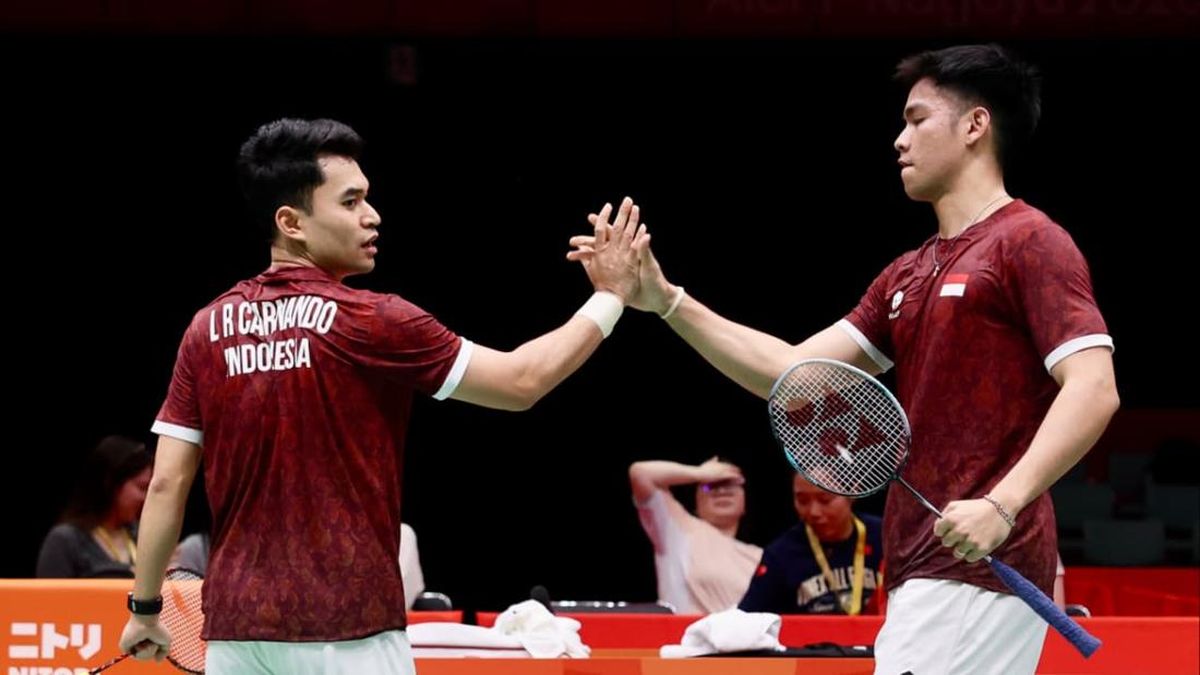
Facing a potential match-point scenario in the first game of their own fixture, Leo and Daniel exhibited nerves of iron. They successfully fended off the opponent’s game points to snatch the opening frame 23-21. Riding this immense wave of psychological momentum, the Indonesian duo completely dismantled their opponents in the second game, securing a resounding 21-10 victory to bring the overall team score dead even at 2-2.
For Daniel Marthin, the victory carried deeper emotional resonance, serving as sweet redemption for past disappointments. He candidly pointed to the painful lessons learned from the previous Asian Games cycle. "Thank God we played quite well today. Naturally, we wanted to contribute a point, so we refused to lose. We communicated a lot and played with greater calmness. I felt this was the right moment, and we didn’t want to waste the opportunity," Daniel stated.
He further elaborated on the psychological motivation driving their performance: "We learned from our mistakes at the 2022 Hangzhou Asian Games team event. We played against Korea back then, and the result was far from ideal, so we didn’t want to make the same mistakes again. That served as our primary motivation to win the match."
The Climax: Moh Zaki Ubaidillah Completes the Resurrection
With the score tied at two matches apiece, the stage was set for a dramatic, winner-take-all fifth and final match. Stepping into the spotlight was Moh Zaki Ubaidillah, affectionately known as Ubed. Tasked with completing the ultimate comeback, Ubed faced Weng Hong Yang in a clash that would determine the color of the medal.
Displaying technical maturity and a fearless tactical approach that belied his years, Ubed mirrored the resilience shown by his teammates earlier in the afternoon. In a nail-biting first game, Ubed held his nerve to win 23-21, breaking the resistance of his opponent. Unfazed by the magnitude of the moment, he dominated the second game with aggressive attacking play and airtight defense, sealing it 21-13.
Ubed’s victory officially finalized the miraculous 3-2 comeback, crowning Indonesia as the gold medalists of the men’s team badminton event at the 2026 Asian Games. The stadium erupted in celebration as the Indonesian coaching staff, players, and travelling supporters rushed the court to embrace the young heroes.
Broader Implications and Strategic Analysis of the Triumph
The implications of this gold medal extend far beyond a single tournament victory. In the high-stakes ecosystem of international badminton, depth of character and mental resilience are often the definitive factors separating good teams from legendary ones. By orchestrating a comeback from a 2-0 deficit against elite continental opposition, the Indonesian team proved that their developmental pipeline continues to produce athletes capable of handling the most extreme psychological pressures.
Furthermore, this triumph highlights the critical importance of squad versatility and psychological preparation. Modern badminton is no longer just a test of physical endurance and technical prowess; it is increasingly a psychological battleground. The ability of players like Alwi Farhan, Leo Rolly Carnando, Daniel Marthin, and Moh Zaki Ubaidillah to compartmentalize failure, adapt to tactical shifts mid-match, and execute under the threat of elimination demonstrates world-class readiness.
For the Badminton Association of Indonesia (PBSI), this gold medal serves as a powerful validation of their ongoing youth integration programs and training methodologies. Integrating younger prospects alongside established pairs has fostered a competitive internal culture where accountability and hunger for victory are paramount. The lessons learned from previous continental setbacks—such as the aforementioned struggles in Hangzhou—were directly converted into actionable mental frameworks that guided the team to glory in 2026.
As the dust settles on the 2026 Asian Games team competition, the enduring image of this campaign will not merely be the gold medals placed around the necks of the Indonesian athletes, but the sheer willpower required to claim them. From the brink of elimination at 0-2 down, Alwi Farhan, Leo Rolly Carnando, Daniel Marthin, and Moh Zaki Ubaidillah rewrote the script, proving definitively that in elite sports, as long as the final point has not been played, the game is never truly over.