KRI Sriwijaya: Indonesia Marks a New Maritime Era with the Arrival of its First Aircraft Carrier

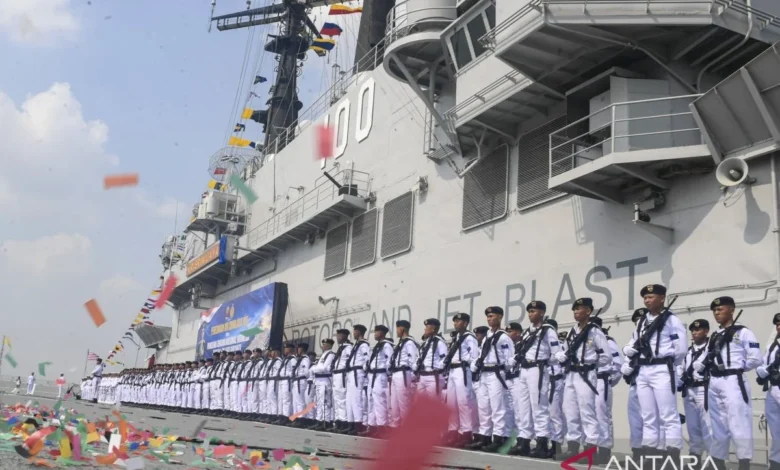
The arrival of the former ITS Giuseppe Garibaldi at Pier 107 of Tanjung Priok Port, North Jakarta, on Friday, September 18, 2026, marks a historic milestone for the Indonesian Navy (TNI AL). As the vessel formally integrates into the fleet, it brings with it the title of Indonesia’s first-ever aircraft carrier, a strategic acquisition that promises to redefine the nation’s maritime power projection. Once the formal commissioning ceremony takes place on September 24, 2026, the ship will be officially renamed KRI Sriwijaya, honoring the historical maritime legacy of the Srivijaya Empire, which once dominated the archipelago’s sea lanes.
A Strategic Addition to the Archipelago’s Defense
The acquisition of the ship, formerly known by its Italian Navy hull number C551, is the result of long-standing diplomatic and military cooperation between Jakarta and Rome. The vessel represents a significant leap in capabilities for a country that comprises over 17,000 islands. While the Indonesian Navy has long relied on frigates, corvettes, and landing platform docks (LPDs), the introduction of a carrier-capable vessel introduces a new dimension to maritime operations, specifically in the areas of power projection, surveillance, and humanitarian assistance.
Military analysts view the inclusion of the KRI Sriwijaya as a pragmatic move. Given Indonesia’s vast Exclusive Economic Zone (EEZ) and its position astride critical international shipping lanes—such as the Malacca, Sunda, and Lombok Straits—the ability to deploy air power from a mobile sea-based platform provides a tactical advantage that land-based airfields cannot always guarantee.
Anatomy of an Aircraft Carrier: Beyond the Hull
A common misconception among the public is that any large naval vessel qualifies as an aircraft carrier. In reality, the designation is defined by function and engineering. An aircraft carrier is fundamentally a mobile, sea-based airfield. Unlike destroyers or frigates, which rely on missile batteries and anti-submarine warfare (ASW) suites as their primary offensive mechanisms, the aircraft carrier’s primary weapon is the air wing it carries.
The KRI Sriwijaya is equipped with a flight deck, hangar space, fuel storage, and complex communication systems necessary to sustain flight operations. This allows the ship to host helicopters, Unmanned Aerial Vehicles (UAVs), and potentially Short Take-Off and Vertical Landing (STOVL) aircraft. This functional architecture transforms the vessel from a mere combatant into a command-and-control hub that can extend the operational reach of the Indonesian military far beyond the horizon.
Timeline and Milestones
The journey toward this historic arrival has been a multi-year process involving negotiations, inspections, and logistics planning:
- Late 2024: Initial discussions between the Indonesian Ministry of Defense and the Italian government regarding the potential transfer of surplus naval assets.
- Early 2025: Technical assessments conducted by TNI AL engineers and experts to evaluate the hull integrity and the state of the machinery on the ITS Giuseppe Garibaldi.
- Mid-2025: Formal agreement signed for the transfer of the vessel, including training programs for Indonesian personnel in Italy.
- August 2026: The vessel departs Italy, beginning its transit toward Indonesian waters.
- September 18, 2026: The ship arrives at Tanjung Priok, Jakarta, signaling the start of the final integration phase.
- September 24, 2026: Scheduled date for the official handover and flag-lowering ceremony, where the vessel will be commissioned as KRI Sriwijaya.
Shifting the Doctrine: From Combat to OMSP
Chief of Staff of the Indonesian Navy (KASAL) Admiral Muhammad Ali has emphasized that while the KRI Sriwijaya is a naval combatant, its primary focus in the near term will be centered on Operations Other Than War (OMSP—Operasi Militer Selain Perang). Indonesia’s geographic vulnerability to natural disasters—including earthquakes, tsunamis, and volcanic eruptions—makes the ship’s ability to act as a floating command center invaluable.
During a disaster, the ability to deploy helicopters from the KRI Sriwijaya to transport medicine, medical teams, and relief supplies to remote, isolated islands is a capability the Indonesian military has previously struggled to maintain at scale. Furthermore, the ship serves as an ideal platform for long-endurance drone operations, allowing for real-time maritime domain awareness (MDA) across contested or vast, unmonitored waters.
Comparative Analysis: Why the KRI Sriwijaya Matters
When comparing the KRI Sriwijaya to other vessels in the Indonesian fleet, the distinction lies in the concept of operations. A frigate can carry a single helicopter for reconnaissance or limited logistics. In contrast, the KRI Sriwijaya is designed to facilitate the maintenance and sustained sortie generation of multiple aircraft.
It functions as a "floating airport," enabling the Indonesian military to operate in environments where shore-based infrastructure has been destroyed or is non-existent. This capability is vital for both national security and regional stability. In the event of maritime search and rescue (SAR) missions, the ship can provide a stable base for coordination, significantly increasing the probability of success in deep-sea operations.
Technical Aspirations and Future Upgrades
The Indonesian Navy has expressed clear intentions to modernize the ship’s systems to align with its current operational needs. Admiral Ali has indicated that the vessel will undergo extensive refitting, focusing on propulsion efficiency and the integration of modern communication suites. There is also ongoing discourse regarding the acquisition of aircraft capable of vertical or short take-offs to maximize the utility of the ship’s flight deck.
While the vessel previously operated AV-8B Harrier II jets under the Italian flag, the current procurement focus remains on rotary-wing assets and surveillance drones. This approach allows the Navy to build institutional expertise in carrier operations before transitioning to more complex fixed-wing aviation assets.
Geopolitical Implications
The introduction of a carrier-capable ship into the Indonesian Navy sends a clear signal regarding Indonesia’s commitment to its status as a "Global Maritime Fulcrum." By securing the ability to project power and humanitarian support independently, Indonesia reduces its reliance on external partners during crisis management.
Furthermore, the presence of such a vessel in the waters of Southeast Asia contributes to the regional balance of power. While Indonesia maintains a policy of non-alignment, the ability to sustain a significant naval presence in the South China Sea and the Indian Ocean provides a deterrent against illegal fishing, piracy, and unauthorized incursions into Indonesian territory.
The Human Element: Training and Readiness
The success of the KRI Sriwijaya project hinges as much on the personnel as it does on the hardware. The Indonesian Navy has been undergoing rigorous training to manage the complexities of carrier operations. Managing an air wing—including flight deck crew, air traffic controllers, maintenance technicians, and specialized command staff—requires a cultural shift in naval operations. The Navy has collaborated with international partners to ensure that the transition from a traditional fleet to one with a carrier component is handled with precision.
Conclusion: A New Horizon
The arrival of the KRI Sriwijaya is not merely the delivery of a ship; it is the delivery of a new strategic framework for Indonesia. As the nation faces increasing challenges—from climate-induced humanitarian crises to the need for robust maritime security—the KRI Sriwijaya stands as a testament to Indonesia’s growing naval maturity.
As the flag of the Italian Navy is lowered and the Merah Putih (Red and White) is hoisted on September 24, the vessel will begin its new life. It will serve as a symbol of Indonesian sovereignty, a guardian of its vast maritime borders, and a beacon of hope during times of catastrophe. The era of the aircraft carrier in Indonesia has officially begun, and with it, a new chapter in the nation’s long and storied maritime history. The eyes of the region remain fixed on Jakarta, observing how this new capability will be integrated into the broader security architecture of the Indo-Pacific.