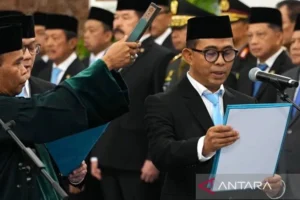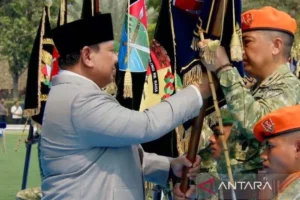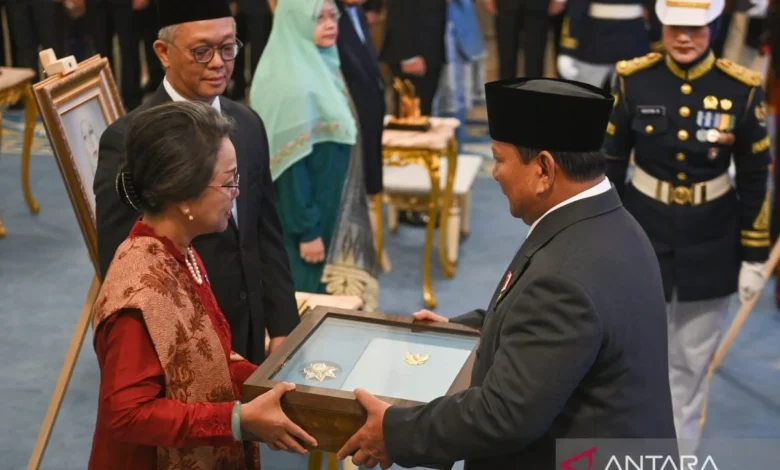
Jakarta (ANTARA) – In a solemn ceremony commemorating National Hero Day 2025 at the State Palace in Jakarta on Monday, President of the Republic of Indonesia, Prabowo Subianto, conferred the prestigious title of National Hero upon ten distinguished figures. This significant recognition, enacted through Presidential Decree of the Republic of Indonesia (Keppres) Number 116/TK/Tahun 2025 concerning the Conferment of the National Hero Title, celebrates individuals whose extraordinary contributions have profoundly shaped the nation’s history, sovereignty, and international standing. Among the esteemed recipients was the late Mochtar Kusumaatmadja, whose unparalleled dedication to the fields of law and politics earned him this highest national honor.
Mochtar Kusumaatmadja, an internationally renowned legal expert and seasoned diplomat, served Indonesia with distinction during the New Order era, holding critical portfolios as Minister of Foreign Affairs and Minister of Justice. His legacy is particularly marked by his relentless advocacy for the Archipelagic State Principle, an endeavor that fundamentally redefined Indonesia’s maritime boundaries and sovereignty.
The Significance of National Hero Day and the Award
Hari Pahlawan, or National Hero Day, observed annually on November 10th, commemorates the Battle of Surabaya in 1945, a pivotal moment in Indonesia’s struggle for independence. This day serves as a powerful reminder of the sacrifices made by countless individuals to secure and maintain the nation’s freedom and integrity. The conferment of the National Hero title is the highest honor bestowed by the Indonesian government, reserved for individuals who have demonstrated exceptional heroism, courage, and dedication in defending the nation, advancing its interests, or contributing significantly to its development across various fields. The criteria for such an award are stringent, requiring a proven track record of extraordinary service, often involving personal sacrifice, and a lasting impact on the nation’s welfare and identity. President Subianto’s decision to recognize ten new heroes underscores the nation’s enduring commitment to honoring its past and drawing inspiration from those who have laid the groundwork for its present and future prosperity. This year’s recipients represent diverse backgrounds and contributions, collectively reflecting the multifaceted nature of Indonesian heroism. The inclusion of figures like Mochtar Kusumaatmadja highlights the government’s recognition of intellectual and diplomatic struggles as equally vital to military valor in nation-building.
Early Life and Formative Years
Mochtar Kusumaatmadja’s journey began in Jakarta on April 17, 1929. He was born into a family that valued education and public service. His father, Taslim Kusumaatmadja, was a prominent pharmacist from Tasikmalaya, West Java, while his mother, Sulmi Soerawisastra, hailed from Kuningan, West Java, and worked as an elementary school teacher during the Dutch East Indies colonial period. This familial background, characterized by intellectual pursuits and a sense of responsibility, provided a strong foundation for young Mochtar. Due to his family’s frequent relocations, Mochtar received his early education in various cities, including Jakarta and Cirebon, exposing him to diverse environments and broadening his perspectives from a young age.
His academic prowess became evident early on. He pursued higher education at the University of Indonesia (UI), where he graduated with a Meester in de Rechten (Master of Laws) degree from the Faculty of Law and Social Sciences in 1955, specializing in international law. This period at UI was critical, as it coincided with Indonesia’s nascent years of independence, a time ripe with intellectual ferment and the urgent need to establish a legal framework for the new nation. His passion for international law would prove prescient, given the significant role he would later play on the global stage.
In 1956, Mochtar furthered his legal studies abroad, enrolling at Yale University in the United States, a world-renowned institution for legal scholarship. He successfully earned a Master of Laws (LL.M.) degree, deepening his understanding of complex international legal principles and expanding his network within the global legal community. His education in both the Dutch legal tradition at UI and the common law system at Yale provided him with a unique, comprehensive perspective on jurisprudence, which would be invaluable in his later career.
Academic Career and Early Challenges
Upon his return to Indonesia, Mochtar Kusumaatmadja quickly immersed himself in both academia and public service. The government, recognizing his expertise, immediately sought his assistance in developing the concept of an archipelagic state, a revolutionary idea first declared by Prime Minister Djuanda as the Djuanda Declaration in 1957. This declaration was a bold assertion of Indonesia’s territorial integrity, claiming all waters connecting its thousands of islands as internal waters, thereby creating a unified maritime domain. Mochtar’s intellectual rigor and international legal acumen were crucial in articulating and defending this groundbreaking concept.
Simultaneously, he embarked on a distinguished academic career. He joined the Faculty of Law at Padjadjaran University (Unpad) as a lecturer, where he quickly rose through the ranks. His commitment to legal education was unwavering, and in 1962, he earned his Doctor of Law degree from Unpad. However, his outspoken nature and critical analysis of the Old Order government, particularly under President Soekarno, led to a controversial episode. His doctoral degree was controversially revoked by President Soekarno, a move that highlighted the political tensions of the era and the challenges faced by intellectuals who dared to voice dissent. Despite this setback, Mochtar’s spirit remained undeterred. Rather than being discouraged, he viewed it as an impetus to further his knowledge, choosing to continue his education in the United States.
Between 1964 and 1966, he pursued advanced studies at two other prestigious American institutions: Harvard University and the University of Chicago. These experiences further enriched his understanding of international law, diplomacy, and governance. He returned to Unpad, where his academic contributions were eventually fully recognized, culminating in his appointment as a Professor in 1970. Before his ministerial appointments, Mochtar served multiple terms as Dean of the Faculty of Law at Unpad during the 1960s and 1970s, shaping generations of legal professionals. His leadership qualities were further acknowledged when he was appointed Rector of Unpad in 1973, a position he held for one year before being called to national service.
Ministerial Roles and Defining Contributions
Mochtar Kusumaatmadja’s transition from academia to national politics marked a new chapter of profound impact. In 1974, he was entrusted with the portfolio of Minister of Justice in the Second Development Cabinet, serving until 1978. In this capacity, he played a crucial role in strengthening Indonesia’s legal infrastructure and ensuring the fair administration of justice. His deep understanding of legal systems, both domestic and international, allowed him to implement reforms that streamlined judicial processes and enhanced legal certainty.
His most enduring and globally recognized contributions, however, came during his tenure as Minister of Foreign Affairs. He served two consecutive terms in this vital role, first in the Third Development Cabinet and then in the Fourth Development Cabinet, from 1978 to 1988. This decade-long period was characterized by intense diplomatic activity, where Mochtar Kusumaatmadja emerged as a tireless champion of Indonesia’s interests on the world stage.
The Architect of Wawasan Nusantara and UNCLOS 1982
During his time as Foreign Minister, Mochtar Kusumaatmadja actively championed the concept of "Wawasan Nusantara" or the Archipelagic State Principle. This visionary concept, initially articulated in the Djuanda Declaration of 1957, posits that all islands, waters, and airspace within Indonesia’s defined boundaries constitute a single, indivisible territorial entity. Before this declaration, Indonesia’s territorial sea was limited to 3 nautical miles, leaving vast stretches of water between its islands open to international transit, effectively fragmenting the nation. The Djuanda Declaration, and subsequently Wawasan Nusantara, aimed to consolidate Indonesia’s territorial integrity, asserting its sovereignty over its entire archipelagic domain.
Mochtar’s diplomatic genius lay in his ability to translate this national aspiration into a globally recognized legal principle. He spearheaded Indonesia’s negotiations at the Third United Nations Conference on the Law of the Sea (UNCLOS III), a marathon process that spanned years. His unwavering resolve and persuasive arguments were instrumental in garnering international support for the Archipelagic State Principle. This monumental effort culminated in its successful recognition and codification within the United Nations Convention on the Law of the Sea (UNCLOS) in 1982. The adoption of UNCLOS 1982 was a landmark achievement for Indonesia and a testament to Mochtar Kusumaatmadja’s diplomatic prowess. It fundamentally altered the landscape of international maritime law, providing a legal framework for archipelagic states to claim their internal waters and exclusive economic zones (EEZs). For this unparalleled contribution, he is rightfully revered as the "Father of Indonesian Maritime Law" (Bapak Hukum Laut Indonesia).
The implications of UNCLOS 1982 for Indonesia were immense. It formally secured Indonesia’s territorial integrity, unified its vast archipelago, and provided a legal basis for managing its immense marine resources. Economically, it opened up vast areas for fishing, oil and gas exploration, and maritime transport under Indonesian jurisdiction. Strategically, it enhanced national security and defense by clearly defining its maritime boundaries. The recognition of Wawasan Nusantara was not merely a legal victory; it was a foundational act of nation-building, solidifying Indonesia’s identity as a unified maritime nation.
Broader Diplomatic Achievements
Beyond Wawasan Nusantara, Mochtar Kusumaatmadja’s tenure as Foreign Minister was marked by several other significant diplomatic achievements. He was a proponent of "cultural diplomacy," initiating efforts to promote Indonesia’s rich cultural heritage abroad. He believed that fostering international understanding of Indonesia’s diverse cultures would build stronger diplomatic ties and enhance the nation’s soft power.
Furthermore, he played a crucial role in regional peacemaking efforts. He opened pathways for peace in the protracted conflict between Vietnam and Cambodia, contributing significantly to the processes that eventually led to the Paris Peace Agreement. This agreement was pivotal in bringing stability to Southeast Asia, demonstrating Mochtar’s commitment to regional cooperation and conflict resolution. His ability to navigate complex geopolitical landscapes and facilitate dialogue earned him respect among his regional counterparts and the international community.
Post-Ministerial Career and Enduring Legacy
Even after concluding his service as Foreign Minister in 1988, Mochtar Kusumaatmadja remained an active and influential figure on the international stage. He served as a member of the United Nations International Law Commission (ILC), an expert body responsible for the progressive development and codification of international law. In this capacity, he continued to shape global legal norms and principles, drawing on his vast experience and profound legal insights. He also chaired the Iraq-Kuwait Boundary Commission, a critical role in resolving post-conflict territorial disputes, further cementing his reputation as a respected arbiter in international affairs.
Domestically, his commitment to education never waned. He continued to teach at Padjadjaran University until his retirement in 1999, inspiring new generations of legal scholars and practitioners. His dedication to the legal profession extended to entrepreneurship; he co-founded Mochtar, Karuwin, Komar (MKK), which became one of the first law firms in Indonesia to employ foreign lawyers. This pioneering initiative not only elevated the standards of legal practice in Indonesia but also fostered greater international collaboration within the legal sector.
Mochtar Kusumaatmadja passed away at the age of 92 in 2021 in Jakarta. He was laid to rest at the Kalibata National Heroes Cemetery in Jakarta, a fitting tribute to a man who dedicated his life to his nation. He is survived by his three children from his marriage to Siti Chadidjah: Armida Salsiah Alisjahbana, Emir Kusumaatmadja, and Rachmat Askari Kusumaatmadja.
His legacy continues to resonate across Indonesia. In 2009, the Law Library at Padjadjaran University was named the Mochtar Kusumaatmadja Law Library, a permanent tribute to his profound impact on legal education. In 2023, his name was further honored when a prominent elevated road in Bandung, formerly known as Jalan Layang Pasopati, was officially renamed Jalan Layang Mochtar Kusumaatmadja, cementing his place in the public consciousness of West Java.
The conferment of the National Hero title upon Mochtar Kusumaatmadja is a profound acknowledgment of his intellectual prowess, diplomatic skill, and unwavering commitment to Indonesia’s sovereignty and international standing. His pioneering work on Wawasan Nusantara and its successful integration into UNCLOS 1982 stands as a monumental achievement, not just for Indonesia but for international law itself. His life exemplifies the power of strategic diplomacy and legal scholarship in shaping a nation’s destiny, offering an enduring inspiration for future generations of Indonesians. His recognition underscores the multifaceted nature of heroism, celebrating those who fight for national interests not just on battlefields, but also in lecture halls, negotiation rooms, and the intricate corridors of international law.