
Category Baking Pastry Arts
Mastering Pastry Arts: A Comprehensive Guide to Baking Categories
Pastry arts, a cornerstone of the culinary world, encompass a vast and intricate discipline dedicated to the creation of sweet and savory baked goods. Understanding the fundamental categories within pastry arts is crucial for any aspiring baker, from the home enthusiast to the professional patissier. These categories are not arbitrary; they represent distinct techniques, ingredient ratios, and resulting textures that define a specific type of baked creation. This article delves into the primary categories of baking within pastry arts, offering insights into their defining characteristics, common applications, and essential techniques for successful execution.
I. Breads: The Foundation of Baking
While often distinguished from purely "sweet" pastry, breads form the foundational category from which many other baked goods evolve. Their simplicity belies a complex science of fermentation and gluten development. Breads are characterized by their reliance on yeast or other leavening agents to create a light and airy crumb, with varying degrees of crust crispness. The core ingredients are typically flour, water, yeast, and salt, though additions like sugar, fat, and dairy are common to enrich the dough and enhance flavor.
-
Types of Bread:
- Lean Doughs: These are basic doughs with minimal fat and sugar, yielding a crusty exterior and an open crumb. Examples include baguettes, ciabatta, and basic white bread. The focus here is on gluten development through kneading and proper proofing.
- Enriched Doughs: These doughs incorporate fat, sugar, eggs, and milk, resulting in a softer crumb and a richer flavor. Brioche, challah, and cinnamon rolls fall into this category. The added fat tenderizes the gluten, requiring careful handling to avoid overworking.
- Sourdough: This category utilizes wild yeast and bacteria for leavening, producing a characteristic tangy flavor and a chewy texture. Maintaining a healthy starter is paramount to success.
- Quick Breads: While not yeast-leavened, quick breads are often grouped with breads due to their common usage in savory applications. They rely on chemical leaveners like baking soda and baking powder. Examples include muffins, scones, and quick loaves. Their quick preparation time makes them accessible for home bakers.
-
Key Techniques: Kneading, proofing (first and second rise), shaping, scoring, baking at appropriate temperatures to develop crust. Understanding hydration levels and the role of gluten is paramount.
II. Cakes: The Sweet Centerpiece
Cakes are perhaps the most iconic category in pastry arts, celebrated for their celebratory nature and endless flavor possibilities. They are typically leavened by chemical agents (baking powder, baking soda) or by the aeration of eggs. Cakes are characterized by their soft, tender crumb and are almost always served as a dessert.
-
Types of Cakes:
- Butter Cakes (Creaming Method): This is the most common cake type, where butter and sugar are creamed together to incorporate air, followed by the addition of eggs, then flour and liquid. This method produces a moist and tender crumb. Examples include pound cake, vanilla cake, and chocolate cake.
- Sponge Cakes (Foaming Method): These cakes rely entirely on the aeration of eggs (whole eggs or separated whites and yolks) for leavening. They are lighter and airier than butter cakes, with a finer crumb. Genoise, Angel Food cake, and chiffon cake are prime examples. Mastering the art of folding ingredients without deflating the egg foam is critical.
- Oil-Based Cakes: Using oil instead of butter results in a consistently moist cake, as oil remains liquid at room temperature. Carrot cake and some chocolate cakes often utilize this method.
- Chiffon Cakes: A hybrid, chiffon cakes use vegetable oil for tenderness and egg whites for lightness, creating a uniquely delicate and moist texture.
-
Key Techniques: Creaming butter and sugar, whisking eggs, folding, careful measurement of ingredients to achieve the correct batter consistency, precise baking times to avoid dryness. Frosting and decorating are integral to cake presentation.
III. Cookies: Versatile Delights
Cookies, or biscuits, are small, flat, and often crisp baked treats. Their versatility lies in their vast array of textures, from chewy and soft to crisp and brittle, and their ability to incorporate a wide range of flavors and inclusions.
-
Types of Cookies:
- Drop Cookies: The dough is dropped onto baking sheets by spoonfuls. Chocolate chip cookies and oatmeal raisin cookies are classic examples. The dough consistency dictates spread and texture.
- Bar Cookies: Dough is spread into a baking pan and then cut into squares or rectangles after baking. Brownies and lemon bars fall into this category.
- Rolled Cookies: The dough is chilled, rolled out, and then cut into shapes using cookie cutters. Sugar cookies and gingerbread cookies are common examples.
- Molded Cookies: The dough is shaped by hand into balls or other forms before baking. Peanut butter cookies are a prime example.
- Pressed Cookies: Dough is forced through a cookie press to create intricate shapes. Spritz cookies are a good illustration.
- Refrigerator Cookies: Dough is shaped into logs, chilled, and then sliced before baking. Icebox cookies are known for their uniform shape.
-
Key Techniques: Creaming butter and sugar, incorporating dry ingredients without overmixing to prevent toughness, chilling dough for some types to control spread, precise baking times to achieve desired crispness or chewiness.
IV. Pies and Tarts: A Symphony of Crust and Filling
Pies and tarts are defined by their pastry crusts, which act as edible vessels for a diverse range of fillings. The distinction between pies and tarts often lies in their depth and crust preparation. Pies are typically deeper and may have a double crust (top and bottom), while tarts are shallower and often feature an open-faced design with a single, decorative crust.
-
Types of Pastry Crusts:
- Flaky Pastry (Pâté Brisée): This is a basic, tender, and flaky pastry made with flour, cold fat (butter or shortening), and ice water. The key is to keep the fat cold and cut it into the flour to create distinct layers that puff up during baking.
- Shortcrust Pastry (Pâte Sablée): This pastry is richer and more crumbly than Pâté Brisée due to a higher fat-to-flour ratio and often the inclusion of egg yolks and sugar. It’s ideal for tart shells.
- Puff Pastry (Pâte Feuilletée): This is a highly technical pastry characterized by hundreds of paper-thin layers of dough and butter. The steam generated during baking separates these layers, creating an incredibly light and airy result. It requires meticulous folding and chilling.
- Phyllo Dough (Filo Dough): Extremely thin sheets of unleavened dough brushed with butter or oil and layered to create crisp, delicate pastries. Baklava is a quintessential example.
-
Types of Fillings:
- Fruit Fillings: Fresh or cooked fruits, often thickened with starch or cooked down.
- Custard Fillings: Creamy fillings made with eggs, milk or cream, and sugar.
- Cream Fillings: Light and airy fillings often incorporating whipped cream or meringue.
- Savory Fillings: Incorporating meats, vegetables, and cheeses for quiches and savory tarts.
-
Key Techniques: Cutting fat into flour to create flaky or short textures, chilling dough to prevent shrinkage and aid in handling, blind baking for pre-baked crusts, creating decorative edges, ensuring proper filling consistency to avoid a soggy bottom.
V. Choux Pastry: The Ethereal Wonder
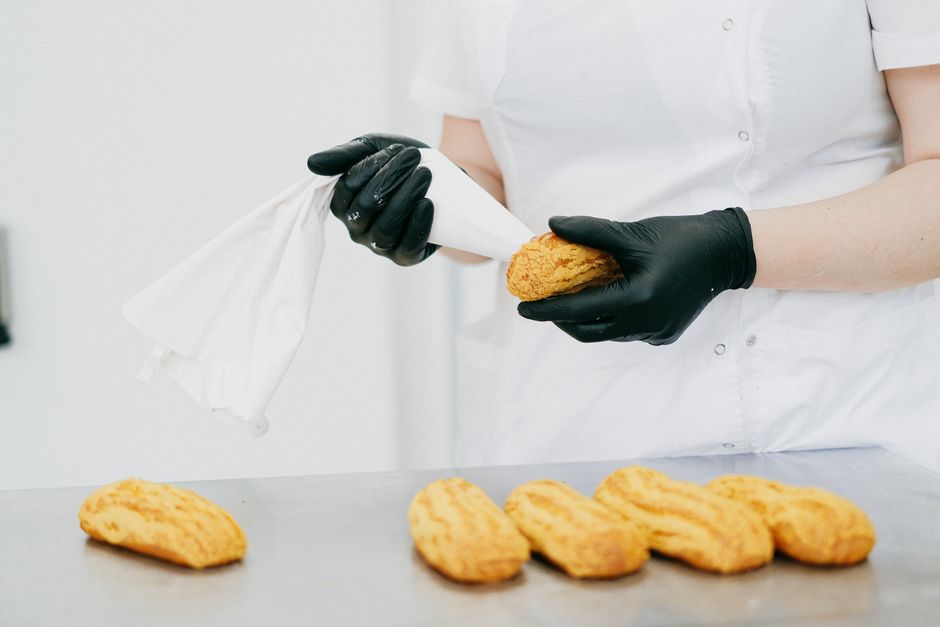
Choux pastry, often referred to as pâte à choux, is a unique and versatile dough that puffs up dramatically when baked, creating a hollow interior perfect for fillings. It is made by boiling water, butter, and flour, then beating in eggs to create a smooth, thick paste.
-
Key Characteristics: Unlike most pastries, choux dough does not rely on chemical or yeast leavening. The steam trapped within the dough expands rapidly in the oven, forcing it to rise.
-
Applications:
- Éclairs: Oblong pastries filled with cream and topped with icing.
- Profiteroles (Cream Puffs): Small, round pastries filled with cream or ice cream and often drizzled with chocolate.
- Gougères: Savory choux puffs often flavored with cheese.
- Churros: Fried dough pastries, often coated in cinnamon sugar.
-
Key Techniques: Boiling the initial mixture to cook the flour, gradually adding eggs to achieve the correct consistency, piping the dough accurately, baking at specific temperatures to ensure proper puffing and prevent collapse, and creating a crisp exterior.
VI. Meringues: Airy Delicacies
Meringues are light, airy confections made primarily from whipped egg whites and sugar. The whipping process incorporates air, which expands and sets during baking, creating a crisp and delicate texture.
-
Types of Meringues:
- French Meringue: Raw egg whites are whipped with sugar. This is the simplest and most common type, but less stable.
- Swiss Meringue: Egg whites and sugar are heated over a double boiler while whisking until the sugar dissolves and the mixture is warm, then whipped to stiff peaks. This method creates a more stable and glossy meringue.
- Italian Meringue: A hot sugar syrup is slowly poured into whipping egg whites. This is the most stable type and is often used in mousses and frostings as it is safe to consume without further baking.
-
Applications: Toppings for pies and cakes, standalone cookies, components in other desserts like macarons and mousses.
-
Key Techniques: Ensuring impeccably clean equipment (no fat or yolk contamination), proper whipping of egg whites to stiff peaks, gradual addition of sugar, careful and low-temperature baking to dry out the meringue without browning.
VII. Doughnuts and Fritters: Deep-Fried Delights
This category encompasses a variety of baked goods that are typically deep-fried, resulting in a golden-brown, crispy exterior and a soft, airy interior.
-
Doughnuts: Can be yeast-raised or cake-based.
- Yeast-Raised Doughnuts: Use yeast for leavening, resulting in a light and airy texture. They require proofing before frying.
- Cake Doughnuts: Use chemical leaveners and have a denser, cake-like texture.
-
Fritters: Often made with batters containing fruit or other ingredients, then deep-fried. Apple fritters are a classic example.
-
Key Techniques: Proper dough preparation (for yeast doughnuts, adequate kneading and proofing), precise oil temperature for frying to ensure even cooking and prevent greasiness, draining excess oil, and glazing or coating while warm.
Conclusion: The Interconnectedness of Pastry Arts
Each category within pastry arts, while distinct, shares fundamental principles of ingredient interaction, heat transfer, and dough development. A strong understanding of flour types, the role of fats, the science of leavening, and precise temperature control are universal to success. Mastery of these categories not only unlocks a world of delicious creations but also fosters a deeper appreciation for the artistry and science behind every perfectly baked treat. From the humble loaf of bread to the elaborate celebration cake, each category represents a unique expression of culinary skill and creativity.
