King Abdullah II of Jordan Arrives in Indonesia for State Visit, Bolstering Bilateral Ties and Regional Cooperation

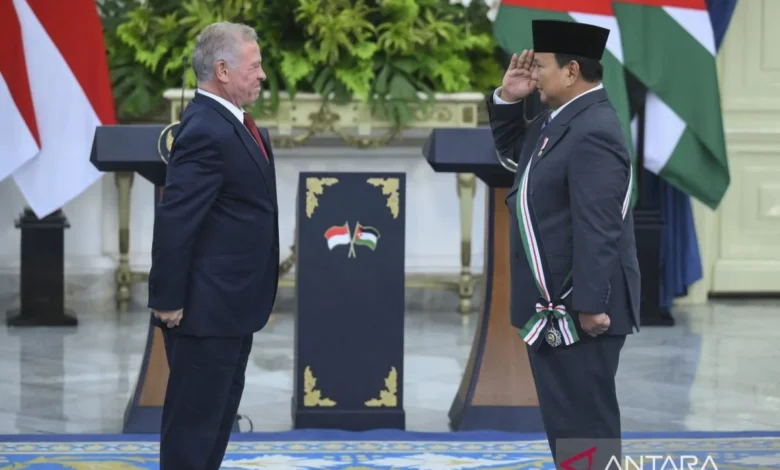
Jakarta, Indonesia – His Majesty King Abdullah II bin Al-Hussein of the Hashemite Kingdom of Jordan arrived in Indonesia on Friday afternoon for a high-profile state visit, marking a significant moment in the diplomatic relations between the two nations. The Jordanian monarch is scheduled to engage in crucial discussions with Indonesian President Prabowo Subianto, aiming to strengthen bilateral ties across various sectors, particularly economic and strategic cooperation. The visit culminates in the witnessing of a bilateral Memorandum of Understanding (MoU) signing ceremony, underscoring the commitment of both leaders to forge deeper partnerships.
The King’s itinerary in Jakarta includes a pivotal meeting with President Prabowo, followed by discussions with representatives from Danantara Indonesia, an entity signaling potential collaborative ventures. This engagement is expected to lay the groundwork for tangible economic and investment projects, with a particular focus on resource-based industries, as implied by earlier reports regarding cooperation on phosphate. The bilateral MoU, to be signed in the presence of both heads of state, is anticipated to cover a spectrum of areas, from trade and investment to defense and cultural exchanges, reflecting the multifaceted nature of their evolving relationship.
This visit to Indonesia forms part of a broader diplomatic tour by King Abdullah II across several key Asian nations, including Japan, Vietnam, Singapore, and Pakistan. This strategic tour highlights Jordan’s proactive foreign policy and its commitment to diversifying and strengthening alliances beyond traditional Western partners, seeking to enhance economic opportunities and political cooperation with dynamic Asian economies. For Indonesia, hosting King Abdullah II underscores its growing stature as a significant player in global diplomacy and an attractive destination for investment and strategic partnerships, especially with nations that share similar commitments to regional stability and interfaith harmony.
A Foundation of Personal Friendship and Shared History
A unique and compelling aspect of this state visit is the long-standing personal friendship between King Abdullah II and President Prabowo Subianto. Their bond traces back to their youth, rooted in a shared military background and experience. Both leaders are alumni of the prestigious United States Army training institution at Fort Benning, Georgia. This common foundation in military training and discipline has fostered a deep mutual respect and understanding that transcends typical diplomatic protocols, providing a robust personal bedrock for their nations’ bilateral relations.
President Prabowo had previously paid a visit to Jordan on April 14, 2025, where he held a private, face-to-face meeting with King Abdullah II at the Al Husseiniya Palace in Amman on the second day of his trip. This earlier meeting set the stage for the current reciprocal visit, indicating a deliberate and concerted effort from both sides to elevate their diplomatic engagement. Such high-level exchanges, particularly those underpinned by personal rapport, often lead to more effective and swift advancements in bilateral cooperation, as trust and understanding are already well-established.
The shared military background is not merely a biographical detail; it signifies a common appreciation for strategic thinking, discipline, and national service. For two leaders guiding their respective nations through complex geopolitical landscapes, this shared ethos can translate into more cohesive approaches to regional security, defense cooperation, and multilateral challenges. It suggests a potential for deeper collaboration on issues such as counter-terrorism, peacekeeping, and defense industry partnerships, areas where both Jordan and Indonesia have significant experience and capabilities.
King Abdullah II: A Profile in Leadership and Modernization
King Abdullah II bin Al-Hussein, born in Amman, Jordan, on January 30, 1962, is the eldest son of the late King Hussein bin Talal and Princess Muna Al Hussein. He holds the distinguished lineage as the 41st direct descendant of Prophet Muhammad (PBUH), a heritage that imbues his leadership with profound historical and religious significance within the Islamic world.
His educational journey reflects a truly international upbringing and a commitment to comprehensive development. He began his schooling at the Islamic Educational College in Amman before continuing at St. Edmund’s School in Surrey, England. He completed his secondary education at Deerfield Academy in the United States, providing him with a robust academic foundation and exposure to diverse cultural perspectives from a young age.
Further solidifying his military and academic credentials, King Abdullah II attended the Royal Military Academy Sandhurst in England in 1980, a world-renowned institution for officer training. He then pursued higher education at Pembroke College, University of Oxford, England, in 1982, broadening his intellectual horizons. Later, between 1987 and 1989, he studied at Georgetown University in the United States, where he focused on international relations, an area directly relevant to his future role as a head of state. This extensive educational background equipped him with a deep understanding of global affairs, strategic policy, and leadership principles.
His career trajectory within the Royal Jordanian Army was marked by steady advancement and significant responsibility. From 1981 to 1993, he served actively in various capacities within the armed forces, gaining invaluable hands-on experience in military operations and leadership. His expertise was further recognized when he was appointed Deputy Commander of the Jordanian Special Forces from 1993 to 1994. Demonstrating exceptional command capabilities, he subsequently served as the Commander of the Jordanian Special Forces from 1994 to 1999, a highly demanding role that prepared him for the ultimate leadership position.
In 1999, following the passing of his father, King Hussein, King Abdullah II ascended to the throne as the monarch of Jordan. His reign has been characterized by efforts to modernize Jordan’s economy, enhance social welfare, and play a constructive role in regional and international diplomacy, particularly concerning the Israeli-Palestinian conflict and promoting interfaith dialogue. He is widely recognized for his steadfast commitment to stability in a volatile region and his progressive vision for Jordan.
King Abdullah II is married to Queen Rania Al Abdullah, whom he wed on June 10, 1993. They have four children: two sons, Crown Prince Hussein and Prince Hashem, and two daughters, Princess Iman and Princess Salma. Beyond his official duties, King Abdullah II is known for his diverse hobbies, which include being a qualified pilot and a skilled parachutist. He also enjoys car racing, diving, and collecting antique weapons, showcasing a blend of adventurous spirit and historical appreciation. These personal facets provide a glimpse into the multifaceted character of a monarch who balances demanding state responsibilities with personal passions.
Deepening Economic and Strategic Cooperation
The discussions surrounding Danantara Indonesia and the focus on phosphate cooperation point towards a significant economic dimension of this visit. Jordan is one of the world’s leading producers of phosphate rock, a critical raw material for the global fertilizer industry and various industrial applications. Indonesia, with its vast agricultural sector and growing industrial needs, represents a substantial potential market and partner for Jordan in this area. Cooperation could involve direct trade, joint ventures in processing, or even investment in related infrastructure. This would be mutually beneficial: Jordan gains a reliable market and investment, while Indonesia secures a stable supply of a vital agricultural input.
Beyond phosphate, the economic agenda is likely to explore broader trade and investment opportunities. Indonesia, as a member of the G20 and Southeast Asia’s largest economy, offers a dynamic market and a hub for regional trade. Jordan, strategically located at the crossroads of the Middle East, serves as a gateway to regional markets. Potential areas for collaboration include tourism, information technology, renewable energy, and infrastructure development. Both countries could explore preferential trade agreements or investment protection treaties to facilitate increased economic exchange.
Strategically, the visit holds implications for regional stability. Both Jordan and Indonesia are moderate Muslim-majority nations committed to peace, interfaith harmony, and combating extremism. They have often found common ground in multilateral forums, advocating for peaceful resolutions to conflicts and promoting tolerance. Given the complex geopolitical landscape of the Middle East and the Indo-Pacific, enhanced security cooperation could involve intelligence sharing, joint training exercises, and coordination on counter-terrorism strategies. Such collaboration is vital for addressing shared threats and contributing to global security.
Broader Implications of the Asia Tour
King Abdullah II’s extensive tour of Asia signifies a deliberate strategic pivot for Jordan. Facing economic challenges and regional instabilities, Jordan is actively seeking to diversify its economic partnerships and secure political support from emerging global powers. Asia, with its rapid economic growth and increasing geopolitical influence, offers fertile ground for such endeavors.
Each stop on the King’s tour holds specific strategic value:
- Japan: A key economic partner and investor, known for its technological prowess and development assistance.
- Vietnam: A rapidly growing economy in Southeast Asia, offering trade and investment opportunities.
- Singapore: A financial and logistics hub, providing expertise in urban development and innovation.
- Pakistan: A large Muslim-majority nation with historical ties, important for regional security dynamics and economic cooperation.
- Indonesia: The largest Muslim-majority nation, a G20 economy, and a significant voice in global affairs, offering a broad spectrum of partnership potential from trade to strategic dialogue.
By engaging with these diverse Asian nations, Jordan aims to attract foreign direct investment, boost its exports, foster technological exchange, and garner political support for its foreign policy objectives, particularly regarding regional peace and the Palestinian cause. This "Look East" policy is a pragmatic approach to enhance Jordan’s resilience and influence on the international stage.
For Indonesia, hosting King Abdullah II during this significant tour reinforces its role as a bridge-builder between different regions and a crucial partner for nations seeking to engage with Southeast Asia and beyond. It also provides an opportunity for Indonesia to deepen its engagement with the Middle East, a region of both economic and strategic importance, ensuring a balanced and comprehensive foreign policy approach.
Conclusion: A New Chapter in Bilateral Relations
The state visit of King Abdullah II of Jordan to Indonesia marks a pivotal moment, poised to elevate the bilateral relationship to new heights. Built upon a unique foundation of personal friendship between the two leaders and bolstered by shared strategic interests, the visit is expected to yield concrete outcomes in economic cooperation, particularly in vital sectors like phosphate, and strengthen collaboration across defense, cultural, and educational spheres.
The strategic context of King Abdullah II’s broader Asia tour underscores Jordan’s proactive diplomacy and its commitment to forging diverse global partnerships. For Indonesia, hosting the Jordanian monarch reaffirms its growing international prominence and its dedication to fostering robust relationships with nations that share its vision for peace, prosperity, and stability. As the two leaders witness the signing of the bilateral MoU, it will symbolize not just agreements on paper, but a renewed commitment to a partnership that promises mutual benefit and contributes significantly to regional and global harmony. This visit is more than a diplomatic formality; it is a strategic investment in a future of deeper cooperation and shared prosperity between two important nations.