
Category Robotics And Engineering
Robotics and Engineering: Design, Development, and the Future of Automation
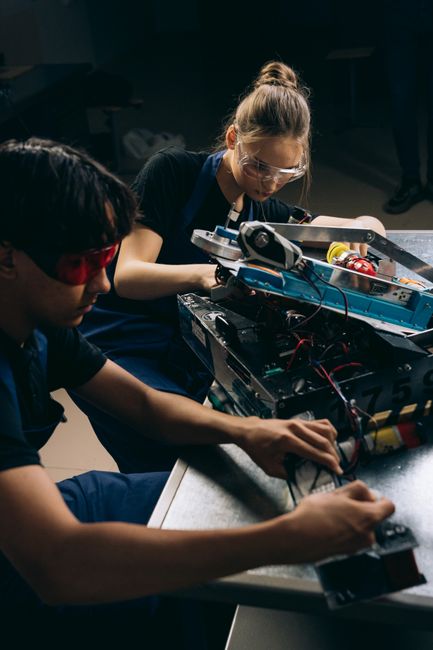
The convergence of robotics and engineering is fundamentally reshaping industries, driving innovation, and presenting unprecedented opportunities. Robotics, at its core, involves the design, construction, operation, and application of robots – automated machines capable of performing tasks with varying degrees of autonomy. Engineering provides the foundational principles and methodologies that enable the creation and advancement of these complex systems. This symbiotic relationship fuels progress in fields ranging from manufacturing and healthcare to exploration and domestic assistance. The engineering disciplines that underpin robotics are diverse and interdisciplinary, encompassing mechanical, electrical, computer, and software engineering, alongside crucial contributions from fields like artificial intelligence, material science, and control theory. Understanding this intricate interplay is essential for grasping the current state and future trajectory of robotic technology.
Mechanical engineering forms the bedrock of robotic design, focusing on the physical embodiment of robots. This includes the structural integrity, locomotion, and manipulation capabilities. Designers must consider factors such as material selection for strength, weight, and durability; the kinematics and dynamics of robotic arms and mobile bases; the design of actuators (motors and other components that produce motion) and their integration; and the mechanisms for transmitting power and force. Finite element analysis (FEA) and computational fluid dynamics (CFD) are vital tools used by mechanical engineers to simulate and optimize designs, ensuring robots can withstand operational stresses and perform movements efficiently and precisely. From the articulated joints of an industrial robot arm to the complex leg mechanisms of a humanoid robot, mechanical engineering dictates the robot’s physical form and its ability to interact with the environment. The development of lightweight yet robust materials, such as advanced composites and alloys, is a continuous area of research, directly impacting robot performance and energy efficiency. Furthermore, the miniaturization of mechanical components allows for the creation of smaller, more agile robots suitable for delicate tasks or operation in confined spaces.
Electrical engineering plays a pivotal role in powering and controlling robots. This involves the design of power systems, including batteries, power supplies, and efficient power distribution networks. It also encompasses the selection and integration of sensors, which are the robot’s "eyes" and "ears," providing data about its surroundings. These sensors can range from simple limit switches to sophisticated vision systems, LiDAR, sonar, and tactile sensors. Furthermore, electrical engineers design the control circuitry, including microcontrollers, FPGAs, and ASICs, that process sensor data and execute commands. Motor control, crucial for precise robot movement, is another key responsibility, often involving complex algorithms for managing speed, torque, and position. The development of advanced power electronics is critical for improving the efficiency and longevity of robotic systems, especially in battery-powered mobile robots. Electromagnetic compatibility (EMC) is also a significant consideration, ensuring that the electrical components of a robot do not interfere with each other or with external systems. The increasing complexity of robotic systems necessitates sophisticated electrical architectures that can handle high data rates and computational demands.
Computer engineering and software engineering are indispensable for the intelligence and functionality of robots. Computer engineers are involved in the hardware architecture, including the selection and integration of processors, memory, and communication interfaces. They ensure the computational resources are sufficient for the robot’s intended tasks, often involving parallel processing and specialized hardware accelerators. Software engineers are responsible for developing the operating systems, control software, and algorithms that dictate a robot’s behavior. This includes programming the robot’s movements, enabling it to perceive its environment, make decisions, and learn. Key software components include motion planning algorithms, sensor fusion techniques, pathfinding algorithms, and the implementation of artificial intelligence and machine learning models. Robotic operating systems (ROS) have become a de facto standard in research and development, providing a flexible framework for building complex robot applications. The development of robust and reliable software is paramount, especially for robots operating in safety-critical applications. Advances in embedded systems and real-time operating systems are crucial for ensuring that robots can respond to their environment in a timely and predictable manner.
Artificial intelligence (AI) and machine learning (ML) are transforming robotics from pre-programmed machines into adaptive and intelligent agents. AI enables robots to perceive, reason, learn, and act autonomously. Machine learning algorithms allow robots to improve their performance over time through experience, learning from data to recognize patterns, predict outcomes, and optimize their actions. This includes areas like computer vision for object recognition and scene understanding, natural language processing for human-robot interaction, reinforcement learning for developing complex behaviors, and predictive maintenance for anticipating component failures. The integration of AI and ML is crucial for enabling robots to operate in unstructured and dynamic environments, such as autonomous vehicles navigating city streets or surgical robots adapting to the patient’s anatomy. The development of explainable AI (XAI) is an ongoing area of research, aiming to make the decision-making processes of AI-powered robots more transparent and understandable.
Control theory is fundamental to the precise and stable operation of robots. It provides the mathematical framework for designing controllers that regulate robot behavior, ensuring desired performance characteristics such as accuracy, speed, and stability. This includes understanding feedback systems, where sensor readings are used to adjust actuator commands, and developing sophisticated control strategies like PID (proportional-integral-derivative) control, model predictive control (MPC), and adaptive control. For mobile robots, precise navigation and path following require advanced control algorithms to compensate for external disturbances and ensure accurate trajectory tracking. The design of robust controllers is essential for robots operating in environments with uncertainties and unpredictable dynamics. Advanced control techniques are also crucial for achieving cooperative behaviors between multiple robots, enabling them to work together to achieve a common goal.
Material science plays an increasingly vital role in the advancement of robotics. The development of novel materials with specific properties, such as high strength-to-weight ratios, self-healing capabilities, or enhanced conductivity, can significantly improve robot performance, durability, and functionality. For instance, advanced composites are used to create lighter and stronger robot frames, while shape memory alloys can be employed for actuators or reconfigurable structures. Biomimetic materials, inspired by biological systems, are also being explored for creating robots that can move and interact with their environment in more natural and efficient ways. The development of smart materials that can change their properties in response to external stimuli opens up new possibilities for sensor integration and actuator design.
The applications of robotics and engineering are vast and continuously expanding. In manufacturing, industrial robots have revolutionized assembly lines, performing repetitive, dangerous, or highly precise tasks with unparalleled efficiency and consistency. This has led to increased productivity, improved product quality, and enhanced worker safety. Collaborative robots, or "cobots," are designed to work alongside humans, augmenting human capabilities rather than replacing them. In healthcare, surgical robots enable minimally invasive procedures with greater precision, leading to faster recovery times and reduced patient trauma. Robotic exoskeletons assist individuals with mobility impairments, and robotic assistants are being developed for elder care and rehabilitation. In logistics and warehousing, autonomous mobile robots (AMRs) are transforming inventory management and order fulfillment.
Exploration is another domain where robotics is indispensable. Robots are deployed in environments too hazardous or inaccessible for humans, such as deep-sea exploration vehicles, planetary rovers on Mars, and drones for aerial surveillance and disaster assessment. These robots are equipped with sophisticated sensors and manipulators to collect data, perform scientific experiments, and gather samples. In agriculture, robots are being developed for precision farming, automating tasks like planting, harvesting, and pest detection, leading to increased yields and reduced resource consumption. Domestic robots, from vacuum cleaners to personal assistants, are becoming increasingly sophisticated, aiming to improve convenience and quality of life in homes.
The future of robotics and engineering is characterized by increasing autonomy, intelligence, and human-robot collaboration. The development of more advanced AI and ML algorithms will enable robots to perform more complex tasks and adapt to a wider range of situations. The integration of robots with the Internet of Things (IoT) will create interconnected robotic systems capable of sophisticated coordination and data sharing. Advances in human-robot interaction will lead to more intuitive and seamless communication, making robots more accessible and user-friendly. The ethical implications of widespread robot deployment, including job displacement, privacy concerns, and the potential for misuse, are critical considerations that engineers and policymakers must address proactively. The pursuit of artificial general intelligence (AGI), robots that possess human-level cognitive abilities, remains a long-term, ambitious goal within the field. The continuous drive to miniaturize robotic components and improve energy efficiency will lead to the development of smaller, more versatile robots capable of performing an even broader spectrum of tasks. Furthermore, the ongoing research into soft robotics, utilizing compliant and flexible materials, promises to unlock new forms of robotic interaction and manipulation, particularly in sensitive environments. The synergistic evolution of robotics and engineering is a testament to human ingenuity, continuously pushing the boundaries of what is possible and shaping the future of our world.
