Researchers in Switzerland Unveil Robotic Hand That Walks on Its Fingertips Reminiscent of The Addams Family Character Thing

In an intersection of pop culture nostalgia and cutting-edge mechatronics, a specialized robotics laboratory in Switzerland has successfully developed an autonomous mechanical hand capable of navigating confined and hazardous environments by walking on its fingertips. Developed by a team of engineers and researchers at ETH Zurich, one of the world’s leading science and technology universities, the unique locomotion system has immediately drawn comparisons to the fictional character "Thing" from the iconic multimedia franchise The Addams Family. While the resemblance to the disembodied, scuttling hand popularized in films, television series, and most recently the Netflix hit Wednesday provides a whimsical aesthetic, the underlying engineering represents a significant leap forward in search-and-rescue technology, industrial maintenance, and modular robotics.
The scientific breakthrough, spearheaded by a team at ETH Zurich’s robotics lab, addresses a fundamental limitation in contemporary automation: the ability of robotic appendages to operate independently outside the confines of a primary robotic arm within tightly restricted spaces. As robotics continues to infiltrate hazardous industries, disaster zones, and microscopic infrastructure, the demand for adaptable, modular tools has grown exponentially. This project highlights a novel approach to utilizing commercial hardware through advanced software integration, bypassing the need to manufacture entirely new appendages from scratch.
Background Context and the Evolution of Modular Robotics
For decades, robotic manipulation has relied heavily on centralized systems—massive robotic arms anchored to industrial assembly lines or complex humanoid platforms tethered to heavy power supplies and computational units. While these systems excel at repetitive, heavy-duty tasks, their bulkiness renders them largely useless in confined spaces such as collapsed structural frameworks, narrow piping networks, debris fields following natural disasters, or micro-machinery interiors.
To solve this spatial dilemma, roboticists have increasingly turned toward modular robotics—systems designed to break apart, reconfigure, and operate autonomously. The ETH Zurich project represents a subset of this philosophy: dettachable end-effectors. By endowing a standard robotic hand with independent locomotion, researchers envision a future where a larger autonomous vehicle or humanoid robot can deploy its hand to crawl through an opening too small for the main chassis, perform a delicate task such as turning a valve or retrieving a sample, and then return to dock with the primary unit.
The conceptual framework of using independent limbs is not entirely new in science fiction, but translating it into stable physical reality requires overcoming immense challenges in physics, load distribution, and algorithmic balance. The human-like proportions of standard commercial robotic hands—featuring fingers of unequal length, variable joint flexibility, and non-uniform weight distribution—historically made such appendages poor candidates for bipedal or multi-fingered walking mechanisms.
Chronology and Development of the Fingertip-Walking Hand
The research initiative began as an experimental exploration into maximizing the utility of pre-existing robotic hardware. Rather than designing a bespoke walking robot from the ground up, the team at ETH Zurich sought to determine if commercially available robotic hands could be programmed to walk without altering their physical morphology.
The findings of this research were formally detailed in a preprint paper published on the arXiv repository, outlining the software architecture and kinematic strategies utilized to achieve stable locomotion. According to the research documentation, the development phase spanned several months of iterative software testing, focusing heavily on reinforcement learning and kinematic coordination.
Lead author and doctoral researcher Amirhossein Kazemipour noted during initial testing phases that the physical gait of the hand inherently appeared awkward and unpolished. This visual idiosyncrasy stems directly from the anatomical constraints inherited from human-like hands. Unlike purpose-built multi-legged walking robots—such as quadrupedal mechanical dogs engineered with symmetrical limbs and perfect balance points—the ETH Zurich robotic hand had to compensate for fingers of varying lengths and rigidities.
Despite these physical asymmetries, the research team successfully programmed the hand to navigate a diverse testing course. In official laboratory demonstrations, the robotic hand was subjected to 14 distinct surface types, ranging from high-friction indoor materials like polished wood flooring and industrial metal sheeting to outdoor terrains including natural grass and loose gravel.
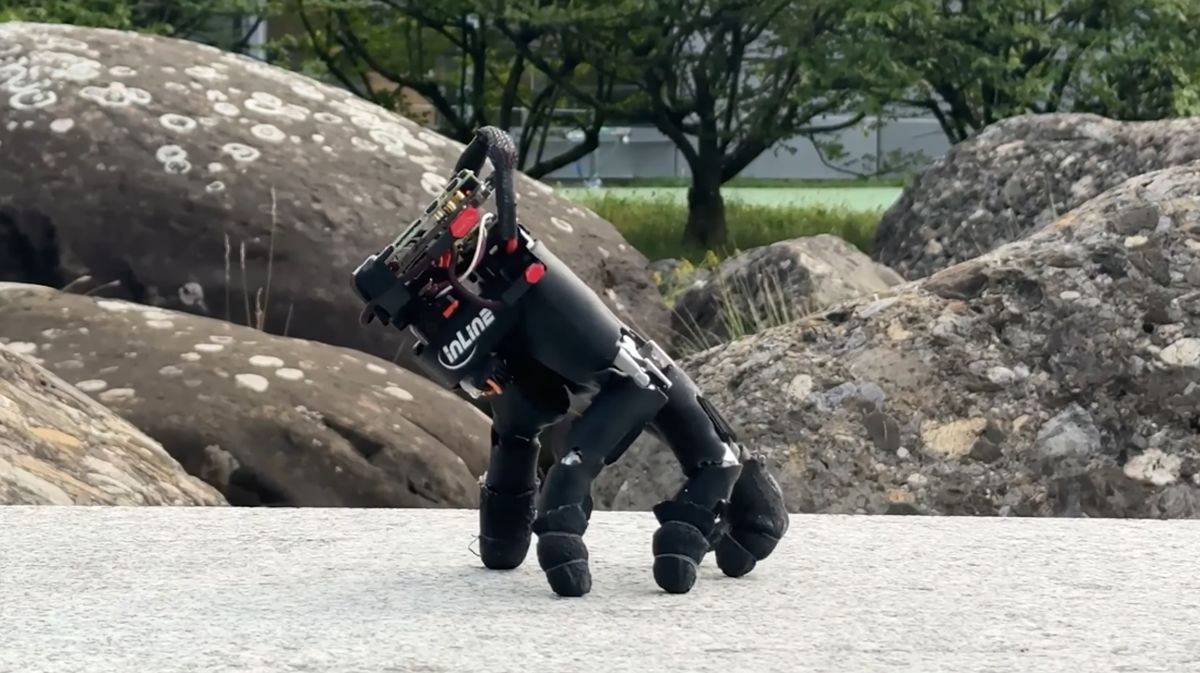
During these trials, the robot achieved an average sustained movement speed of 9.3 centimeters per second across 21 rigorous experimental runs. The control mechanism during these tests relied on a standard gaming gamepad operated by a human technician, while an onboard internal software program managed the complex kinematic calculations, finger coordination, and real-time balance adjustment without the aid of external cameras or optical navigation systems.
Technical Methodology and Engineering Challenges
The primary innovation of the ETH Zurich project lies not in the hardware, but in the software algorithms that govern the hand’s movement. Robert Katzschmann, a prominent robotics expert overseeing the laboratory, emphasized the long-term application of the technology: "In the future, robot systems can send their hands into spaces that cannot be entered by the main body, and then retrieve them once the operation is successfully completed."
Achieving this level of autonomy required solving several complex engineering hurdles. First, the software had to account for dynamic stability. When a human or an animal walks, sensory feedback from the feet and inner ear continuously adjusts posture. For the robotic hand, the internal software had to mathematically predict traction, friction coefficients, and center of gravity shifts on the fly.
Second, the hand was required to maintain structural balance while simultaneously interacting with external objects. Walking across a gravel path is vastly different from stabilizing against a resistance force, such as pushing open a stuck door or manipulating a physical switch within a confined tunnel. The algorithm successfully bridges this gap by treating each finger as an individual leg within a multi-pedal locomotion matrix, dynamically shifting weight distribution depending on the immediate surface texture and inclination angle.
Furthermore, by utilizing commercial-grade hardware rather than custom prototypes, the research team ensured that their software could potentially be retrofitted onto existing robotic deployments worldwide, significantly lowering the financial and logistical barriers to adopting modular robotic hands in industrial settings.
Broader Industry Implications and Future Outlook
The successful demonstration of a finger-walking robotic hand carries profound implications across multiple industries, including search and rescue, nuclear maintenance, aerospace engineering, and subterranean exploration.
In disaster response scenarios—such as earthquakes, structural collapses, or mining accidents—time is critical, and human rescuers are frequently put at extreme risk when entering unstable environments. Deploying compact, versatile robotic systems equipped with detachable, self-propelled tools could revolutionize how first responders assess and mitigate danger. A primary drone or tracked robot could approach a blocked disaster zone, release the mechanical hand to crawl through ventilation shafts or rubble gaps, inspect structural integrity, deliver emergency supplies, or deactivate hazardous electrical pathways.
Similarly, in sectors like nuclear energy or chemical processing, maintenance tasks are often restricted by tiny access hatches and hazardous radiation or chemical exposure levels. Robotic hands capable of independent locomotion could be sent deep into reactor cooling pipes or chemical vats to perform precise maintenance without requiring extensive teardowns of heavy industrial infrastructure.
Looking toward the horizon, the research team at ETH Zurich has already outlined ambitious milestones for the next phase of development. The primary objective is to engineer a reliable, automated docking system that allows the robotic hand to physically detach from a larger parent robot, execute remote tasks independently, and seamlessly reconnect to the main arm autonomously.
While researchers continue to refine the software to eliminate the initial awkwardness of the gait and enhance autonomous pathfinding capabilities without human gamepad intervention, the project has already captured the global scientific community’s imagination. By bridging practical engineering constraints with an eerie yet fascinating pop-culture aesthetic, the Swiss laboratory has moved the needle closer to a future where modular, adaptable robotics are seamlessly integrated into daily industrial and emergency operations.