The Thrilling Art of Sepak Takraw: A Fusion of Agility, Acrobatics, and Southeast Asian Tradition

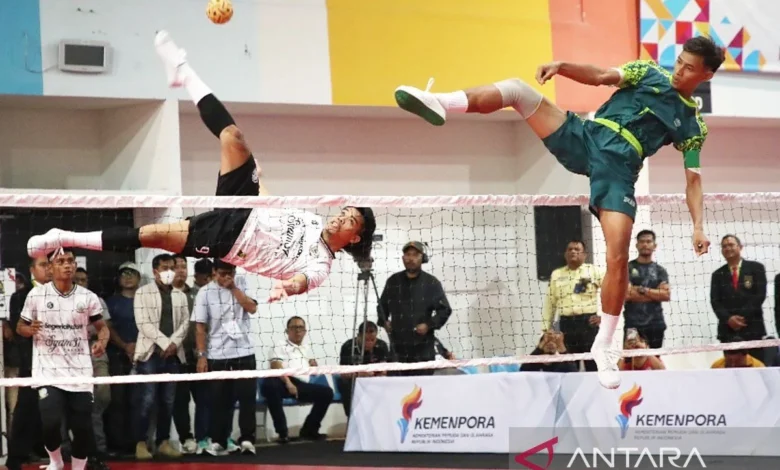
Sepak Takraw, a captivating sport that artfully blends the aerial dynamism of volleyball with the acrobatic footwork of football, all while prohibiting any hand contact, is captivating audiences across Southeast Asia and beyond. This unique martial art on a court, played with a woven rattan ball, has a rich history deeply embedded in the cultural fabric of nations like Indonesia, Thailand, Malaysia, and the Philippines, showcasing a tradition that continues to thrive and evolve.
The very name "Sepak Takraw" offers a linguistic clue to its essence. Derived from two distinct languages, "Sepak" originates from Malay and translates to "kick," while "Takraw" hails from Thai, signifying a "woven rattan ball." Thus, the sport’s name literally means "to kick the rattan ball." This fusion of language mirrors the sport’s hybrid nature, merging diverse cultural influences into a singular, exhilarating spectacle. The formal recognition of the sport under this name solidified during a match between Malaysia and Thailand in Kuala Lumpur in 1960, marking a significant milestone in its standardization.
Prior to this, in Malaysia, the game was known as "Sepak Raga Jaring." The addition of the word "Jaring" (net) is attributed to Hamid Mydin, widely regarded as a foundational figure in the sport’s development. In Penang, around 1945, Mydin introduced the net, a crucial element that distinguished it from the older, traditional "Sepak Raga" which was played without one. This evolution highlights the sport’s adaptive nature, incorporating new elements to enhance its competitive and spectator appeal.
Often described as "kick volleyball," Sepak Takraw is a team-based sport typically contested by two to four players per side on a court that bears a striking resemblance to a badminton court. The gameplay itself is a testament to athletic prowess, demanding incredible agility, precision, and coordination. Players are strictly forbidden from using their hands and must rely on their feet, knees, shoulders, chest, and head to propel the ball over the net, a rule that elevates the spectacle of its aerial maneuvers. This restriction not only enhances the difficulty but also contributes to the sport’s unique visual appeal, showcasing incredible feats of athleticism.
Internationally, the governance of Sepak Takraw falls under the purview of the International Sepaktakraw Federation (ISTAF), established in 1988. ISTAF plays a vital role in standardizing rules, organizing global competitions, and promoting the sport worldwide, ensuring its continued growth and accessibility. The organization’s efforts have been instrumental in elevating Sepak Takraw from a regional pastime to a recognized international sport.
The sport’s regional diversity is reflected in its myriad local names. In Indonesia, Brunei, Malaysia, and Singapore, it is known as "Sepak Raga." The Philippines calls it "Sipa," while Myanmar’s iteration is "Chinlone." Thailand’s contribution, as noted, is "Takraw." These variations underscore the sport’s deep roots and widespread adoption across different cultures, each imbuing it with its own unique nuances and traditions.
The Historical Tapestry of Sepak Takraw
The origins of Sepak Takraw are traced back to Malaysia, with evidence suggesting its existence as far as 500 years ago. It gained prominence among royal courts during the 15th century, a testament to its early appeal and sophistication. By the 16th century, the game had traversed geographical boundaries, making its way to Indonesia under the name "Sepak Raga." The 1940s marked a pivotal period, as formal rules began to be codified, leading to a surge in its popularity across Southeast Asia.
The inaugural official competition took place in Penang in 1945, then known as "Sepak Raga Jaring." This event was a crucial step in formalizing the game and establishing a competitive framework. The establishment of the Malaysian Sepak Raga Federation in Penang in 1960 further solidified the sport’s organizational structure. Its inclusion in the Southeast Asian Peninsula Games in 1965 was a watershed moment, not only raising its profile but also officially christening it "Sepak Takraw." This renaming represented a unified identity for the sport, transcending regional nomenclature.
Interestingly, some historical accounts suggest that Sepak Takraw’s lineage may extend even further back, with potential introductions to Southeast Asia by Chinese traders. This theory posits a shared ancestry with football, a notion supported by the sport’s striking similarities to Cuju, an ancient Chinese ball game recognized by FIFA as an early precursor to modern football. Cuju, essentially a military training exercise, involved soldiers kicking a leather ball, with the objective of keeping it airborne for as long as possible. This historical connection, if accurate, would place Sepak Takraw within a much grander global history of ball games, linking it to the very roots of sports played with the feet.
Navigating the Rules: The Mechanics of Sepak Takraw
The strategic positioning of players within a Sepak Takraw team is crucial for success. While the original text omits specific details on player positions and their regulations, a typical team comprises three players on the court: a "Tekong" (server), a "Feeder," and a "Killer." The Tekong is primarily responsible for initiating the rally with a serve. The Feeder plays a supporting role, setting up opportunities for the Killer, who is the primary offensive player, aiming to score points with powerful, acrobatic spikes. The defensive players work to receive the opponent’s attacks and transition to offense.
The flow of a Sepak Takraw match is governed by a clear set of rules designed to foster dynamic play. The game commences with a coin toss to determine which team serves first. The Tekong then launches the ball from their hands before striking it with their foot over the net into the opposing court. This initial serve is critical, setting the tone for the rally.
Following the serve, both teams engage in a rapid exchange of passes, utilizing their feet, knees, chest, head, and shoulders to keep the ball in play and strategize their attacks. The objective is to ground the ball on the opponent’s side of the court, a feat that earns a point. The interplay between the Feeder and the Killer is paramount; the Feeder’s precise passes create scoring chances for the Killer’s decisive shots. Meanwhile, the Tekong’s focus remains on delivering accurate and potent serves.
The scoring system in Sepak Takraw is designed for competitive intensity. A team earns a point each time the ball is legally grounded within the opponent’s court. A set is won by the first team to reach 21 points. To secure victory in a match, a team must win two out of three sets, a format that ensures a comprehensive and demanding contest.
The Evolving Landscape: Recent Developments and Future Prospects
Recent reports highlight significant progress in resolving dualistic governance issues within Indonesian Sepak Takraw. The successful resolution of these internal conflicts, facilitated by bodies like the Indonesian National Sports Committee (KONI) and the Indonesian Olympic Committee (KOI), has been met with considerable optimism. This internal reconciliation is a crucial step towards a more unified and robust development of the sport within the nation, paving the way for stronger national teams and more effective participation in international events. The International Sepaktakraw Federation (ISTAF) has publicly welcomed these developments, recognizing the positive impact on the sport’s global trajectory. Such endorsements underscore the importance of strong national federations in fostering international sporting cooperation and growth.
The implications of these advancements extend beyond mere administrative resolutions. A unified national federation can better allocate resources for training, infrastructure development, and talent scouting. This, in turn, can lead to improved performance on the international stage, potentially challenging established powerhouses and broadening the competitive landscape. The long-term vision for Sepak Takraw includes not only strengthening its presence in traditional strongholds but also expanding its reach to new regions, attracting a wider audience and a new generation of athletes. The sport’s inherent athleticism and visual appeal make it a prime candidate for global popularization, especially with increased media coverage and strategic promotional efforts.
The journey of Sepak Takraw from its ancient origins to its modern, codified form is a compelling narrative of cultural exchange, athletic evolution, and enduring tradition. As the sport continues to gain traction globally, it stands as a vibrant testament to the rich sporting heritage of Southeast Asia, promising even more exhilarating performances and wider recognition in the years to come. The fusion of martial arts grace, volleyball strategy, and football’s raw power ensures that Sepak Takraw will remain a captivating spectacle for sports enthusiasts worldwide.
Related posts: