King Abdullah II of Jordan Embarks on Crucial State Visit to Indonesia, Reinforcing Strategic Bilateral Ties and Economic Cooperation.

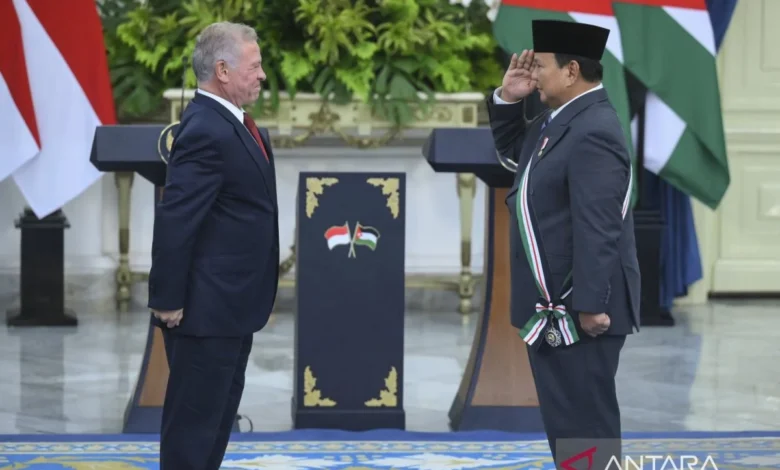
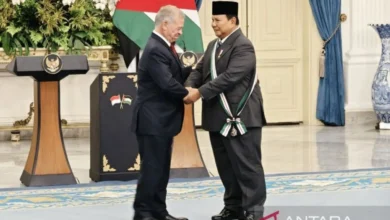
King Abdullah II bin Al-Hussein of the Hashemite Kingdom of Jordan arrived in Jakarta on Friday afternoon for a pivotal state visit to Indonesia, signaling a deepening of diplomatic and economic relations between the two nations. The Jordanian monarch’s itinerary included high-level discussions with Indonesian President Prabowo Subianto and key representatives from Danantara Indonesia, culminating in the ceremonial signing of significant bilateral memoranda of understanding (MoUs). This visit underscores the growing strategic importance of Indonesia within Jordan’s foreign policy and represents a crucial step in bolstering south-south cooperation.
The state visit to Indonesia is an integral part of a broader diplomatic tour across Asia for King Abdullah II, which has already seen him engage with leaders in Japan, Vietnam, Singapore, and Pakistan. This extensive itinerary highlights Jordan’s commitment to strengthening its presence and partnerships within the dynamic Asian continent, seeking to foster economic collaboration, political alignment, and cultural exchange. The King’s presence in Jakarta follows closely on the heels of President Prabowo Subianto’s own visit to Jordan on April 14, 2025, during which he held a private meeting with King Abdullah II at the Al Husseiniya Palace in Amman. That precursor meeting laid the groundwork for the current state visit, demonstrating a proactive approach by both leaders to cultivate a robust and multifaceted bilateral relationship.
A Foundation of Personal Friendship and Shared History
At the heart of the strong diplomatic ties between Jordan and Indonesia lies a remarkable and enduring personal friendship between King Abdullah II and President Prabowo Subianto. Their bond traces back to their younger years, forged by a shared background in military service and a common experience as alumni of the esteemed United States Army training institution at Fort Benning. This unique personal rapport, developed over decades, provides a solid and informal bedrock for official state interactions, often facilitating more candid and productive discussions on matters of mutual interest. The shared understanding derived from their military training and leadership experiences contributes to a mutual respect and trust that transcends typical diplomatic protocols.
Their early careers in the military, particularly their training at Fort Benning, instilled in both leaders a disciplined approach to problem-solving, a strategic mindset, and a deep appreciation for international cooperation. For King Abdullah II, his extensive military career in the Royal Jordanian Army, from an early officer to the commander of elite special forces, provided him with invaluable insights into national security and regional dynamics. Similarly, President Prabowo’s distinguished service in the Indonesian armed forces equipped him with a profound understanding of defense, geopolitics, and nation-building. This shared professional ethos not only strengthens their personal connection but also enhances their ability to collaborate effectively on complex regional and global challenges, from security cooperation to economic development.
Key Agendas and Expected Outcomes of the Visit
The discussions between King Abdullah II and President Prabowo are anticipated to cover a wide spectrum of issues, with a strong emphasis on economic cooperation, particularly in strategic sectors, and geopolitical collaboration. The meeting with representatives from Danantara Indonesia specifically signals a focused effort on strengthening trade and investment ties, particularly concerning natural resources.
I. Economic Cooperation: Phosphate and Beyond
A central theme of the economic discussions during the visit revolves around cooperation in the phosphate industry. Jordan is one of the world’s leading producers of high-quality phosphates, a critical raw material for the global fertilizer industry. Indonesia, with its vast agricultural sector and growing demand for food security, represents a significant market for phosphate imports to support its domestic fertilizer production. The discussions with Danantara Indonesia are expected to explore concrete mechanisms for enhancing the supply chain of Jordanian phosphates to Indonesia, potentially through long-term agreements, joint ventures, or technology transfer initiatives.
Beyond phosphates, the two leaders are expected to identify other areas for mutual economic benefit. These could include:
- Trade Expansion: Exploring opportunities to increase bilateral trade volumes, which, while steady, have significant room for growth. This could involve expanding the range of goods exchanged, from Jordanian chemicals, pharmaceuticals, and agricultural products to Indonesian palm oil, textiles, electronics, and manufactured goods.
- Investment Opportunities: Encouraging reciprocal investments in sectors such as tourism, renewable energy (where both countries have substantial potential), infrastructure development, and the digital economy. Jordan’s strategic location and Indonesia’s burgeoning market present attractive propositions for investors from both sides.
- Halal Economy: Given both nations’ Muslim-majority populations, there is immense potential for collaboration in the global halal industry, encompassing food, finance, tourism, and lifestyle products. Joint certification, market access, and product development could be explored.
- Maritime Cooperation: As maritime nations, albeit with different geographical contexts, there could be discussions on port management, logistics, and marine resource management, leveraging Indonesia’s expertise as an archipelagic state.
The enhancement of economic ties is not merely about increasing trade figures; it is also about fostering sustainable development, creating jobs, and enhancing food and energy security for both nations. By diversifying their economic partnerships, both Indonesia and Jordan aim to build greater resilience against global economic fluctuations.
II. Geopolitical and Regional Stability
Beyond economic imperatives, the state visit provides a crucial platform for King Abdullah II and President Prabowo to discuss pressing regional and global issues. Both leaders share a commitment to promoting peace, stability, and moderation.
- Middle East Peace Process: Given Jordan’s pivotal role in the Middle East and its custodianship over Islamic and Christian holy sites in Jerusalem, discussions on the ongoing situation in Palestine and the broader Middle East peace process are highly probable. Indonesia, as a staunch supporter of Palestinian independence, would find common ground with Jordan in advocating for a just and lasting solution based on international law.
- Counter-Terrorism and Extremism: Both Indonesia and Jordan have faced the challenges of extremism and radicalization. They are expected to reaffirm their commitment to combating terrorism in all its forms, sharing intelligence, best practices in de-radicalization programs, and promoting narratives of tolerance and coexistence. Jordan’s ‘Amman Message’ and Indonesia’s Pancasila ideology offer strong foundations for such cooperation.
- Interfaith Dialogue: As nations with diverse religious communities, Indonesia and Jordan can collaborate on initiatives promoting interfaith dialogue and understanding, aiming to counter religious intolerance and foster harmony globally.
- Multilateralism: Both countries are active participants in various international forums, including the United Nations, the Organization of Islamic Cooperation (OIC), and the Non-Aligned Movement. The leaders may explore avenues for coordinating their positions on global challenges such as climate change, sustainable development, and global health.
King Abdullah II’s Broader Asian Engagement
King Abdullah II’s extensive tour of Asia, encompassing Japan, Vietnam, Singapore, Pakistan, and now Indonesia, reflects a strategic reorientation of Jordan’s foreign policy. Historically focused on the Middle East and its traditional Western allies, Jordan is increasingly recognizing the economic dynamism and geopolitical influence of Asian powers.
- Diversification of Partnerships: The tour aims to diversify Jordan’s economic and political partnerships, reducing reliance on a limited set of allies and markets. Asian economies offer vast opportunities for trade, investment, and technological cooperation.
- Economic Growth Drivers: Asian nations, particularly Indonesia, represent rapidly growing markets and sources of capital. By engaging with these economies, Jordan seeks to attract foreign direct investment, boost exports, and create job opportunities for its young population.
- Geopolitical Balancing: Strengthening ties with diverse global players allows Jordan to enhance its diplomatic leverage and navigate complex regional dynamics more effectively. It positions Jordan as a bridge between the Middle East and Asia, fostering greater south-south cooperation.
- Learning and Exchange: The visits also provide opportunities for Jordan to learn from the development experiences of successful Asian economies, particularly in areas like infrastructure, technology, and human resource development.
Profile of His Majesty King Abdullah II bin Al-Hussein
King Abdullah II bin Al-Hussein, born in Amman, Jordan, on January 30, 1962, is the current monarch of the Hashemite Kingdom. He is the eldest son of the late King Hussein bin Talal and Princess Muna Al Hussein, and notably, traces his lineage as the 41st direct descendant of Prophet Muhammad (PBUH). His ascension to the throne in 1999 marked a new chapter for Jordan, building upon a legacy of stability and modernization.
Early Life and Education:
King Abdullah II’s formative years were characterized by a robust and internationally diverse education. He began his schooling at the Islamic Educational College in Amman, providing him with a strong grounding in his cultural and religious heritage. He then pursued secondary education abroad, first at St. Edmund’s School in Surrey, England, and subsequently completing his high school studies at Deerfield Academy in the United States. This exposure to different educational systems and cultures from an early age broadened his perspective and prepared him for a role on the global stage.
His higher education continued to reflect this international outlook and a strong inclination towards military service and strategic studies. He attended the prestigious Royal Military Academy Sandhurst in the United Kingdom in 1980, a path common for future monarchs and military leaders. Following Sandhurst, he furthered his academic pursuits at Pembroke College, University of Oxford, England, in 1982, delving into Middle Eastern affairs. Later, from 1987 to 1989, he attended Georgetown University in the United States, focusing on international relations, which equipped him with a profound understanding of global politics and diplomacy. This comprehensive educational journey, blending military rigor with academic depth, shaped his leadership style and his approach to both domestic and international affairs.
Distinguished Military Career:
Before his reign, King Abdullah II had a distinguished career in the Royal Jordanian Army, demonstrating his commitment to national service and security. He served actively in the army from 1981 to 1993, steadily rising through the ranks. His expertise and leadership qualities led him to specialized units, serving as Deputy Commander of the Jordanian Special Forces from 1993 to 1994. Recognizing his exceptional capabilities, he was entrusted with the command of the elite Jordanian Special Forces from 1994 until 1999. This hands-on military experience provided him with practical leadership skills, an understanding of complex operational environments, and a deep connection with the Jordanian armed forces.
Accession to the Throne and Reign:
In 1999, following the passing of his father, King Hussein, King Abdullah II ascended to the Hashemite throne. His reign has been characterized by a continuous effort to modernize Jordan’s economy, enhance its democratic institutions, and maintain its crucial role as a beacon of stability and moderation in a volatile region. He has championed initiatives for economic reform, technological advancement, and social development, striving to improve the living standards of Jordanians and empower its youth.
Family Life:
King Abdullah II is married to Her Majesty Queen Rania Al Abdullah. They were married on June 10, 1993, and their union has been blessed with four children: two sons, Crown Prince Hussein and Prince Hashem, and two daughters, Princess Iman and Princess Salma. Queen Rania is renowned globally for her advocacy work in education, health, and youth empowerment, often accompanying the King on state visits and playing a prominent role in national development.
Personal Interests and Hobbies:
Beyond his royal duties, King Abdullah II is known for his diverse and adventurous personal interests. He is a qualified pilot and an accomplished paratrooper, reflecting his continued connection to aviation and military disciplines. His hobbies also include car racing, an interest that speaks to his passion for speed and precision, as well as diving, showcasing an appreciation for exploration and the natural world. Furthermore, he maintains a keen interest in collecting antique weapons, a hobby that connects to his military background and an appreciation for history and craftsmanship. These personal pursuits offer a glimpse into the dynamic and multifaceted personality of the monarch.
Broader Impact and Future Implications
The state visit of King Abdullah II to Indonesia carries significant implications for the future trajectory of relations between the two countries and potentially for broader south-south cooperation.
- Enhanced Strategic Partnership: The visit solidifies the perception of Indonesia and Jordan as key strategic partners, capable of collaborating not only on economic fronts but also on diplomatic and security issues. This partnership can serve as a model for cooperation between nations in the Middle East and Southeast Asia.
- Economic Diversification and Growth: The agreements signed and the discussions held are expected to stimulate trade, attract investment, and foster joint ventures, contributing to economic diversification and growth in both nations. This is particularly crucial for Jordan, which is constantly seeking to expand its economic horizons beyond its immediate region.
- Strengthening Regional Stability: By aligning on critical geopolitical issues, Indonesia and Jordan can amplify their voices on the international stage, advocating for peace, moderation, and multilateralism. Their collaboration in counter-terrorism and interfaith dialogue is vital in addressing global challenges.
- Cultural and People-to-People Ties: Beyond official engagements, such high-level visits often pave the way for increased cultural exchanges, tourism, and educational collaborations, strengthening the bonds between the peoples of Indonesia and Jordan.
In conclusion, King Abdullah II’s state visit to Indonesia is more than a ceremonial exchange; it is a strategic maneuver to deepen a multifaceted relationship rooted in personal friendship, shared values, and mutual interests. The outcomes of this visit are poised to significantly enhance economic cooperation, strengthen diplomatic synergy, and contribute to regional and global stability, marking a new chapter in the enduring partnership between the Hashemite Kingdom of Jordan and the Republic of Indonesia.