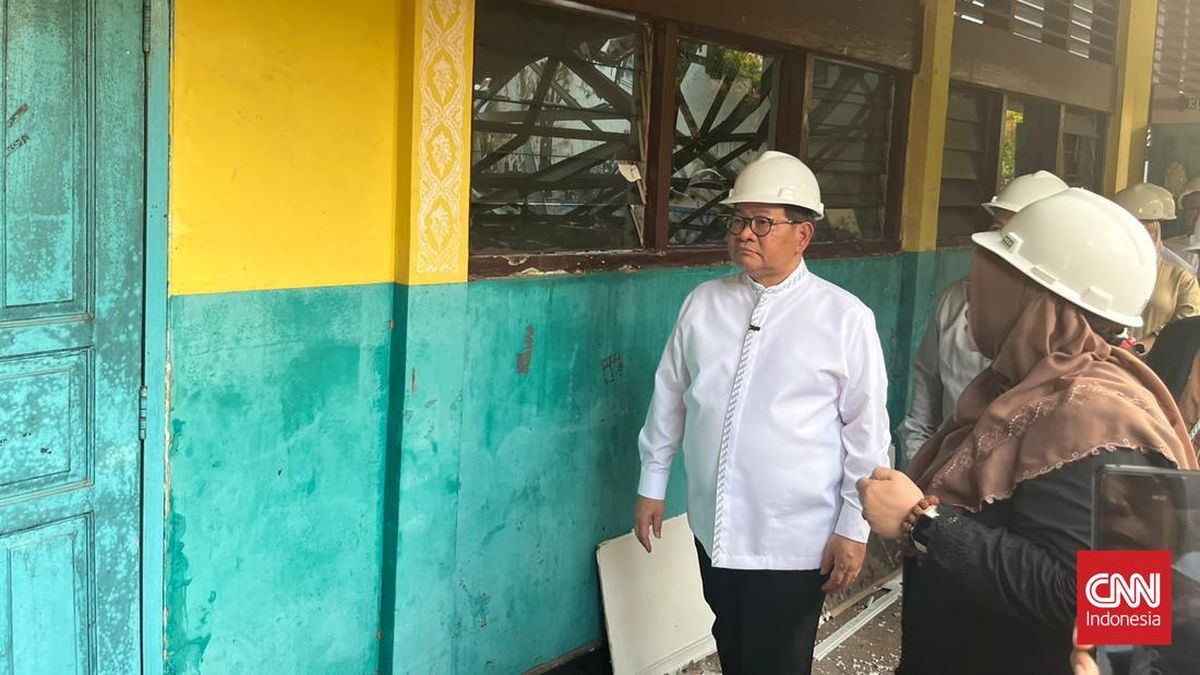
Jakarta, Indonesia – Governor Pramono Anung of DKI Jakarta has officially announced the commencement of the long-awaited reconstruction of State Elementary School (SDN) Kebayoran Lama Selatan 09, a crucial step to address the severe learning environment faced by its students. The school, located in South Jakarta, has remained in a collapsed state for the past two years, forcing students to attend classes in temporary, often inadequate, facilities. The provincial government has allocated a substantial Rp48.1 billion (approximately USD 3.1 million, based on current exchange rates) for this critical project, marking a significant commitment to improving educational infrastructure in the capital.
The announcement came following a direct inspection by Governor Anung of the dilapidated school site on Friday, July 24th, underscoring the urgency and personal attention given to the matter. His visit highlighted the deeply concerning conditions that have persisted since the school’s structural failure, which occurred approximately two years prior to this declaration. The governor’s decision to fast-track this project, along with three other educational facilities, reflects a re-prioritization of public infrastructure development in the face of various budgetary challenges.
A Chronology of Collapse and Delay
The saga of SDN Kebayoran Lama Selatan 09 began two years ago when the school building suffered a significant structural collapse. While the exact cause was not detailed in the initial reports, such incidents in Indonesia are often attributed to aging infrastructure, inadequate maintenance, poor construction quality, or occasionally, natural factors like heavy rainfall or seismic activity in vulnerable areas. The immediate aftermath saw the school declared unsafe, leading to its closure and the displacement of hundreds of students.
For two academic years, the students of SDN Kebayoran Lama Selatan 09 have been forced to adapt to alternative learning arrangements. This typically involves temporary classrooms, often rented spaces, or even sharing facilities with other schools, leading to overcrowded conditions, reduced learning hours, and a compromised educational experience. The psychological impact on students, teachers, and parents during this prolonged period of uncertainty and substandard facilities cannot be overstated. Parents have repeatedly voiced their frustrations and concerns over their children’s safety and the quality of education they were receiving. Teachers, too, have faced immense challenges in maintaining educational standards and morale in less-than-ideal environments.
Initially, the DKI Jakarta Provincial Government had ambitious plans to construct or rehabilitate 22 schools by 2026. However, these plans faced significant setbacks due to a confluence of factors, including a reduction in the Dana Bagi Hasil (DBH) – a revenue-sharing fund from the central government – broader budgetary efficiencies, and other unforeseen economic pressures. These constraints led to a scaling back of the initial plan, with only seven schools initially earmarked for funding. The plight of SDN Kebayoran Lama Selatan 09, however, proved compelling enough to warrant a re-evaluation of priorities.
Governor Anung’s Intervention and Project Prioritization
During his inspection, Governor Anung personally witnessed the "very concerning" state of the collapsed school. This direct observation served as a catalyst for his decisive action. He convened a meeting where he mandated the immediate prioritization of four critical school reconstruction projects, including SDN Kebayoran Lama Selatan 09. "I decided in the meeting yesterday that four schools must be built immediately. This location is one of them. Why must it be built now? Because its condition is truly very concerning," Governor Anung stated, emphasizing the urgent need.
The three other schools receiving immediate priority for reconstruction are:
- SMA Negeri 102 Jakarta: Allocated Rp67.5 billion.
- SDN Cempaka Putih Barat 03: Allocated Rp48.4 billion.
- SDN Papanggo 01 and TK Negeri Papanggo 01 (combined project): Allocated Rp74.1 billion.
The combined budget for these four critical projects amounts to approximately Rp249 billion (around USD 16.1 million), signaling a significant provincial investment in educational infrastructure. This strategic allocation reflects a shift in focus towards addressing the most dilapidated and structurally compromised schools first, ensuring student safety and restoring conducive learning environments.
Funding Mechanisms and Budgetary Context
The funding for these ambitious projects is a blend of resources: the Koefisien Lantai Bangunan (KLB) and the Anggaran Pendapatan dan Belanja Daerah Perubahan (APBD-P) or Revised Regional Budget.
The KLB (Building Floor Coefficient) is a regulatory tool used in urban planning that dictates the maximum allowable floor area of a building relative to the land area. In Jakarta, the provincial government has, in recent years, utilized a mechanism where developers seeking to exceed the standard KLB for their projects contribute a "public contribution" or "compensation" in the form of funds or direct infrastructure development. These funds are often earmarked for public services, including social infrastructure like schools and hospitals. This innovative funding stream allows the provincial government to undertake large-scale projects without solely relying on conventional budgetary allocations, which are often stretched thin. The use of KLB funds for school reconstruction demonstrates a creative approach to financing public goods, leveraging urban development for social benefit.
The APBD-P (Revised Regional Budget), on the other hand, represents modifications made to the original annual provincial budget. These revisions typically occur mid-year to account for unforeseen expenses, changes in revenue projections, or to reallocate funds to more pressing priorities that emerged after the initial budget approval. The inclusion of these school projects in the APBD-P signifies that their urgency superseded other planned expenditures, or that new revenue streams became available, allowing for their immediate commencement. This mechanism provides the flexibility necessary for governments to respond to evolving needs and crises.
The initial reduction in planned school projects from 22 to 7 was largely due to cuts in the Dana Bagi Hasil (DBH). DBH is a system where a portion of central government revenues (such as taxes on oil, gas, land and building, and natural resources) is shared with regional governments. These funds are crucial for regional development and public service provision. A reduction in DBH can significantly impact a regional government’s financial capacity, forcing them to scale back on non-essential or less urgent projects. Governor Anung’s decision to add four more schools, despite these constraints, highlights the critical nature of these particular projects and the administration’s determination to overcome financial hurdles for education.
Ensuring Quality and Timely Completion
Governor Anung has set an ambitious target for the reconstruction of SDN Kebayoran Lama Selatan 09: a completion period of 10 months. He explicitly stated that construction must commence no later than September of the current year. This tight deadline reflects the pressing need to get students back into proper learning environments.
Crucially, the Governor also emphasized the importance of rigorous oversight and quality control. "Tomorrow, a meeting will be held again, and a technical team will be appointed, along with those who will supervise, and so on. Because I do not want this difficult-to-secure development to then, for example, not be carried out seriously," he remarked. This statement underscores a broader concern about potential inefficiencies, corruption, or substandard work that can sometimes plague large infrastructure projects. By stressing the appointment of a dedicated technical team and supervisors, the provincial government aims to ensure transparency, accountability, and the delivery of high-quality, safe, and durable school buildings. This proactive approach is vital to prevent future collapses or structural issues, guaranteeing the safety of students and educators for decades to come.
Broader Impact and Implications for Education in Jakarta
The reconstruction of SDN Kebayoran Lama Selatan 09 and the other three prioritized schools carries significant implications beyond just providing new buildings.
1. Educational Equity and Access: Jakarta, despite being the nation’s capital, still grapples with disparities in educational infrastructure. The collapse of a school in Kebayoran Lama Selatan, a densely populated area, highlights the vulnerability of older school buildings. By prioritizing these reconstructions, the government is actively working to ensure that all children, regardless of their socioeconomic background or location, have access to safe and conducive learning environments. This is fundamental to achieving educational equity.
2. Student Welfare and Learning Outcomes: A safe, comfortable, and well-equipped school environment is directly linked to better student attendance, engagement, and academic performance. The prolonged period in temporary facilities likely impacted the students’ ability to focus and learn effectively. The new buildings, designed with modern standards, are expected to foster a more positive learning atmosphere, potentially leading to improved educational outcomes.
3. Teacher Morale and Professionalism: Teachers, too, are significantly affected by their working environment. A dilapidated or temporary school can demotivate educators and hinder their ability to deliver quality instruction. A new, well-designed school can boost teacher morale, attract and retain talented educators, and provide them with the resources they need to excel.
4. Community Development and Trust: Schools often serve as community hubs. A collapsed school can be a source of frustration and a symbol of neglect for local residents. The successful reconstruction can rebuild community trust in government initiatives and foster a sense of pride and ownership in the new facility. It also signals the government’s responsiveness to citizen needs.
5. Sustainable Infrastructure Planning: The challenges faced in funding the initial 22-school plan underscore the need for more robust and sustainable infrastructure planning. This includes not only building new schools but also implementing comprehensive maintenance programs for existing ones to prevent future collapses. The use of KLB funds for social infrastructure sets a precedent for how urban development can contribute directly to public welfare.
6. Governance and Accountability: Governor Anung’s direct intervention and emphasis on oversight also serve as a crucial lesson in governance. It demonstrates that political will and direct leadership can cut through bureaucratic inertia and address critical public needs. The appointment of technical teams and supervisors is a step towards greater accountability in public project execution.
Voices from the Community and Education Sector
While specific quotes from parents, teachers, or education officials were not provided in the original text, it is logical to infer their reactions based on similar situations.
A representative from the DKI Jakarta Education Agency, speaking on condition of anonymity, might have stated: "The reconstruction of SDN Kebayoran Lama Selatan 09 is a testament to the Governor’s commitment to education. We understand the challenges faced by the students and teachers over the past two years, and we are now fully dedicated to ensuring this project is completed on time and to the highest standards. This is a crucial step in our broader mission to revitalize Jakarta’s educational infrastructure."
A parent from the Kebayoran Lama Selatan area, Mrs. Siti Aisyah, whose child attends the school, could express: "We are incredibly relieved. For two years, our children have been learning in crowded, makeshift classrooms. We worried about their safety and their future. This announcement brings so much hope. We just pray the construction truly starts in September and finishes quickly."
A local community leader, Mr. Budi Santoso, might add: "This school is the heart of our community. Its collapse was a huge blow. We have tirelessly advocated for its reconstruction. Governor Anung’s personal visit and swift decision show true leadership. We will be watching closely to ensure the project benefits our children and community fully."
Moving Forward: A Model for Future Development?
The reconstruction of SDN Kebayoran Lama Selatan 09, along with the other three prioritized schools, represents a critical moment for educational infrastructure in Jakarta. It highlights the persistent challenges faced by large urban centers in maintaining and upgrading public facilities, especially in the context of fluctuating national budgets and competing development priorities.
The provincial government’s decision to leverage both traditional budgetary allocations (APBD-P) and innovative financing mechanisms (KLB) could serve as a model for addressing similar infrastructure deficits across the archipelago. Furthermore, the strong emphasis on oversight and quality control during construction is essential to ensure that the new facilities are not only built quickly but also built to last, providing a safe and inspiring learning environment for generations of students to come. As September approaches, the eyes of the community, educators, and policy watchers will be on Kebayoran Lama Selatan, awaiting the first signs of construction that promise a brighter future for its young learners.