Indonesia Sets Sights on Glory: Target Four Gold Medals in Badminton, Sport Climbing, and Weightlifting at the 2026 Asian Games Aichi-Nagoya

As the global sporting community sets its sights on the horizon, the Indonesian contingent is meticulously laying the groundwork for its campaign at the upcoming 2026 Asian Games, officially known as the 20th Asian Games, which will be co-hosted by Aichi Prefecture and the city of Nagoya in Japan. With the quadrennial multi-sport extravaganza drawing closer, sports authorities, national federations, and elite athletes have intensified their preparations. Indonesia has officially identified its primary medal-winning powerhouses, pinning its highest ambitions on three traditional stronghold disciplines: badminton, sport climbing, and weightlifting. Collectively, these disciplines have been entrusted with a strict target of securing a minimum of four gold medals for the Red and White contingent, maintaining the nation’s proud tradition of competing at the highest tiers of continental athletics.
The strategic blueprint laid out by the Indonesian National Sports Committee (KONI) in coordination with respective sports associations reflects a calculated approach to the games. Rather than spreading resources thin across all competing events, Indonesia is channeling its focus and financial backing into disciplines with proven track records of international success. This disciplined targeting ensures that high-performance athletes receive optimal training, sports science support, and international exposure leading up to the competition in Japan.
Badminton: The Quest for Men’s Team Redemption
Badminton remains the crown jewel of Indonesia’s multi-sport aspirations, holding immense cultural significance and a rich history of international dominance. For the 2026 Asian Games, the Badminton Association of Indonesia (PBSI) has placed its highest priority on the men’s team event, designating it as a primary gold medal sanctuary.
The badminton tournament is scheduled to take place at the modern Ichinoya Municipal Gymnasium. The high-stakes action will kick off with the highly anticipated team events running from September 20 to September 24, 2026. Following the conclusion of the fiercely contested team battles, the focus will seamlessly shift to the individual categories, which are slated to run from September 25 through September 29, 2026.
The decision to heavily target the men’s team gold stems from both strategic analysis and historical pride. Indonesian men’s badminton has long been a formidable force globally, boasting legendary depth in both singles and doubles categories. PBSI high-performance directors have emphasized that winning the team gold requires not only individual brilliance but also unbreakable tactical unity, mental resilience, and superior physical conditioning. The pressure will be immense as powerhouse nations such as China, Japan, South Korea, and traditional SEA Games rivals field equally competitive squads. Nevertheless, the Indonesian camp remains resolute, viewing the Aichi-Nagoya arena as the ideal stage to reclaim undisputed continental supremacy in the team division.
Sport Climbing: Speed as Indonesia’s Modern Gold Mine
If badminton represents Indonesia’s historical legacy, sport climbing has rapidly emerged as its modern-day gold mine. Over the past several years, Indonesian speed climbers have utterly redefined the global landscape of the discipline, consistently dominating International Federation of Sport Climbing (IFSC) World Cups and setting blistering world records that leave international competitors trailing in their wake.
For the 2026 Asian Games, sport climbing has been assigned a lofty target of two gold medals, with absolute focus directed toward the men’s and women’s speed categories. Indonesia’s hopes rest squarely on the shoulders of world-class phenoms Veddriq Leonardo in the men’s division and Desak Made Rita Kusuma Dewi in the women’s division. Both athletes have proven themselves on the grandest stages, combining explosive power, flawless biomechanics, and nerves of steel on the vertical wall.
Veddriq Leonardo, whose name is synonymous with sheer velocity in vertical sprinting, has openly stated his absolute determination to capture the individual Asian Games gold medal in the men’s speed event. His preparations involve rigorous simulation training, continuous refinement of grip techniques, and meticulous attention to recovery science. Similarly, Desak Made Rita Kusuma Dewi has established herself as a titan in the women’s speed circuit, combining technical precision with relentless consistency under pressure.
The sport climbing schedule is compact and intensely demanding, set to unfold from September 29 to October 1, 2026. The women’s speed competition will open with the qualification rounds on September 29, culminating in the dramatic gold-medal finals on September 30. Directly following this, the men’s speed category will take center stage, holding its qualifications on September 30 before concluding with the high-octane medal showdowns on October 1. Sports analysts note that while the margin for error in speed climbing is measured in mere milliseconds, Indonesia’s proven psychological fortitude in these events gives them a distinct mental edge over their continental rivals.
Weightlifting: Rahmat Erwin Abdullah Leads the Heavy Metal Charge
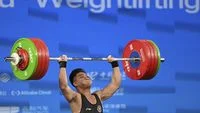
Completing the triumvirate of Indonesia’s gold-mining sports is weightlifting, a discipline that has historically delivered reliable podium finishes for the nation at both Olympic and Asian Games levels. For the 2026 campaign, the Indonesian weightlifting contingent has been tasked with securing at least one prestigious gold medal, with the spotlight shining brightly on reigning champion Rahmat Erwin Abdullah.
Rahmat will compete in the men’s 75-kilogram category, a weight class where he enters as the undisputed athlete to beat. His status as the defending champion is well-earned; Rahmat previously delivered a breathtaking performance to claim gold in the 73-kilogram division at the 2022 Hangzhou Asian Games, an achievement that cemented his legacy as one of the finest pound-for-pound lifters in the world. His transition to the 75-kg category has been managed with scientific precision by his coaching staff, ensuring that his incredible strength-to-weight ratio remains uncompromised while enhancing his overall lifting power.
The weightlifting events are scheduled to run from September 23 to September 29, 2026, hosted at the prestigious Nagoya City Trade and Industry Center. Beyond Rahmat’s gold-medal campaign, Indonesia is sending a deeply experienced and formidable squad to Nagoya, signaling the nation’s broader ambitions across multiple weight divisions. The roster includes the legendary Eko Yuli Irawan, competing in the men’s 65-kilogram class, whose enduring career features multiple Olympic medals and unmatched resilience. Joining them are Rizki Juniansyah, who will test his mettle in the fiercely competitive men’s 85-kilogram class, and Ricko Saputra, who is slated to battle in the men’s 60-kilogram division. This balanced combination of veteran mastery and youthful dynamism underscores Indonesia’s comprehensive approach to continental weightlifting dominance.
Comprehensive Master Schedule for Indonesia’s Core Disciplines
To ensure optimal logistical planning, peak athletic conditioning, and seamless coordination between coaches, athletes, and sports officials, the National Sports Committee has released the consolidated master schedule for Indonesia’s primary medal-contending sports at the 2026 Asian Games:
- Badminton: September 20 – September 29, 2026 (Team events: Sept 20–24; Individual events: Sept 25–29 at Ichinoya Municipal Gymnasium)
- Weightlifting: September 23 – September 29, 2026 (Hosted at the Nagoya City Trade and Industry Center)
- Sport Climbing: September 29 – October 1, 2026 (Speed events for both men and women)
Broader Implications and Strategic Outlook
The strategic targeting of four gold medals across badminton, sport climbing, and weightlifting is more than just a numerical projection; it represents a mature, data-driven evolution in Indonesia’s high-performance sports policy. In past decades, multi-sport delegations often faced criticisms of spreading resources too thin across non-competitive events. By concentrating financial investments, advanced sports science, specialized nutrition, and international sparring camps on proven medal-producing federations, the Indonesian government and sports authorities are maximizing the return on investment for the national sports budget.
Furthermore, the 2026 Asian Games serve as a crucial developmental and evaluative stepping stone toward the ultimate summit of global athletics: the Olympic Games. Performances in Aichi-Nagoya will provide invaluable data for coaching staffs to fine-tune training methodologies, test younger athletes under extreme continental pressure, and solidify mental conditioning frameworks.
As the countdown to September 2026 continues, the atmosphere within Indonesia’s national training camps is one of intense focus, quiet confidence, and unwavering dedication. Athletes such as Veddriq Leonardo, Desak Made Rita Kusuma Dewi, Rahmat Erwin Abdullah, and the elite members of the national badminton and weightlifting squads carry the hopes of over 275 million citizens. With meticulous preparation, world-class coaching, and a clear tactical roadmap, the Indonesian contingent travels to Japan not merely to participate, but to etch their names into the storied history of Asian sports excellence.
Related posts: