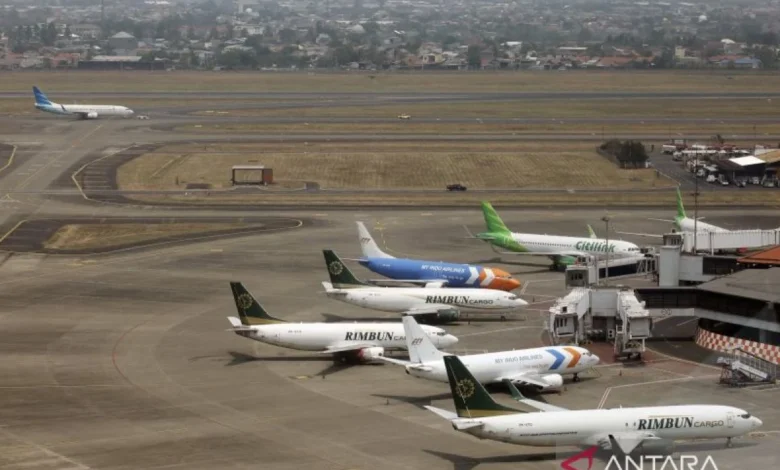
The recent eruptive activity of Mount Anak Krakatau in early September 2026 has sent shockwaves through Indonesia’s aviation sector, grounding thousands of passengers and forcing a massive recalibration of flight paths across the Java and Sumatra corridors. While the visual impact of the eruption—a towering plume of ash—is apparent from the ground, the true danger lies thousands of feet in the air, where microscopic volcanic debris poses a catastrophic threat to modern jet engines. As of September 6, 2026, the plume reached a staggering altitude of 50,000 feet, effectively creating a "no-fly zone" that has paralyzed connectivity for over 170,000 travelers and disrupted more than 1,500 flights.
A Chronology of the 2026 Eruption
The current crisis began in early September 2026, when Mount Anak Krakatau—a volcanic island located in the Sunda Strait—began exhibiting signs of heightened magmatic pressure. By the first week of September, the volcano transitioned into a significant eruptive phase. The ash column rapidly ascended, caught by high-altitude winds that dispersed the material toward the densely populated areas of Sumatra and the capital city, Jakarta.
By September 6, the situation reached a critical inflection point. Aviation authorities, including the Indonesian Ministry of Transportation and the Volcanology and Geological Disaster Mitigation Agency (PVMBG), issued urgent notices to airmen (NOTAMs). These alerts mandated the closure of eight major regional airports as the volcanic ash cloud expanded beyond the immediate vicinity of the volcano, drifting into primary commercial flight corridors.
The Invisible Threat: Why Volcanic Ash Is Not Just Dust
The public often confuses volcanic ash with common dust, but the chemical and physical composition of the former is fundamentally different and far more hazardous. According to the United States Geological Survey (USGS), volcanic ash consists of pulverized rock, mineral crystals, and volcanic glass. These particles are not only jagged and abrasive but also possess a hardness that can scour metallic surfaces and erode cockpit glass.
The danger is amplified by the internal mechanics of jet engines. When a commercial airliner traverses an ash cloud, the particles are ingested into the jet engine intake. Once inside, the high temperatures—often exceeding 1,000 degrees Celsius—cause the volcanic glass to liquefy. As this molten material moves toward the cooler sections of the turbine, it resolidifies, forming a glass-like coating on turbine blades. This phenomenon, known as "turbine glazing," effectively chokes the airflow through the engine, leading to a loss of thrust, compressor stalls, and in extreme cases, total engine failure or "flameout."
Historical Precedents and the Reality of Air Travel Risk
The aviation industry’s strict stance on volcanic ash is not born of over-caution, but of hard-learned experience. The 1982 incident involving British Airways Flight 009 remains a sobering case study. While flying over the Indian Ocean near the eruption of Mount Galunggung, the Boeing 747 lost power in all four engines as it passed through an undetected ash cloud. The aircraft descended 25,000 feet in a desperate glide before the crew managed to restart three engines and perform an emergency landing in Jakarta.
Data from the USGS confirms that between 1953 and 2009, there were 129 documented encounters between aircraft and volcanic ash clouds. Of these, 79 resulted in significant damage to the aircraft. In nine of those instances, pilots reported total engine failure. Modern aviation protocols, such as those implemented by the International Civil Aviation Organization (ICAO), dictate that even low-density ash clouds necessitate the diversion of aircraft, as the long-term impact on engine maintenance and airframe integrity remains high, even if a catastrophic failure is not immediate.
Operational Challenges: Why Altitude Offers No Escape
A common question raised by passengers during these disruptions is why aircraft cannot simply fly over or under the ash plume. The reality, as witnessed in the current Anak Krakatau crisis, is that ash plumes are dynamic and non-uniform. Unlike weather-based storm clouds, which can often be circumnavigated via radar, volcanic ash is often invisible to standard weather radar systems.
Because the eruption reached an altitude of 50,000 feet, it directly intersected the cruising altitude of commercial jets, which typically fly between 30,000 and 42,000 feet. Furthermore, the ash is highly volatile, shifting direction and density based on atmospheric currents at varying layers of the troposphere and stratosphere. Attempting to navigate through or around such a plume is deemed an unacceptable risk by flight dispatchers and air traffic control, as the margin for error is effectively zero.
Economic and Societal Implications
The grounding of over 1,500 flights has created a logistical bottleneck across the Indonesian archipelago. Beyond the immediate inconvenience to passengers, the economic fallout is substantial. Airlines face not only the loss of revenue from canceled tickets but also the significant costs associated with fuel for diverted flights, aircraft cleaning, and the inspection of engines for potential microscopic damage.
Public health in affected regions has also become a concern. As the ash settles, authorities in Jakarta and Sumatra have advised residents to wear masks to protect against respiratory issues caused by fine particulate matter. The broader societal impact has seen a spike in demand for protective equipment, highlighting the dual threat that volcanic activity poses to both the aviation industry and the health of the population residing downwind.
Official Responses and Safety Protocols
The Indonesian government has prioritized a "Safety First" approach. The Ministry of Transportation has coordinated closely with the Meteorology, Climatology, and Geophysics Agency (BMKG) to monitor the dispersion of the ash in real-time. Satellite imagery, ground-based sensors, and pilot reports (PIREPs) are synthesized to provide a live map of the restricted airspace.
Airlines, including flag carrier Garuda Indonesia and various low-cost operators, have implemented rigorous safety inspections. Any aircraft suspected of having traversed an area with potential ash contamination must undergo a borescope inspection of the engines and a thorough examination of the fuselage, pitot tubes, and air data sensors. This ensures that the abrasive particles have not compromised the aircraft’s instrumentation or propulsion systems.
Conclusion: The Necessity of Vigilance
The eruption of Mount Anak Krakatau in September 2026 serves as a powerful reminder of the vulnerability of modern global transport systems to natural geological phenomena. While technology has advanced significantly since the 1980s, the laws of physics remain unchanged: jet engines are inherently incompatible with volcanic ash.
The decision to close airports and suspend flights, while disruptive, is a necessary measure to prevent a potential disaster. As the aviation industry continues to monitor the volcanic activity, the focus remains on the synthesis of satellite data and ground observations to ensure that when flights resume, they do so with a clear path free from the lethal debris of the eruption. Until the volcanic activity subsides, the aviation authorities are expected to maintain these strict safety protocols, proving that in the face of nature’s power, caution remains the highest form of duty to the traveling public.