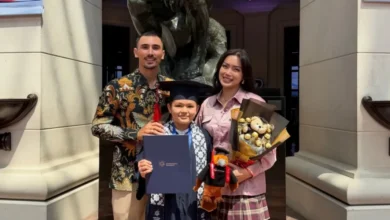
The ongoing legal dispute between celebrity couple Ruben Onsu and Sarwendah Tan has escalated significantly as the two parties grapple with a complex financial disagreement over property obligations. Currently pending at the South Jakarta District Court, the case centers on an alleged breach of contract (wanprestasi) regarding the installment payments for a residential property, which carries a staggering debt obligation of Rp12.4 billion with Bank Central Asia (BCA). As the mediation process continues, the fundamental impasse lies in the conflicting interpretations of post-divorce financial commitments and the legal validity of existing agreements.
Chronology of the Dispute
The roots of this conflict trace back to the aftermath of the couple’s high-profile separation. Following their divorce, the division of assets and the assumption of outstanding liabilities became critical points of contention. According to legal documentation and assertions made by both parties, an agreement—referred to as "Akta 39"—was established to govern the post-marital settlement, including the responsibility for servicing the significant mortgage linked to the shared residence.
The situation reached a flashpoint when Sarwendah filed a formal lawsuit for breach of contract, contending that Ruben Onsu had failed to uphold the payment obligations as previously agreed. On Tuesday, November 3, 2026, the court-mandated mediation session took place, aimed at facilitating a settlement. However, the session revealed a deep rift, with both sides presenting diametrically opposed perspectives on financial responsibility. The court has since granted a grace period, with the next critical mediation date scheduled for November 10, 2026.
The Stance of Ruben Onsu: Seeking Shared Responsibility
Representing Ruben Onsu, attorney Raka Kariti Suprapto has maintained that the financial burden of the Rp12.4 billion mortgage cannot be placed solely on his client. During the mediation, the defense presented a peace proposal, arguing that the debt is a joint responsibility that should be shared by both parties until the obligation to the bank is fully extinguished.
"From our side, we have conveyed that these installments are a collective responsibility, a responsibility of both parties until they are paid in full," stated Raka Kariti Suprapto. The defense explicitly rejected the narrative that Ruben Onsu is the sole party liable for the entirety of the debt. They argue that the interpretation of Akta 39, which Sarwendah’s team relies upon, does not impose a singular burden on Ruben. Furthermore, the defense has hinted at the possibility that the plaintiff’s insistence on excluding herself from these payments may be motivated by factors beyond the scope of the original agreement, suggesting an attempt to pressure the defendant through public perception.
Sarwendah’s Rejection: Maintaining the Original Agreement
Sarwendah’s legal counsel, Jaenudin, has been vocal in rejecting the settlement proposal offered by Ruben Onsu. During the proceedings, which involved a virtual appearance by Sarwendah, she categorically refused to accept the terms that would require her to contribute to the remaining mortgage payments.
The core of Sarwendah’s argument rests on the claim that the initial agreement, supported by documented digital communication, placed the full burden of the mortgage on Ruben. Jaenudin highlighted that private WhatsApp conversations between the former couple reinforce the position that Ruben had committed to settling the BCA debt entirely. "Sarwendah has clearly stated before the judge via video call that she rejects the offer. There is a sense of detachment from the other side, as if they are washing their hands of the matter, saying, ‘This is your asset, you finish it.’ That is not justifiable," Jaenudin asserted.
For Sarwendah, the legal strategy is to enforce the terms of the divorce settlement. She maintains that the financial obligations were already negotiated and finalized, and any attempt to revisit these terms—specifically citing current financial constraints—does not invalidate the legal weight of the previous commitment.

Legal and Financial Implications
The dispute over the Rp12.4 billion debt highlights the complexities involved in high-net-worth divorce settlements, particularly when significant real estate assets are involved. From a legal standpoint, the case revolves around the enforceability of "Akta 39" versus the reality of current financial capacity.
If the mediation fails to produce a resolution on November 10, the court will likely transition the case to the adjudication phase, where the judge will examine the merits of the breach of contract claim. This involves a rigorous analysis of the contract’s language, the intent of both parties at the time of signing, and whether the alleged financial hardship constitutes a legitimate legal defense for non-payment.
Financial analysts note that cases involving multi-billion rupiah debt often have far-reaching implications for the parties involved, particularly concerning credit scores and the potential for foreclosure if the debt remains unpaid. If the court finds in favor of Sarwendah, Ruben Onsu could be legally compelled to settle the debt or face potential asset seizure. Conversely, if the court determines that the agreement implies shared liability, the burden would shift toward a collaborative repayment plan, potentially requiring the sale of the asset to clear the debt.
The Role of Mediation in the Legal Process
The mediation process in Indonesia serves as a crucial mechanism to reduce the caseload of the judiciary. Under Supreme Court regulations, parties are required to attempt mediation before a case proceeds to a full trial. In this instance, the mediator’s role is to bridge the gap between two parties who have lost trust in one another.
The fact that the court has set a firm deadline of November 10 for a potential agreement indicates that the judiciary is keen to avoid a protracted trial. However, the public nature of the dispute—compounded by the status of the parties involved—adds a layer of complexity. The pressure to reach a settlement is high, as a public trial would expose intimate financial details and private communications to greater scrutiny.
Broader Context: The Challenges of Post-Divorce Asset Management
This case serves as a cautionary tale regarding the importance of precise, unambiguous language in divorce settlement agreements. Disputes often arise when one party experiences a shift in financial status, prompting a re-evaluation of previous commitments. When agreements are based on verbal understandings or incomplete written contracts, the risk of litigation increases exponentially.
As the legal teams prepare for the upcoming hearing, the focus remains on whether a middle ground can be reached. Sarwendah’s legal team has indicated that they are not inherently opposed to peace, provided that the terms align with the original agreement and reflect a genuine recognition of responsibility. Whether Ruben Onsu’s team will adjust their proposal to include compensatory measures or alternative solutions remains to be seen.
Ultimately, the resolution of this case will not only determine the fate of the Rp12.4 billion debt but will also set a precedent for how these two public figures manage their ongoing professional and personal obligations. For now, the eyes of the public and the legal community remain fixed on the South Jakarta District Court, awaiting a conclusion that could either solidify the existing agreement or fundamentally alter the financial landscape of the former couple’s separation.