
APKASINDO Criticizes Plummeting PSR Targets and Urges Government Intervention to Revitalize National Palm Oil Productivity

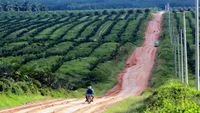
The Indonesian Palm Oil Farmers Association (Asosiasi Petani Kelapa Sawit Indonesia, or APKASINDO) has raised serious concerns regarding the steep decline in targets for the People’s Palm Oil Rejuvenation program (Peremajaan Sawit Rakyat, or PSR). According to agricultural advocacy groups and industry leaders, this downward trend poses a severe threat to the long-term productivity and sustainability of Indonesia’s national oil palm plantations.
The core of the crisis centers on stringent and often contradictory land legality requirements, which have systematically locked smallholder farmers out of critical financial and administrative assistance. During a recent public discussion titled "Strengthening the Narrative of the National Palm Oil Campaign," APKASINDO General Chairman Gulat Manurung delivered a sharp critique of the program’s shrinking scope. He highlighted that despite rising domestic demands for crude palm oil (CPO) and ambitious government green energy initiatives, the framework designed to support smallholders is failing to keep pace due to administrative bottlenecks.
Shrinking Targets Amid Growing National Ambitions
The discrepancy between the government’s macroeconomic ambitions and the reality on the ground has become increasingly pronounced. When the PSR program was initially scaled up to accelerate the replacement of aging, low-yielding trees with superior, certified seeds, the targets were ambitious. Over recent years, however, these figures have experienced a dramatic contraction.
According to APKASINDO data, the national PSR target once stood at an impressive 185,000 hectares annually. In subsequent planning cycles, this figure was progressively downgraded to 160,000 hectares, then to 120,000 hectares, before plunging to a meager 50,000 hectares for the current year. This steady reduction stands in stark contrast to the stated directives of the Indonesian presidency, which has repeatedly emphasized the urgent need to boost national CPO production to satisfy both domestic consumption and export markets.
Gulat pointed out the illogical nature of reducing agricultural revitalization targets at a time when raw material demand is at an all-time high. The mismatch between policy execution and agricultural reality threatens to undermine Indonesia’s position as the world’s leading exporter of palm oil while simultaneously stalling the income growth of millions of independent smallholders who depend on the crop for their livelihoods.
The Land Legality Crisis: Tumpang Tindih and Forest Boundaries
At the heart of the PSR bottleneck is the stringent prerequisite of land legality, commonly referred to in Indonesian administration as being "clean and clear." To qualify for the PSR grant—which provides financial assistance per hectare to cover replanting costs—farmers must prove that their plots are entirely free from legal disputes, boundary overlaps, and forestry designation conflicts.
In practice, however, a vast majority of smallholder plantations fail to meet these rigid benchmarks. Decades of historical land allocation policies, shifting regional boundaries, and complex agrarian laws have left countless smallholders farming on land that is officially classified as state forest estate or experiencing overlapping permits between the Ministry of Environment and Forestry and regional agricultural offices.
Gulat noted that even dedicated task forces and specialized internal committees established within agricultural associations have hit a bureaucratic brick wall. He referenced the strenuous efforts made by specialized teams tasked with locating eligible plots, explaining that dedicated personnel have scoured regions for qualifying lands only to find that the administrative hurdles are virtually insurmountable. When land parcels cannot achieve official "clean and clear" status due to technicalities over historical mapping or zoning definitions, farmers are barred from accessing the funds necessary to modernize their farms.
The stark reality, according to industry insiders, is that tracts of smallholder land completely devoid of administrative ambiguities are increasingly difficult to find. Consequently, thousands of farmers possessing aging, unproductive trees are trapped in a regulatory limbo, unable to secure the legal clearances required to participate in the multi-billion-rupiah revitalization initiative.
Yield Multipliers: The Urgent Case for Replanting
The urgency of resolving these administrative roadblocks is underscored by the dramatic yield discrepancies between aged plantations and newly rejuvenated plots. Independent agricultural research consistently demonstrates that oil palm trees past their prime—often defined as those exceeding 25 years of age—suffer from severe physiological decline, making them highly susceptible to disease and yielding minimal volumes of fresh fruit bunches (FFB).
During his address, Gulat provided a compelling statistical breakdown of the productivity gains associated with the PSR program. Unrejuvenated smallholder plots frequently yield a meager 500 kilograms of FFB per harvest cycle under suboptimal conditions. In stark contrast, successfully rejuvenated plantations utilizing superior seed varieties and modern agronomic practices can achieve yields ranging from 2.9 metric tons to 3.4 metric tons under comparable management parameters.
This represents an exponential productivity surge, with modern plantings delivering outputs up to 5.4 times higher than their outdated counterparts. For the smallholder, this shift transforms subsistence-level farming into a viable, profitable enterprise. For the broader economy, widespread replanting guarantees a sustainable and predictable supply of CPO without requiring the clearing of a single additional hectare of land, thereby aligning agricultural expansion with stringent environmental and sustainability commitments.
The Biodiesel Nexus: Opportunity Versus Misconception
The necessity for accelerated replanting has taken on renewed urgency with the rapid expansion of Indonesia’s domestic biodiesel mandates, such as the continuous progression toward higher blending percentages like B35 and forthcoming B40 initiatives. These government-backed green energy programs absorb massive volumes of CPO locally, fundamentally altering the traditional export-heavy dynamics of the domestic palm oil industry.
Some critics and international observers have occasionally framed aggressive domestic biofuel policies as a potential threat to global food supplies or export quotas. However, APKASINDO strongly rejects this narrative, characterizing the surging domestic bioenergy demand as an unprecedented economic opportunity rather than an existential threat to the sector.
Gulat argued that complaints regarding domestic supply tightness are misplaced when buyers are actively competing for available feedstock. Rather than viewing domestic energy consumption as a burden, policymakers and industry stakeholders should recognize it as a guaranteed domestic market that shields local producers from global price volatility. However, to safely satisfy both export commitments, food industry requirements, and expanding green energy mandates without triggering supply shortages, national agricultural productivity must expand concurrently. This expansion, industry experts emphasize, cannot be achieved through land expansion due to deforestation moratoriums; it must come exclusively from intensive yield improvements driven by aggressive replanting programs.
Policy Recommendations: Mandating PSR as a National Strategic Priority
Frustrated by years of sluggish bureaucratic progress and shrinking annual achievements, APKASINDO has put forward a series of decisive policy recommendations aimed at overhauling the administration of the PSR program. The association is calling for a fundamental shift in how the government approaches land legality requirements for smallholders.
Gulat forcefully advocated for the elevation of the People’s Palm Oil Rejuvenation program into an official National Strategic Program (Program Strategis Nasional). By granting the initiative strategic national status, the government would possess the legal instruments necessary to cut through bureaucratic red tape, override conflicting ministerial classifications, and streamline administrative workflows.
Under such a framework, secondary administrative requirements that currently serve as insurmountable barriers for smallholders could be pragmatically managed or temporarily set aside in favor of prioritized operational execution. APKASINDO maintains that verifying basic smallholder identity and the physical existence of the plantation should take precedence over complex, historical land-status discrepancies, provided that environmental safeguards and sustainability standards are maintained.
Furthermore, the association is urging the central government to implement sweeping legal certainties and localized administrative support systems. By offering amnesty or expedited regularization pathways for smallholders caught in administrative overlaps, the state could unlock hundreds of thousands of hectares of dormant potential, directly injecting capital and modern resources into rural economies.
Implications for the Future of Indonesian Palm Oil
The ongoing challenges surrounding the Peremajaan Sawit Rakyat program serve as a critical microcosm of the broader structural hurdles facing Indonesia’s agricultural sector. As global markets demand increasingly rigorous standards of traceability, sustainability, and productivity, the capacity of smallholders—who account for approximately 40 percent of total national palm oil acreage—remains a decisive variable in the industry’s future.
Without decisive executive intervention to reform the legal prerequisites of the PSR program, targets will likely remain depressed, aging plantations will continue to deteriorate in productivity, and the full economic potential of downstream initiatives like biodiesel will remain constrained. Conversely, a streamlined, nationally prioritized replanting framework could revitalize rural livelihoods, secure long-term feedstock security for green energy transitions, and reinforce Indonesia’s standing as a responsible, high-yield agricultural superpower.
As stakeholders await further policy announcements from relevant ministries, the pressure from agricultural associations like APKASINDO highlights a singular, undeniable conclusion: accelerating smallholder palm oil rejuvenation is no longer merely an option for agricultural development, but an absolute economic necessity for the nation’s sustainable future.