Indonesia and European Union Sign Landmark IEU-CEPA Trade Agreement After Decade of Negotiations

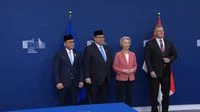
Jakarta — In a historic milestone for international trade diplomacy, Indonesia and the European Union have officially signed the Indonesia-European Union Comprehensive Economic Partnership Agreement (IEU-CEPA). The landmark trade pact, finalized in Brussels, Belgium, marks the conclusion of a protracted negotiation process that spanned approximately a decade and encompassed nearly 19 intensive rounds of talks.
The agreement is designed to dismantle long-standing trade barriers, slash tariffs, and usher in a new era of deeper economic integration between Southeast Asia’s largest economy and the 27-nation European bloc. Hailed as one of the most comprehensive and modern trade pacts ever undertaken by Jakarta, the IEU-CEPA is expected to fundamentally reshape Indonesia’s export landscape, supercharge domestic manufacturing, and catalyze foreign direct investment across strategic sectors.
The formal signing ceremony took place in Brussels on Saturday, local time. Indonesian Minister of Trade Budi Santoso signed the monumental text alongside European Commissioner for Trade and Economic Security, Interinstitutional Relations, and Transparency, Maros Sefcovic. The high-level proceeding was witnessed directly by European Commission President Ursula von der Leyen. For the administration of Indonesian President Prabowo Subianto, the successful conclusion of the IEU-CEPA stands out as a crowning achievement in international trade diplomacy, signalling Jakarta’s readiness to engage robustly with advanced Western economies under clear, mutually beneficial rules.
Massive Tariff Reductions and Export Boost
At the heart of the IEU-CEPA is a sweeping liberalization of tariff lines designed to grant Indonesian exporters unprecedented access to the lucrative European market. According to details shared by the Indonesian Ministry of Trade, an overwhelming 90.4 percent of European Union tariff lines will immediately drop to zero percent the moment the agreement officially enters into force.
This immediate zero-tariff advantage encompasses several of Indonesia’s core export commodities and manufacturing mainstays. Palm oil and its myriad downstream derivatives, natural rubber, footwear, and textiles and textile products (TPT) will experience instant relief from customs duties, instantly boosting their price competitiveness against regional rivals who lack similar trade pacts with Brussels.
Furthermore, the tariff-elimination schedule does not stop there. An additional 7.92 percent of EU tariff lines will be phased out progressively over a transition period spanning between 3 and 15 years. When combined with the immediate zero-tariff items, the total scope of tariff elimination will ultimately cover a staggering 98.35 percent of all EU tariff lines.
"More than 98 percent of EU tariff lines will provide market access with preferential tariffs for Indonesia’s leading export products, such as palm oil and its derivatives, footwear, textiles, fishery products, rubber, furniture, and various other manufactured goods," Minister Budi Santoso stated following the signing ceremony in Jakarta.
By removing these tariff walls, Indonesian products are poised to gain a distinct pricing advantage. Economists and trade analysts note that this shift will enable domestic exporters to aggressively expand their market penetration across the European continent, moving beyond traditional markets and cementing Indonesia’s position in global value chains.
Beyond Goods: Services, Investments, and Modern Standards
While the tariff cuts on physical goods capture the most immediate headlines, the IEU-CEPA is structurally designed as a "deep integration" agreement. Its chapters extend far beyond traditional merchandise trade to encompass a wide array of modern economic disciplines.
The text outlines comprehensive frameworks governing trade in services, cross-border investments, intellectual property rights, government procurement, fair competition policies, and sustainable development. By locking in regulatory clarity and transparency across these sectors, the agreement creates a predictable and stable business environment that international investors increasingly demand.
Government officials in Jakarta have emphasized that the structural depth of the IEU-CEPA makes it Indonesia’s most advanced trade agreement to date. It establishes a new benchmark for how the nation negotiates modern commercial pacts, blending market access demands with stringent commitments to environmental sustainability and labor standards.
Crucially, the agreement contains provisions aimed at channeling European capital into Indonesia’s high-priority strategic sectors. These include advanced processing industries—aligning with Jakarta’s long-term push down the downstreaming pathway—as well as the automotive sector, renewable energy infrastructure, and the booming digital economy. Enhanced legal certainty is expected to mitigate investor risk, paving the way for substantial capital inflows from European enterprises seeking resilient, diversified supply chains in the Indo-Pacific region.
A Decade-Long Road to Brussels: The Chronology of IEU-CEPA
The path to the IEU-CEPA signing was neither short nor straightforward. The negotiations reflect the immense complexity of harmonizing regulatory frameworks, environmental stipulations, and economic interests between two vastly different geopolitical and economic entities.
Exploratory talks and preliminary discussions regarding a potential trade framework between Indonesia and the European Union began in the early 2010s, laying the groundwork for official negotiations. The formal launch of the IEU-CEPA negotiations was officially announced in July 2016, under the administration of former President Joko Widodo, with the shared goal of forging a comprehensive free trade area.
Over the next eight years, the negotiating teams weathered numerous headwinds. The talks advanced through nearly 19 formal rounds of negotiations, interspersed with countless technical inter-sessional meetings held alternately in Brussels and Jakarta. Discussions frequently encountered friction points regarding European sustainability regulations, particularly concerning deforestation-free supply chains, palm oil labeling, environmental governance, and the EU’s Carbon Border Adjustment Mechanism (CBAM).
Despite these regulatory hurdles and shifting geopolitical landscapes, both sides maintained a steady commitment to dialogue. The breakthrough came as negotiators found common ground on sustainability chapters, balancing Indonesia’s developmental aspirations and downstreaming policies with Europe’s stringent Green Deal objectives. The finalization of the text in late 2024 and the subsequent signing in November 2025 mark the culmination of this grueling marathon of economic diplomacy.
Inclusivity and the Empowerment of SMEs
A notable feature emphasized by the Indonesian government is the intentional design of the IEU-CEPA to be inclusive. Policymakers recognized early in the drafting process that large corporations and multinational conglomerates naturally possess the resources to navigate complex foreign markets. Consequently, specific mechanisms were integrated to ensure that micro, small, and medium enterprises (MSMEs) and young entrepreneurs could also reap the rewards of the European market.
The agreement incorporates provisions designed to reduce administrative friction, enhance trade facilitation, and provide technical assistance to smaller businesses. By lowering compliance costs and simplifying export procedures, Jakarta hopes to empower domestic SMEs—which form the backbone of the national economy—to internationalize their operations and tap into high-value European consumer bases.
Next Steps: Ratification and Implementation
With the ink now dry on the foundational text in Brussels, the focus shifts immediately to the domestic and regional legislative processes required to bring the agreement into force.
Minister Budi Santoso confirmed that the Indonesian government will accelerate the domestic ratification process. This will involve submitting the IEU-CEPA text to the national legislature (DPR) for review and approval, alongside administrative preparations across relevant ministries. Simultaneously, the European Union will initiate its own rigorous ratification procedures, which include approval by the European Parliament and the respective member states.
Once ratifications are finalized by both parties, the agreement will officially enter into force, triggering the immediate zero-tariff schedules and setting the clock ticking on the progressive elimination phases.
Broader Implications for Indonesia’s Economic Future
The finalization of the IEU-CEPA carries profound macroeconomic implications for Indonesia. For years, policymakers have stressed the urgent need to transition the economy away from raw commodity exports toward higher-value manufacturing and processing. By securing preferential market access for processed goods, textiles, and technology-adjacent products in one of the world’s wealthiest consumer markets, the agreement provides a direct commercial incentive for domestic industrial upgrading.
Furthermore, the anticipated surge in European investment is expected to bridge financing gaps in Indonesia’s green energy transition. As the archipelago seeks to meet its ambitious net-zero carbon emission targets, European capital, technological expertise, and regulatory best practices in renewable energy will prove invaluable.
Ultimately, the Indonesia-European Union Comprehensive Economic Partnership Agreement represents more than just a reduction in customs duties. It serves as a comprehensive strategic anchor, binding two major global economies closer together in an era of rising trade fragmentation and global economic uncertainty. As ratification procedures loom, both Jakarta and Brussels stand on the threshold of a revitalized economic partnership poised to define trade relations for decades to come.
Related posts: