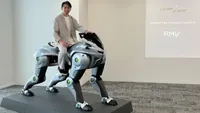
The landscape of personal mobility is undergoing a radical transformation, driven by technological convergence, environmental imperatives, and the relentless pursuit of innovative engineering. Japanese heavy industries giant Kawasaki is poised to capture the imagination of the global automotive and robotics sectors at the upcoming EICMA 2026 exhibition in Milan, Italy. The company has announced plans to showcase Corleo, an ambitious quadrupedal robotic personal mobility vehicle designed to be ridden much like a living horse. While the physical unit displayed at the exhibition booth will be a full-scale replica rather than a working prototype, the conceptual framework and technological aspirations behind the project signal a profound shift in how manufacturers envision off-road transportation and personal mobility in the decades to come.
Located at Hall 11, booth N46, Kawasaki’s exhibition space will serve as the primary global stage for the Corleo concept. To provide comprehensive insights and engage directly with international media, industry professionals, and enthusiasts, a dedicated team of engineers and corporate representatives traveling directly from Japan will be present throughout the event. The exposition itself is scheduled to run from November 3 through November 8, hosted at the prominent Fiera Milano Rho exhibition center. Alongside the Corleo replica, Kawasaki’s booth will feature a comprehensive lineup of its latest motorcycle models for the 2027 model year, alongside existing production vehicles, bridging the gap between conventional two-wheeled transportation and futuristic robotic mobility solutions.
The Genesis of Corleo and the Safe Adventure Initiative
The development of the Corleo project is spearheaded by Kawasaki’s specialized Safe Adventure Business Development team. Notably, this division operates within a unique corporate structure, reporting directly to the President of Kawasaki Heavy Industries. This high-level oversight underscores the strategic importance that the corporate leadership places on diversifying beyond traditional internal combustion engines and standard motorcycle architectures.
The underlying philosophy of the Safe Adventure initiative centers on enabling human exploration of rugged mountainous terrain and wilderness areas while simultaneously preserving environmental integrity and ensuring absolute safety. This initiative directly aligns with the core pillars of the Kawasaki Group Vision 2030, a strategic roadmap that emphasizes three primary focus areas: fostering a safe, secure, and remotely connected society; pioneering the future of mobility; and delivering advanced energy and environmental solutions.
According to corporate disclosures, Kawasaki has set an ambitious timeline for the realization of this technology, targeting full commercialization and market availability by approximately 2035. This nearly decade-long development runway reflects the immense engineering challenges associated with combining autonomous robotics, advanced hydrogen fuel cell systems, and complex biological movement emulation.
Engineering Mechanics and Technological Integration
Corleo represents a sophisticated hybrid of advanced quadrupedal robotics and decades of motorcycle engineering expertise. Unlike standard all-terrain vehicles or utility task vehicles, Corleo utilizes a four-legged robotic platform capable of navigating treacherous off-road environments that are traditionally inaccessible to wheeled or even tracked vehicles.
Despite its robotic locomotion, the interface between human and machine remains intimately familiar to riders accustomed to traditional equestrianism or motorcycling. The rider sits atop the robotic chassis, steering and controlling the vehicle’s movement by intuitively shifting their body weight. This dynamic control system mimics the natural synergy experienced when riding a horse or leaning into a motorcycle turn, thereby reducing the cognitive load required to operate an advanced robotic machine.
Beneath its striking exterior, Corleo relies on a hydrogen-powered powertrain. The vehicle is equipped with a compact 150 cc hydrogen engine that functions as an onboard generator, producing the necessary electrical energy to power the quadrupedal actuators and electronic systems. Hydrogen fuel is safely stored within specialized high-pressure canisters positioned at the rear of the chassis. This choice of fuel underscores Kawasaki’s broader commitment to achieving carbon neutrality and exploring alternative energy vectors beyond standard battery-electric powertrains, which can face limitations in remote outdoor applications due to weight and charging infrastructure constraints.
Furthermore, Kawasaki is engineering a proprietary navigation and environmental monitoring system tailored specifically for the Corleo platform. This system is designed to provide real-time data regarding local weather patterns, ambient temperature fluctuations, surface conditions—such as mud, snow, or loose gravel—and the potential presence of wildlife in the vicinity. Critical data and operational metrics will be displayed seamlessly on an integrated instrument panel as well as synchronized external smart devices, ensuring that the rider remains fully informed of environmental hazards during their journey.
Leadership Perspectives and Strategic Implications
The introduction of the Corleo concept has elicited significant commentary from corporate leadership, highlighting the multifaceted nature of the project. Shigemi Tanaka, Managing Director of Kawasaki Motors Europe, emphasized the symbolic and technological weight of the vehicle in statements reported by automotive media.
"Corleo is one example, not only of the depth of our unique technical, industrial, and environmental experience across the company, but also of our drive towards a carbon-neutral future, a future that embraces personal freedom through the concept of Safe Adventure," Tanaka stated. He further expressed optimism regarding public reception at the Milan exhibition, noting that corporate stakeholders are eager to gauge how attendees respond to this unconventional vision of tomorrow. "We hope that, aside from viewing all our 2027 motorcycle models and our current range, visitors will be just as mesmerized and just as excited by Corleo as we are," he added.
Broader Industry Impact and Future Outlook
The public debut of the Corleo replica at EICMA 2026 carries implications that extend far beyond a mere design exercise. As global automotive and heavy machinery manufacturers grapple with stringent emissions regulations and shifting consumer expectations, diversification into advanced robotics and alternative fuels has become a strategic necessity.
By targeting the year 2035 for commercialization, Kawasaki is signaling a methodical, long-term approach to research and development. The integration of a hydrogen-powered generator within a quadrupedal robotic chassis demonstrates that alternative fuels can be adapted to niche, high-mobility applications where traditional battery storage may prove inefficient. Moreover, the focus on environmental monitoring and wilderness safety reflects a growing corporate responsibility trend, wherein technology is deployed not merely to conquer nature, but to coexist harmoniously with fragile ecosystems.
As the doors of Fiera Milano Rho open in November 2026, all eyes will be on Kawasaki’s exhibition space. While visitors examine the latest commercial motorcycles designed for the immediate market, the towering presence of the full-scale Corleo replica will serve as a compelling reminder of the engineering horizons yet to be explored. Whether the ambitious 2035 commercialization target is met on schedule remains to be seen, but Kawasaki’s proactive foray into hydrogen-powered robotic mobility has undeniably established a high benchmark for innovation in the personal transport sector.