President Prabowo Subianto Bestows National Hero Title Upon Ten Eminent Figures, Including Architect of Archipelagic State, Mochtar Kusumaatmadja

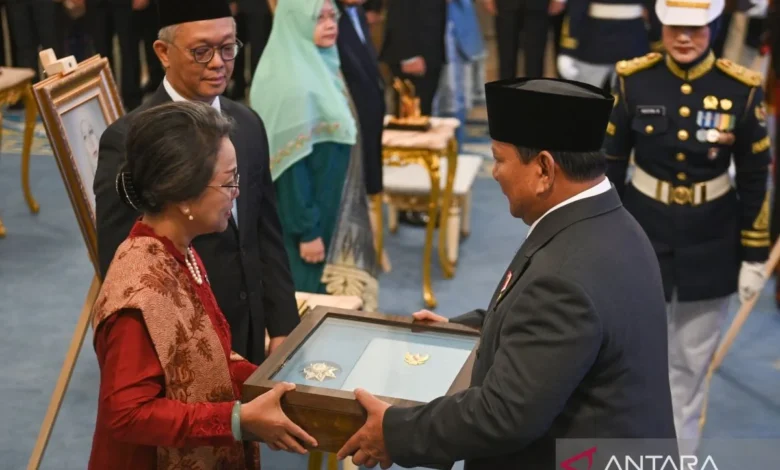
Jakarta, Indonesia – On Monday, during the solemn commemoration of Hari Pahlawan (Heroes’ Day) 2025 at the State Palace in Jakarta, President of the Republic of Indonesia, Prabowo Subianto, officially conferred the esteemed title of National Hero upon ten distinguished figures. This significant act of national recognition, enshrined in Presidential Decree Number 116/TK/Year 2025 concerning the Awarding of the National Hero Title, honors individuals whose extraordinary contributions have profoundly shaped the nation’s destiny and identity. Among the revered recipients is the late Mochtar Kusumaatmadja, whose unparalleled dedication to the fields of law and politics earned him this posthumous accolade, cementing his place in the pantheon of Indonesian patriots.
The conferment ceremony, a poignant annual tradition, underscored the nation’s gratitude for those who have sacrificed and excelled in service to Indonesia. President Subianto, addressing a gathering of dignitaries, family members of the heroes, and national media, emphasized the importance of remembering and emulating the virtues of these figures, whose legacies serve as guiding lights for future generations. He highlighted that the selection process involves rigorous evaluation of each candidate’s historical impact, moral integrity, and enduring relevance to the nation’s values. The inclusion of Mochtar Kusumaatmadja, recognized specifically for his monumental contributions in the realm of international law and diplomacy, signifies a profound appreciation for intellectual and strategic prowess in nation-building.
A Life Dedicated to Law and Nation-Building
Mochtar Kusumaatmadja, a towering figure in Indonesian legal and diplomatic history, was an internationally acclaimed legal scholar and diplomat. His illustrious career saw him serve as both Minister of Foreign Affairs and Minister of Justice during the New Order era, where his visionary leadership left an indelible mark on Indonesia’s standing on the global stage. Born in Jakarta on April 17, 1929, Mochtar hailed from a family that valued education and public service. His father, Taslim Kusumaatmadja, was a renowned pharmacist from Tasikmalaya, while his mother, Sulmi Soerawisastra, was an elementary school teacher from Kuningan, West Java, during the Dutch East Indies administration. This background provided Mochtar with a unique perspective and access to quality education, which was not readily available to many during that colonial period.
His family’s frequent relocations across Java meant that Mochtar received his early education in various cities, including Jakarta and Cirebon, fostering adaptability and a broad understanding of the archipelago’s diverse social fabric. This early exposure to different environments likely contributed to his later holistic approach to national identity and sovereignty. His academic journey culminated in 1955 when he graduated with a Meester in de Rechten (Master of Laws) degree, specializing in international law, from the Faculty of Law and Social Sciences at Universitas Indonesia (UI). UI, as one of the nascent nation’s premier educational institutions, played a crucial role in training the intellectual elite who would shape post-independence Indonesia.
Recognizing his exceptional talent, Mochtar was afforded the opportunity to pursue further studies abroad. In 1956, he embarked on a master’s program in law at Yale University in the United States, a period that significantly broadened his understanding of international legal frameworks and global geopolitics. He successfully earned his Master of Laws (LL.M.) degree, a qualification that would prove instrumental in his future endeavors to champion Indonesia’s sovereignty.
Upon his return to Indonesia, the nascent republic was grappling with complex issues of territorial integrity and international recognition. The government, under Prime Minister Djuanda Kartawidjaja, immediately sought Mochtar’s expertise to develop and articulate the concept of the archipelagic state, which had been boldly declared as the Djuanda Declaration in 1957. This declaration was a revolutionary assertion of Indonesia’s sovereignty over the waters connecting its thousands of islands, challenging the prevailing international maritime law that recognized only a narrow three-mile territorial sea. Mochtar’s intellectual rigor and legal acumen were pivotal in transforming this political declaration into a robust legal argument.
Academic Prowess and Unwavering Conviction
Beyond his governmental roles, Mochtar Kusumaatmadja maintained a deep connection to academia. He became a respected lecturer at the Faculty of Law, Universitas Padjadjaran (Unpad), where he continued to shape the minds of future legal professionals. His commitment to scholarly pursuits led him to earn a doctorate in law from Unpad in 1962, further solidifying his academic credentials. However, his academic journey was not without its challenges. His sharp criticisms of the Old Order government under President Sukarno led to the controversial revocation of his doctoral degree. During a period of intense political polarization and "Guided Democracy," intellectual dissent was often met with severe repercussions. Mochtar’s critiques likely pertained to the government’s foreign policy alignments, economic management, or constitutional interpretations, which he viewed as detrimental to the nation’s long-term interests.
Despite this setback, Mochtar’s spirit for learning remained undeterred. He continued his education in the United States, pursuing advanced studies at prestigious institutions such as Harvard University and the University of Chicago between 1964 and 1966. This period of intense study abroad, amidst the political turbulence in his homeland, further refined his intellectual capabilities and broadened his international perspective. His perseverance paid off, and he eventually attained his professorship from Unpad in 1970, a testament to his enduring academic excellence and the eventual recognition of his contributions.
Before ascending to ministerial positions in the New Order cabinet, Mochtar held significant leadership roles within Unpad. He served multiple terms as Dean of the Faculty of Law during the 1960s and 1970s, guiding the institution through a period of growth and development. His leadership qualities were further recognized when he was appointed Rector of Unpad in 1973, a position he held for a year, demonstrating his capacity for institutional management and academic administration.
The Architect of Indonesia’s Maritime Identity: Wawasan Nusantara and UNCLOS
Mochtar Kusumaatmadja’s most enduring legacy lies in his relentless advocacy for the Archipelagic State concept, enshrined in Indonesia’s national vision known as Wawasan Nusantara (Archipelagic Outlook). His appointment as Minister of Justice in the Second Development Cabinet (1974-1978) and subsequently as Minister of Foreign Affairs for two consecutive terms in the Third and Fourth Development Cabinets (1978-1988) provided him with the platforms to champion this critical national interest on the global stage.
The Djuanda Declaration of 1957, while a bold assertion, required extensive diplomatic effort to gain international recognition. Mochtar Kusumaatmadja became the principal architect and chief negotiator for Indonesia’s archipelagic principles. He articulated the concept of Wawasan Nusantara, which posits that the land, waters, and airspace of Indonesia form a single, indivisible territorial entity. This concept was not merely about drawing lines on a map; it was a profound philosophical and geopolitical statement about Indonesia’s identity, security, and economic future as a vast maritime nation. It challenged the traditional "freedom of the seas" doctrine which allowed foreign vessels to navigate through waters between islands, effectively fragmenting Indonesia’s territorial integrity.
His tireless efforts culminated in a monumental diplomatic victory at the Third United Nations Conference on the Law of the Sea (UNCLOS III), which spanned from 1973 to 1982. This was one of the most extensive and complex multilateral negotiations in history, involving hundreds of states. Mochtar, often dubbed the "Father of Indonesian Maritime Law" (Bapak Hukum Laut Indonesia), skillfully navigated intricate geopolitical currents, patiently building consensus among diverse nations, many of whom were initially skeptical or outright opposed to the archipelagic concept. He articulated how the archipelagic principle was not merely a claim of sovereignty but a practical necessity for the unity, security, and economic development of island nations like Indonesia.
The successful adoption of the United Nations Convention on the Law of the Sea (UNCLOS) in 1982, which formally recognized the archipelagic state concept, marked a watershed moment for Indonesia and for international law. This recognition granted Indonesia sovereign rights over its archipelagic waters, including the seabed and subsoil, and established specific regimes for innocent passage and archipelagic sea lanes passage. The convention transformed Indonesia’s fragmented territorial waters into a unified whole, fundamentally altering its geopolitical landscape and securing its sovereignty over vast maritime resources. This achievement remains a cornerstone of Indonesia’s foreign policy and national security.
Beyond Borders: Diplomacy for Peace and Culture
Mochtar Kusumaatmadja’s contributions extended beyond maritime law. As Foreign Minister, he was a staunch advocate for what he termed "cultural diplomacy." He recognized that projecting Indonesia’s rich cultural heritage abroad was crucial for fostering international understanding and goodwill. He initiated various programs and encouraged diplomatic missions to actively promote Indonesian arts, traditions, and values, believing that cultural exchange could bridge divides and build stronger international relations. This approach was particularly vital during the Cold War era, allowing Indonesia to carve out a unique identity on the global stage, independent of major power blocs.
Furthermore, Mochtar played a pivotal role in regional conflict resolution. He is widely credited for pioneering a pragmatic approach to the complex and protracted conflict between Vietnam and Cambodia in the 1980s. His diplomatic ingenuity led to the initiation of informal "cocktail party" meetings, which eventually evolved into the Jakarta Informal Meetings (JIM I and JIM II) in 1988 and 1989. These meetings brought together warring factions and regional stakeholders, laying the groundwork for the eventual Paris Peace Agreement in 1991. His steady and persistent mediation efforts were instrumental in de-escalating tensions and fostering a pathway towards peace and stability in Southeast Asia, showcasing Indonesia’s leadership within ASEAN.
Continuing Legacy and Posthumous Honors
Even after concluding his tenure as Foreign Minister in 1988, Mochtar Kusumaatmadja remained an active and influential figure in international affairs. His expertise was sought globally, leading him to serve as a member of the International Law Commission (ILC) of the United Nations. The ILC is a crucial body tasked with progressively developing and codifying international law, and Mochtar’s contributions there further solidified his reputation as a leading authority in the field. He also took on the challenging role of Chairman of the Iraq and Kuwait Boundary Commission, a sensitive post-Gulf War assignment that required immense diplomatic skill and an impartial understanding of international legal principles to resolve territorial disputes.
A man of diverse interests, Mochtar was known for his fondness for chess, a reflection of his strategic mind and foresight. He continued to share his knowledge and passion for law by teaching at Unpad until his retirement in 1999. His entrepreneurial spirit also led him to co-found Mochtar, Karuwin, Komar (MKK), a groundbreaking law firm that became one of the first in Indonesia to employ foreign lawyers. This initiative demonstrated his progressive vision for the legal profession in Indonesia, aiming to integrate international best practices and expertise.
Mochtar Kusumaatmadja passed away in Jakarta in 2021 at the age of 92, leaving behind a profound legacy. He was laid to rest at the Kalibata Heroes’ Cemetery in Jakarta, a fitting tribute to a national hero. He is survived by his three children from his marriage to Siti Chadidjah: Armida Salsiah Alisjahbana, Emir Kusumaatmadja, and Rachmat Askari Kusumaatmadja, who continue to carry forward his intellectual and moral torch.
His enduring impact is tangibly recognized through various honors. In 2009, the Law Library at Unpad was proudly named the Mochtar Kusumaatmadja Law Library, a permanent tribute within the institution he so deeply served. More recently, in 2023, the Pasopati Flyover in Bandung, a major infrastructure landmark, was renamed in his honor, serving as a constant reminder of his contributions to the people of West Java and the nation. These tributes reflect the widespread appreciation for his intellectual contributions, his diplomatic achievements, and his unwavering dedication to the sovereignty and prosperity of Indonesia.
Reactions and Implications of the National Hero Title
The announcement of Mochtar Kusumaatmadja as a National Hero has been met with widespread acclaim from various sectors. President Prabowo Subianto’s administration, in conferring this title, sends a clear message about the value it places on intellectual leadership, diplomatic prowess, and the foundational principles of Indonesian sovereignty. Officials within the Ministry of Foreign Affairs have lauded the decision, with many recognizing that Mochtar’s vision continues to guide Indonesia’s maritime foreign policy and its commitment to multilateralism. Academics and legal scholars across Indonesia and internationally have also expressed their approval, highlighting his indelible contributions to international law and the unique position he carved out for Indonesia in the global legal framework.
Family members, while expressing deep gratitude, have also reiterated their hope that this recognition will inspire younger generations to pursue excellence in public service and intellectual endeavors. The conferment of the National Hero title not only honors Mochtar Kusumaatmadja’s individual achievements but also serves to underscore the critical importance of intellectual diplomacy and the peaceful resolution of international disputes as cornerstones of national strength and global standing. His legacy, particularly the successful struggle for the Archipelagic State concept, remains a powerful testament to Indonesia’s determination to define its own destiny and secure its territorial integrity within the framework of international law. The implications of his work continue to resonate in contemporary discussions on maritime boundaries, resource management, and regional security in Southeast Asia, ensuring that the "Father of Indonesian Maritime Law" will forever be remembered as a true architect of modern Indonesia.