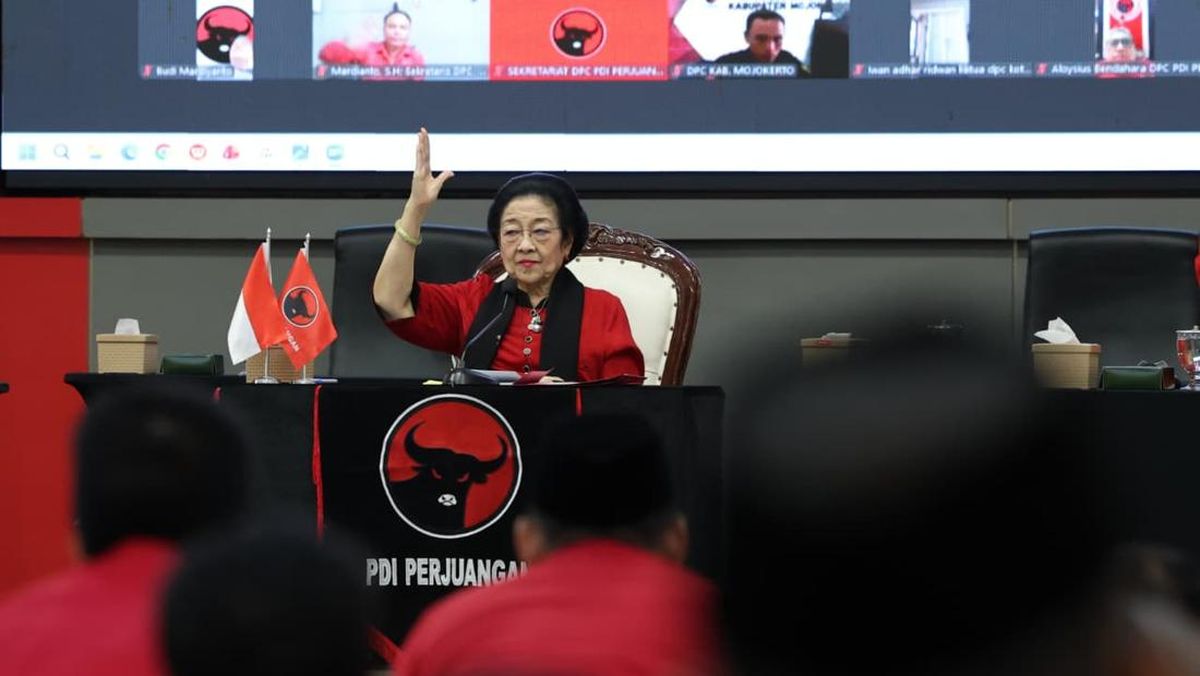
The Chairwoman of the Central Executive Board of the Indonesian Democratic Party of Struggle (PDI Perjuangan), Megawati Soekarnoputri, has issued a powerful directive for the comprehensive reconstruction of Indonesia’s defense posture, advocating for its alignment with the geopolitical vision articulated by the nation’s Proclamator and first President, Sukarno. Speaking at a seminar titled ‘Relevance of the Asia-Africa Movement in the Current Geopolitical Crisis’ held at the Party School in Lenteng Agung on Saturday, April 18, the fifth President of Indonesia underscored the critical importance of a robust geopolitical understanding in safeguarding the nation’s trajectory and interests. She posited that Indonesia’s defense capabilities must be meticulously crafted with a foundational mission of fostering global peace, asserting that "the doctrine, posture, and strategy must be formulated based on Bung Karno’s geopolitical perspective."
Sukarno’s Enduring Geopolitical Legacy and the Birth of Lemhannas
Sukarno’s geopolitical philosophy, deeply rooted in the concept of "Wawasan Nusantara" (Archipelagic Insight), posits Indonesia as a vast archipelagic state strategically positioned at the crossroads of two oceans and two continents. This unique geographical reality, in Sukarno’s view, dictates Indonesia’s inherent role as a bridge between civilizations and a pivotal player in maintaining regional and global equilibrium. His vision transcended mere territorial defense, encompassing cultural, economic, and political dimensions to forge a resilient and self-reliant nation. He famously articulated the "Trisakti" principles – political sovereignty, economic self-reliance, and cultural identity – as the pillars for national development, all underpinned by a deep awareness of Indonesia’s geopolitical position.
It was this profound geopolitical consciousness that compelled President Sukarno to establish the National Resilience Institute (Lemhannas) in 1965. Conceived as a strategic think tank and a national crucible for leadership development, Lemhannas was intended to be the intellectual vanguard in cultivating a holistic understanding of national resilience (Ketahanan Nasional). Its original mandate was to educate and prepare future leaders from various sectors – military, civilian, professional, and academic – to collectively address complex national challenges through a comprehensive, multi-dimensional approach. The institute was designed to imbue its participants with a shared vision of Indonesia’s strategic interests and its role in a dynamic global environment, ensuring that national policies were consistently informed by a robust geopolitical framework.
Megawati’s Critical Appraisal and Vision for Lemhannas’s Revival
However, during her address, Megawati Soekarnoputri delivered a sharp critique regarding the contemporary evolution and perceived narrowing of Lemhannas’s mission. "To build the importance of geopolitical thinking, Bung Karno established Lemhannas. Lemhannas must not be narrowed in its meaning to merely an institution that issues leadership certificates," she emphatically stated. Her words signify a concern that the institute may have drifted from its original, expansive purpose, potentially becoming an administrative body rather than the dynamic intellectual forge it was intended to be.
Megawati’s vision for Lemhannas’s revitalization is ambitious and inclusive. She explicitly articulated that the institute should revert to its foundational role as a comprehensive training ground, a "wahana penggemblengan," for aspiring leaders drawn from an exceptionally diverse array of backgrounds. This includes not only the traditional military and civilian sectors but also professionals, experts, cultural practitioners (budayawan), and crucially, representatives of indigenous leadership (kepemimpinan adat). This emphasis on cross-sectoral collaboration and inclusivity is vital for ensuring that the nation’s leadership reflects the rich tapestry of Indonesian society and is equipped to address challenges from multiple perspectives.
She stressed the imperative for all these diverse leaders to "unite in thought and ideals for Indonesia Raya," signifying a call for a collective national purpose that transcends individual sectoral interests. This unity, she elaborated, is essential for forging a "bonded" collective, a singular progressive force committed to advancing the nation’s civilization. Furthermore, Megawati elaborated that the rigorous process within Lemhannas must cultivate a profound sense of shared destiny as one nation, fostering the collective aspiration for a just and prosperous society. This shared identity, she concluded, must be intrinsically "united with its homeland: namely the earth, air, land, and water as the living space of Indonesian citizens." This holistic view underscores the deep connection between geopolitical strategy, national identity, and environmental stewardship, echoing Sukarno’s reverence for the archipelago.
Indonesia’s Defense Posture: Current Realities and Geopolitical Imperatives
Indonesia, as the world’s largest archipelagic state and the most populous Muslim-majority nation, occupies a strategically critical position in the Indo-Pacific region. Its defense posture, historically characterized by a non-aligned foreign policy, has undergone significant modernization efforts in recent decades. The country’s defense budget has seen a steady increase, with projections indicating substantial investments over the next five years to achieve its Minimum Essential Force (MEF) target. For instance, the defense budget for 2024 was set at approximately IDR 139.3 trillion (around US$8.9 billion), representing a significant portion of the state budget, reflecting the government’s commitment to strengthening its military capabilities. However, compared to other major regional powers, Indonesia’s defense spending remains relatively modest in absolute terms, necessitating a highly strategic and efficient allocation of resources.
The contemporary geopolitical landscape presents Indonesia with a complex array of security challenges. These include traditional threats such as territorial disputes in the South China Sea (where Indonesia maintains that its Natuna Islands exclusive economic zone is being encroached upon), maritime security concerns like illegal fishing and piracy, and the enduring threat of terrorism and radicalism. Emerging threats, such as cyber warfare, climate change-induced disasters, and pandemics, further complicate the national security calculus. In this context, Megawati’s call to re-anchor defense strategy in Sukarno’s geopolitical vision is particularly salient. Sukarno’s emphasis on self-reliance, national unity, and a proactive role in global peace-building offers a framework for navigating these multifaceted challenges without succumbing to external pressures or becoming entangled in great power rivalries. His vision of Indonesia as an independent actor, promoting a new world order based on justice and equality, provides a philosophical bedrock for its contemporary "free and active" foreign policy.
The Seminar’s Broader Context: Asia-Africa Movement in a Fractured World
The seminar’s theme, ‘Relevance of the Asia-Africa Movement in the Current Geopolitical Crisis,’ adds a crucial layer of context to Megawati’s pronouncements. The Asia-Africa Conference of 1955, spearheaded by Sukarno in Bandung, was a landmark event that birthed the Non-Aligned Movement (NAM) and provided a collective voice for newly independent nations amidst the bipolar ideological struggle of the Cold War. It championed principles of self-determination, mutual respect, and peaceful coexistence, laying the groundwork for a more multipolar world.
In the present era, characterized by renewed great power competition, rising protectionism, and a fracturing international order, the principles of the Asia-Africa Movement resonate with renewed urgency. Global geopolitical crises, such as the conflict in Ukraine, escalating tensions in the Middle East, and increasing strategic competition between the United States and China, underscore the need for nations like Indonesia to uphold their independent foreign policy and advocate for dialogue and multilateralism. Megawati’s speech, therefore, was not merely an internal party directive but a broader call to leverage Indonesia’s historical legacy and strategic autonomy to contribute meaningfully to global stability, aligning its defense and foreign policies with its historical commitment to world peace.
Implications for Policy, Leadership, and Regional Standing
Megawati’s powerful intervention carries significant implications for several critical areas of national governance and strategy. Firstly, for Indonesia’s defense policy, it signals a potential shift towards a more deeply integrated "total defense" approach, where military might is explicitly linked to diplomatic objectives, economic resilience, and cultural strength, rather than a purely conventional military buildup. This could lead to a re-evaluation of current defense doctrines, procurement strategies, and military training programs to better incorporate geopolitical awareness and the non-military dimensions of national security.
Secondly, the critique and proposed reform of Lemhannas are particularly impactful. If acted upon, it could catalyze a significant restructuring of the institution, transforming it into a more dynamic and intellectually rigorous platform for strategic thought and leadership development. The emphasis on drawing leaders from diverse backgrounds, including indigenous communities, would broaden the perspectives informing national policy and strengthen the social fabric of the nation. It implies a move away from purely technical or managerial leadership training towards a more holistic development of "statesmen" and "stateswomen" equipped with a profound understanding of Indonesia’s unique identity and global role. This expanded mandate could lead to new curricula, collaborative programs with universities and think tanks, and a more pronounced role for Lemhannas in advising government policy.
Thirdly, at a broader level, this directive reinforces Indonesia’s commitment to its founding principles and its "free and active" foreign policy. By explicitly invoking Sukarno’s geopolitical vision, Megawati is reminding both domestic and international audiences of Indonesia’s historical agency and its aspiration to be a significant, independent voice on the world stage. It suggests that Indonesia will continue to navigate complex global dynamics not by aligning unequivocally with any single power bloc, but by adhering to its own strategic interests and principles of peace, justice, and self-determination, as championed by its founding father. This stance could bolster Indonesia’s leadership within ASEAN and its standing in other multilateral forums, advocating for a more balanced and equitable international order.
In conclusion, Megawati Soekarnoputri’s call for a defense posture built on Sukarno’s geopolitical vision and a revitalized Lemhannas represents a profound re-affirmation of Indonesia’s foundational strategic philosophy. It is a timely reminder for the nation to look inward to its rich intellectual heritage while simultaneously engaging proactively with the complex realities of the 21st-century global geopolitical landscape. The challenge now lies in translating this powerful vision into concrete policy reforms and institutional changes that will shape Indonesia’s trajectory for decades to come, ensuring its continued resilience, prosperity, and contribution to global peace.