Tragic Farewell in Tangerang: Fallen Forest Firefighting Helicopter Crew Member Laid to Rest Amid Deep Sorrow

The humid air of Tangerang was heavy with sorrow and weeping as family members, friends, and local residents gathered to bid a final farewell to Yayan Supyansuri, a dedicated crew member of a forest and land firefighting helicopter that tragically crashed into the Barito River in South Kalimantan. The solemn procession marked the end of a harrowing ordeal that began days earlier when the aircraft went down during a critical environmental protection mission.
The white casket containing the remains of the 39-year-old aviation crew member arrived at the Jami Al Muhajirin Mosque, located within the Bumi Pasar Kemis housing complex in Tangerang Regency, Banten. The transport vehicle was formally escorted by a vehicle belonging to the Military Police, underscoring the official and tragic nature of his passing in the line of duty. As the casket was carried into the mosque for funeral prayers, the stifled cries of grieving relatives quickly broke into unconcealed weeping, reflecting the profound vacuum left by his sudden departure.
Following the congregational prayer, the funeral cortege moved toward the Picung Public Cemetery in Pasar Kemis Village. The grieving widow and their two young children—a nine-year-old and an infant of just seven months—braved their immense grief to accompany the casket to its final resting place. The burial brought to a close a frantic search-and-rescue operation, turning the hope of finding him alive into a mourning community’s final act of remembrance.
Fulfilling a Haunting Final Wish
According to family testimony, Yayan’s final resting place in Tangerang was not chosen by chance, but rather in fulfillment of a poignant request he made before departing for his deployment. Hasan, an uncle of the victim, shared that Yayan had left specific instructions with his wife prior to traveling to Kalimantan in April 2026 to join the national wildfire mitigation task force.
"He told his wife that if his time had come, he wished to be buried right beside his father’s grave. That was his specific message," Hasan recounted to reporters at the graveside. This eerie premonition added an extra layer of heartbreak for the family, who found solace only in the fact that they were able to honor his last wishes, bringing him home to rest alongside his paternal lineage.
Yayan is survived by his wife and two young children, leaving behind a family now facing an uncertain future without their primary provider and anchor. Described by those who knew him best as a pillar of warmth and community spirit, his loss extends far beyond his immediate household. Hasan reflected on Yayan’s character, portraying him as a remarkably kind, approachable, and socially active individual who deeply cared for his neighbors and environment.
"In our eyes, the deceased was truly a good person, friendly, and very sociable. Here, not just our family, but the entire community of Pasar Kemis feels a profound sense of loss," Hasan stated.
Chronology of the Disaster on the Barito River
The tragedy unfolded against the backdrop of Indonesia’s ongoing battle against forest and land fires—known locally as kebakaran hutan dan lahan (karhutla)—which periodically threaten vast swathes of Sumatra and Kalimantan, releasing hazardous haze and straining national emergency resources.
Yayan was serving as an essential crew member on a Super Puma helicopter mobilized to support aerial firefighting operations in South Kalimantan. These operations are critical for water-bombing remote and inaccessible peatland blazes that ground crews cannot easily reach. However, routine aerial missions in dense jungle environments carry inherent risks, ranging from sudden tropical weather shifts to mechanical failures and limited visibility caused by thick smoke.
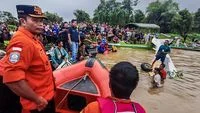
The crisis began when the firefighting helicopter suffered a catastrophic accident, plunging into the turbulent waters of the Barito River. While the exact preliminary causes of the crash remain under thorough investigation by aviation authorities, the immediate aftermath triggered a multi-agency search-and-rescue (SAR) operation involving local authorities, water police, military personnel, and civilian volunteers.
While the crash claimed Yayan’s life, there were survivors among the aircraft’s complement. Two foreign nationals serving as crew members were successfully rescued from the river by swift action from local fishermen and nearby vessel crews. The survivors were subsequently identified as Hugh Page and Mick Betteridge. Their prompt extraction prevented a higher death toll, though the incident cast a dark shadow over the specialized aviation community that supports Indonesia’s environmental protection efforts.
Following days of intensive surface and underwater searches along the Barito River, the joint SAR team finally located Yayan Supiyansuri on Sunday evening. He was recovered from the water, but tragically, life had already left him. His remains were subsequently prepared for rapid repatriation to his family in Banten, culminating in Monday’s emotional funeral service.
Broader Implications for Aviation Safety in Environmental Operations
The loss of Yayan Supyansuri highlights the often-overlooked human cost of combating Indonesia’s annual environmental crises. Forest and land fires require a massive mobilization of national and international assets, including specialized aircraft leased or operated to drop millions of liters of water on raging blazes. The pilots, mechanics, and support crew members who man these machines operate under high-stress conditions, frequently flying through heavy smoke, unpredictable winds, and over treacherous terrain.
This incident is expected to reignite rigorous discussions among government regulators, disaster management agencies, and private aviation contractors regarding safety protocols, equipment maintenance standards, and hazard pay for personnel deployed to high-risk environmental zones. While aerial firefighting is indispensable for mitigating ecological destruction and public health crises caused by smoke haze, safety advocates argue that greater investments in advanced navigation technology, pilot training, and rigorous pre-flight safety audits are paramount to protecting the lives of those who protect the nation’s forests.
Furthermore, the tragedy draws attention to the welfare of families left behind by frontline emergency workers. As government agencies and local communities extend their condolences, questions regarding insurance, state pensions, and long-term educational support for Yayan’s nine-year-old child and seven-month-old infant will undoubtedly come to the forefront. Civil society groups have already begun calling for comprehensive support mechanisms to ensure that the dependents of fallen disaster-response personnel are adequately cared for in the wake of such catastrophic line-of-duty deaths.
As the final prayers were offered at the Picung Public Cemetery and the mourners slowly dispersed from the graveside, the memory of Yayan Supyansuri remained vividly alive in the hearts of the Pasar Kemis community. His sacrifice stands as a sobering reminder of the high price paid on the front lines of environmental defense, etching his name into the collective consciousness of a nation striving to protect its natural heritage while mourning those who give everything in the attempt.