Thousands of Students and Civil Society Groups Paralyze Surabaya in Mass Protests Highlighting Environmental Crisis and Political Accountability

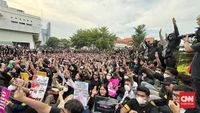
Surabaya witnessed one of its largest coordinated demonstrations in recent memory as an estimated 3,000 students, academics, and civil society representatives flooded the provincial capital of East Java. Marching through major thoroughfares, the coalition—led by prominent institutions including Universitas Airlangga (Unair) and the Sepuluh Nopember Institute of Technology (ITS)—demanded sweeping government accountability, urgent environmental interventions, and the absolute preservation of civil supremacy. The demonstrations, which took place against a backdrop of mounting national discontent, effectively paralyzed key intersections in the city center for hours before concluding peacefully in the evening.
Chronology of the Demonstration
The mobilization began early in the afternoon as contingency groups gathered at Unair’s Campus B on Jalan Airlangga. Around 15.00 Western Indonesian Time (WIB), the growing mass initiated a disciplined long march toward their primary destination: the historic Alun-Alun Surabaya Fountain Roundabout situated on Jalan Gubernur Suryo.
As the contingent swelled with arrivals from various campuses and independent civil society organizations, demonstrators completely encircled the landmark fountain. The convergence blocked four major arteries—Jalan Gubernur Suryo, Jalan Pahlawan, Jalan Panglima Sudirman, and Jalan Yos Sudarso—resulting in the total paralysis of vehicular traffic across these critical commercial and administrative zones.
Protesters utilized the prominent public space to display extensive banners carrying sharp critiques of national governance. Slogans such as "Free Smoke, Critical Breath" and "Forests Burn, Needs Impacted: How Does the Government Act?" visually encapsulated the grievances of a population increasingly strained by compounding socio-economic and environmental crises.
The demonstration maintained its momentum until approximately 17.30 WIB, when organizers orderly dispersed the crowd. Following the clearance of the intersection, municipal traffic authorities gradually normalized the flow of vehicles along the affected roadways, restoring transit connectivity to the city center.
Core Demands and Student Leadership Perspectives
The grievances articulated during the Surabaya protests extended far beyond localized policy issues, touching upon structural flaws in national development, environmental management, and economic policy. Daniel Situmorang, Minister of Social and Political Affairs for the Unair Student Executive Board (BEM) and the designated field coordinator for the action, addressed the crowd regarding the evolving political landscape. Situmorang framed the recent political retreat of Vice President Gibran Rakabuming Raka not as a definitive resolution, but merely as an opening chapter in ongoing civic oversight.
"The resignation of Gibran is akin to a small victory for the student and societal movement. We must not forget that from the inception of their candidacy, they advanced as a packaged unit. Consequently, our critical stance to persistently oversee the administration’s trajectory must not wane in the slightest," Situmorang stated during the demonstrations.
Building upon this sentiment, Rakan Naufal Alief, President of the ITS Student Executive Board, emphasized that public trust in the current regime has eroded significantly due to persistent unaddressed grievances. The decision to bypass traditional legislative lobbying in favor of direct street mobilization stemmed from a widespread conviction that representative institutions had failed to translate public concerns into actionable policy.
"Today, we come together from various organizations and communities, numbering nearly 3,000 strong. From ITS alone, we brought 1,500 participants. The government must remain vigilant and attentive to our demands and aspirations," Alief asserted.
The coalition consolidated its platform into several primary pillars:
-
Environmental Crises and Forest Fires: The coalition demanded that ongoing forest and land fires (known locally as karhutla) be formally classified as a national disaster. Protesters criticized the federal response as inadequate, arguing that toxic haze persistently affects populations across Kalimantan, Papua, Sulawesi, and Sumatra without receiving the priority resource allocation required for effective mitigation.
-
Economic Relief and Affordability: Demonstrators called for immediate state intervention to lower soaring basic commodity prices, highlighting the severe financial pressure placed on ordinary households. Furthermore, the coalition demanded a rigorous evaluation of federal social programs, specifically targeting the Free Nutritious Meal (MBG) initiative and the Red and White Village Cooperative (KDMP), alongside mandatory compensation packages for individuals affected by food poisoning incidents linked to these programs.
-
Supremacy of Civil Law: Proponents of the movement urged an immediate halt to the intimidation of civil society actors. They argued that democratic governance requires the absolute restoration of civil liberties and a strict adherence to the rule of law, free from dominant political interventions.
National Context and Synchronized Regional Protests
The events in Surabaya were not isolated occurrences. They formed part of a synchronized wave of demonstrations that unfolded simultaneously across multiple Indonesian urban centers, including Jakarta, Yogyakarta, Purwokerto, and Makassar. Across these regions, students and civic groups echoed similar frustrations regarding inflation, administrative accountability, and ecological degradation.
The choice of decentralized, high-visibility public spaces like the Surabaya Fountain Roundabout over institutional gates—such as the East Java Regional People’s Representative Council (DPRD) building—signified a strategic shift in movement tactics. Organizers argued that traditional legislative venues had consistently produced symbolic engagements rather than substantive policy reforms, prompting a return to direct public mobilization to command executive attention.
Security Developments and Arrests
While the overwhelming majority of the demonstration proceeded in an orderly and peaceful manner, security operations yielded a potentially volatile intervention. The East Java Regional Police (Polda Jatim) reported the apprehension of two individuals suspected of carrying a ready-to-use Molotov cocktail near the vicinity of the Alun-Alun Fountain.
According to official police statements delivered by Head of Public Relations for Polda Jatim, Commissioner Jules Abraham Abast, the suspects—identified by initials MVK and VS, both 24-year-old residents of Surabaya—were intercepted by the Preventive Strike Task Force near the western perimeter of the Bamboo Monument.
Preliminary investigations at the scene revealed that the suspects were in possession of a glass bottle containing fuel—purportedly Pertamax—fitted with a makeshift fuse crafted from clothing fabric. Investigators deduced that the suspects had meticulously planned the disruption: the pair reportedly traveled by motorcycle to an associate’s residence to assemble the device, left the vehicle behind, and proceeded on foot toward the demonstration corridor along Jalan Embong Kenongo.
"Officers found an object suspected of being a Molotov cocktail containing fuel with a fuse derived from a piece of trouser cloth belonging to one of the detained individuals," Commissioner Abast stated during a press briefing. "Initial examination indicates the motive was to instigate unrest during the public assembly. However, investigators will continue to deepen this inquiry, cross-examining all statements with supportive evidentiary material to uncover potential external involvements."
Broader Implications and Analytical Outlook
The massive turnout in Surabaya and its sister cities underscores a deepening structural tension between contemporary youth-led civic movements and the ruling administrative apparatus. By framing localized economic pain and environmental disasters as symptoms of systemic political failure, student coalitions have successfully broadened their base of support, bridging academic circles with broader working-class communities.
As the administration navigates these compounding pressures, the persistence of coordinated street mobilizations signals that traditional political maneuvering will face sustained, rigorous scrutiny. The demand for tangible policy shifts—ranging from national disaster declarations to consumer price stabilization—will likely remain central to Indonesia’s sociopolitical discourse, ensuring that civil society continues to act as a potent counterweight to executive and legislative power in the foreseeable future.
Related posts: